
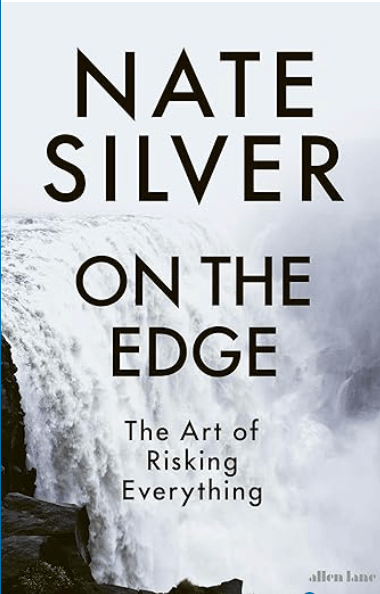
The New York Times bestselling author Nate Silver’s new riveting book, On the Edge, reveals the mastery of risk allows them to shape and dominate modern life. A definitive guide to our era of risk – and players raising the stakes, from Poker players, investors, military generals, astronauts, who are all successful gamblers who knows the art of risking everything to get the adrenaline and dopamine flowing increasing the rates of blood circulation and breathing against the odds.
Professional risk takers- poker player and hedge fund manager, crypto true-believers and blue-chip art collectors can teach us how to navigate the uncertainty of the 21st century, from the frontiers of finance to the future of AI.
Half of Americans have gambled in the past year, some even going to Las Vegas casinos, others prefer black jack, or professional poker. Online gambling is one of the fastest growing segments of the gambling industry with an online revenue in excess of $16.5bn in 2023 and rising.
For most part the “house” wins and gamblers lose out. Some though, can beat the bookmakers, These sharp risk-takes weigh up the probabilities to determine a positive “expected value” (EV) on each wager.
According to Silver, the most effective risk-takers, a poker obsessive who sensibly earn his crust as a writer and commentator, sees the world in terms of risk and probabilities.
In 2012, Silver’s book The Signal and the Noise aimed to demystify the business of prediction. He build his reputation on his accurate predictions, including getting every US state result correct in the 2012 presidential election, his political forecasting business known as FiveThirtyEight.com, became the go-to website for this interested in American politics.
Silver left the website and had been sold to Disney, in 2023, following a round of layoffs at the Media group’s ABC News Unit.
Silver probes the minds and habits of those who put real money behind their wagers. He breaks in the middle to study the effective habits of these and other non-gambling risk-takers. The book’s latter half is devoted to bridging some of his theories on risk-taking with how these are used and misused in the sphere of investing. Here Silver hints at the debate over skill versus luck and even the morality of investing in AI.
Silver envisions a tour through a mythical riverside landscape of poker pros, cryptocurrency traders (including fraudsters), venture capital investors and AI proselytisers.
Poker dominates the early part of On the Edge – that last word refers to any sustainable betting advantage. He interviews hundreds of risk-takers, often playing in professional poker tournaments, with some useful statistical analysis. Globally there over 672, 000 listed poker winners. His interview with Canadian Daniel Negreanu- seventh on the all-time winner list with nearly $54m, and Vanessa Selbst £12m, who access exceptional value from these random outcome games, sometimes using strategies learned from poker software. The overwhelming majority of money wagered in casinos is “EV” – loss making. Silver reveals a perfectly legal card-counting method at a blackjack table, used as a means of anticipating the dealer’s next draw, and focuses also on slot machines as opposite ends of the casino’s profitability spectrum, and the player’s potential to win.
Silver focuses on the last chapter on the 13 habits of highly successful risk-takers, the last of which that “successful risk-takers are not driven by money”. Silver also investigates the illusion of crypto’s promise of supernormal profits for altruistic purposes. The brightest misanthropic founders may become the most driven entrepreneurs in the world, viz Elon Musk, yes, venture capitalists care about making money, not creating Samaritans. Then Silicon Valley did back Sam Bankman-Fried, founder of Cryptocurrency exchange FTX, who was later convicted of fraud and other crimes in the US and his philosophy of effective altruism- how wealth can be best deployed to good ends – which he popularised. He made money by depending on excessive risk, at one point FTX had an $8bn hole in its balance sheet, unlawfully using his customer’s deposits to trade crypto within its related party company Alameda.
Top venture capital shop Sequoia Capital backed Bankman-Fried’s winner take all methods.
Silver’s On the Edge, makes an insightful read, investigating risk-taking ability and how it applies to blue-sky investing.
“Gamblers, traders and model builders see the world as complicated.. We recognise that it’s hard to beat the market – not impossible, but hard- and we have the battle scars to prove it.” Alexander the Great, former king Macedonia, who at the age of 30, created one of the largest empires in history stretching from Greece to north western India said, there is no world in his vocabulary as Impossible “ I am not afraid of an army of lions led by a sheep: I’m afraid of an army of sheep led by a lion. There is nothing impossible to him who will try”.
On the Edge: The Art of Risking Everything by Nate Silver, Penguin Press $35, Allen Lane £30, 576 pages.

 The neptune Herald
Leave a reply to pennynairprice Cancel reply