
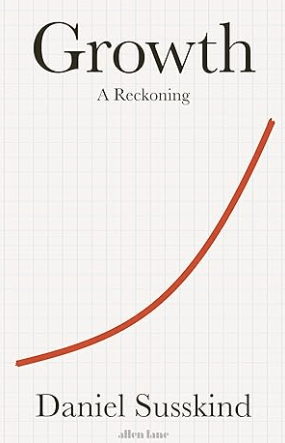
Economic growth has freed billions from poverty in the past two decades and made our lives far healthier and longer, resulting in the unfettered pursuit of growth defining economic life around the world. However, this prosperity has come at an enormous price: deepening inequalities, destabilizing technologies, environmental destruction and climate change.
Daniel Susskind, economist, argues that too few people understand growth and many in our era of sluggish productivity, the worry is slowing growth – in the UK, Europe, China and elsewhere – and reversing this stagnation is the goal of every politician. Some eco-warriors think there’s too much of it.
Susskind in Growth: A Reckoning, starts with a trip through centuries of muddled thinking. Thomas Malthus and his contemporaries thought growth was inherently unsustainable, as a growing population would eventually run out of resources. Development economists at the World Bank sustained a “fetish for investment”, relying on models that saw physical capital – stuff people could touch – as key for generating development. There are also degrowthers who include the likes of activist Greta Thunberg and anthropologist Jason Hickel. Economic growth will gobble up Earth’s resources so policymakers should seek less of it to prevent environmental catastrophe.
Susskind writes good policy is about minimising those trade offs and there is already evidence that it is possible to deliver higher growth alongside falling emissions. History showed that growth beyond Malthus’s wildest dreams was possible, as innovation allowed people to escape cycles of boom and bust. The Nobel laureate Robert Solow found that American growth over the first half of the 20th century came overwhelmingly neither from investment nor growth in the labour force, but from rising what resources there were more productively, whether through inventions or new management practices.
According to Susskind our leaders should shift their attention towards the balance of growth and away from its magnitude. For too long, he argues, they have seen the pursuit of raw growth as a way to avoid tricky compromises about who gets what. But trade-offs are inevitable and best acknowledged. Free trade might cause job losses, undermining traditional sources of collective identity and shared purpose. The spread of new digital technologies in social media platforms might be a boon for shareholders, but risk concentrating power in the hands of unelected tech bros. Dealing with the environmental costs associated with growth should involve carbon taxes. Susskind’s policy prescriptions centres on how to generate new ideas. They include enforcing the rule that patients can only be for non-obvious things, unlike current regimes that have granted protection for a circular transportation facilitation device (a wheel) or single action ordering. Policymakers should experiment with prize funds for scientific discoveries and revive stagnating research and development. The UK government should not congratulate itself for planning annual R&D funding that amounts to a third of what Alphabet spends.
Growth: A Reckoning by Daniel Susskind, Allen Lane £25, 368 pages.

 The neptune Herald
Leave a reply to pennynairprice Cancel reply