
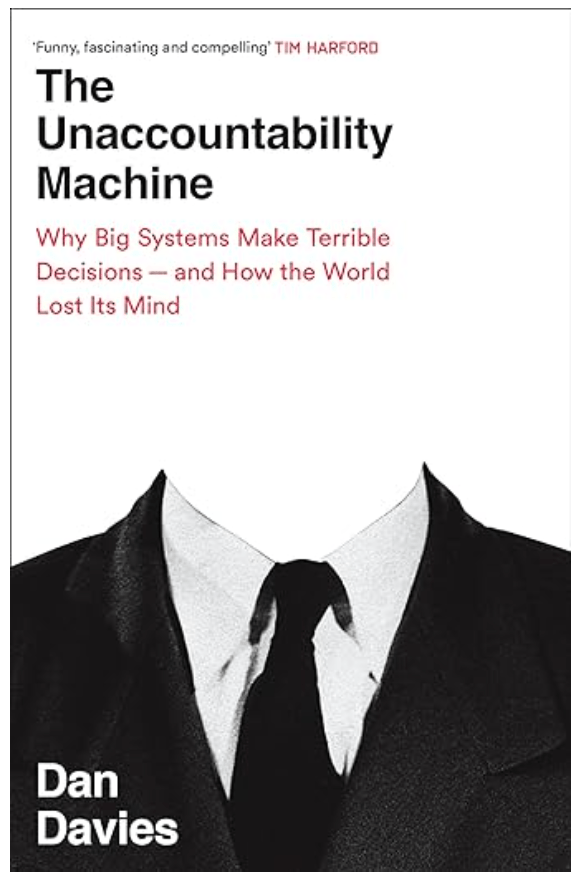
“ A corporation, or a government department isn’t a conscious being, but it is an artificial Intelligence, it has the capability to take decisions which are completely distinct from the intentions of any of the people who compose it. And under stressful conditions, it can go stark raving mad”. Big organisations often make terrible decisions, and how the world lost its mind, have you ever waited for a board to fight recently?
When to avoid taking a decision, what happens to it? In The Unaccountability Machine, Dan Davies examines why markets, institutions, and even governments systematically generates outcomes that everyone involved claims not to want. He casts new light on the writing of Stafford Beer, a legendary economist who argued in the 1950s that we should regard organisations as artificial intelligences, capable of taking decisions that are distinct from the intentions of their members.
Dan Davies calls an “accountability sink” situation in which a human system delegates decision-making to a rule book rather than an identifiable individual. If something goes wrong, no one is held to account. Davies looks at what’s gone wrong, among what might have been, had the world listened to Stafford Beer when it had the chance.
“Computer says no” service departments, in finance, banking crises regularly recur- yet few individual bankers are found at fault. If politicians promise flop, they complain they have no power; The Deep State is somehow to blame.
The problem according to Davies is the managerial revolution that began after the second world war, abetted by the advent of cheap computing power and the diffusion of algorithmic decision-making into every sphere of life. These systems have ended up “ acting like a car’s crumple-zone to shield any individual manager from a disastrous decision”.
The question is not how to return to a world without non-human decision-making systems- it’s how to ensure that they’re open to feedback, able to adapt and improve. Davies identifies the abstract theories of how firms and markets operate are trivial, the classical postulate of the optimality of market outcomes positively feeds the accountability crisis, by convincing managers, and politicians that it is better to let the market decide.
Davies argues “management cybernetics”, a framework for understanding the corporate and economic world that emerged from operations research, the use of mathematics to solve problems of human and technical resource management that began during the second world war.
In The Unaccountability Machine he provides an elegant new introduction to this intriguing road-not- taken in postwar social science, and makes a compelling case that in the age of AI its time has finally arrived, and cybernetics will finally have its day.
The Unaccountability Machine by Dan Davies, Profile £22, 304 pages.

 The neptune Herald
Leave a reply to pennynairprice Cancel reply