

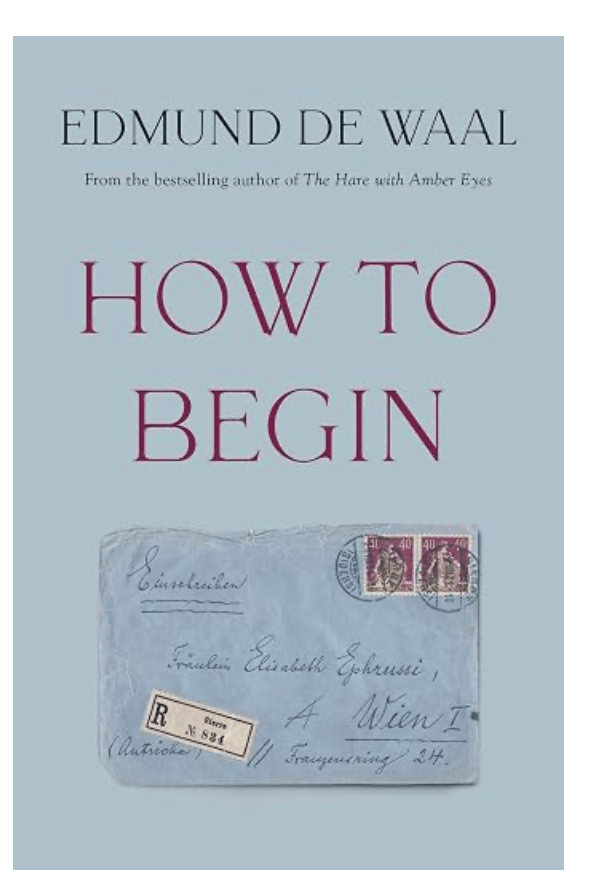
Elisabeth (de Waal)’s letters, with their ardour, impatience and melodrama, focuses on an argument about quiet perseverance and mentorship emerges with subtle force. In 1921, Elisabeth Ephrussi, a young law student and an aspiring poet in Vienna just beginning her creative life, writes a letter to the great poet Rainer Maria Rilke. To her surprise, Rilke writes back with advice. A five-year correspondence follows, an exchange of lyrical and exhortatory letters alongside books, translations, poems in manuscript. They never meet.
Fifty years later, Elisabeth’s grandson, Edmund de Waal, wants to be a poet and a potter. He sends her his own poetry, and she responds with guidance and Rilke’s Duino Elegies.
How to Begin follows Edmund’s journey as an artist. This is a book about failure, about starting again, about apprenticeship and asking for and then disregarding advice, about working out ways to keep going when you don’t know how.
It is a moving, intergenerational story about traces of memory within a family, and a deeply personal reflection on how we learn resilience with the support of others. It is for any reader starting out, seeking the permission to begin.
Edmund’s grandmother, Elisabeth Ephrussi, born at the turn of the 20th century, appeared there as bright young woman growing up in the spectacular Viennese palace of a family who combined banking with lavish patronage. Shortly after the Anschluss to Nazi Germany in 1938 and the brusque, devastating erasure of that well-buttressed world, Elisabeth fled. Resettled in England, she wrote a novel about postwar Vienna, The Exiles Return ( published posthumously in 2013).
How to Begin brings Elisabeth back to the fore in her grandson’s artful entwining of two stories about mentorship. Edmund was only 12 when he started sending poems to his grandmother. Elisabeth herself, aged 21, had aimed higher. Ephrussi asked a fond uncle to send Austria’s greatest living poet a friendly letter about your wish to dedicate a 46-page poem to him?
Rainer Maria Rilke, a past master in the art of licking the manicured hands that fed him, responded to Elisabeth’s ardent overtures. (“I love your books more than anything else in the world”) with predictable urbanity. His letters to her, published here for the first time ) alongside a sample of Elisabeth’s verses), managed to combine flattery with firmness. Rilke seems never to have quite recognised the formidable intelligence of his self-appointed portégé. In 1923, Elisabeth became one of the first young women in Vienna to obtain a law degree. Rilke died of Leukaemia, in 1926, weeks after Elisabeth, unaware of his fatal illness, had written to express undimmed hopes of meeting her hero in person.
Young Edmund seeking is grandmother’s thoughts about his first sonnets, was shaken to be answered with a copy of the Duino Elegies, one of Rilke’s most famous collections, an engagement with modernity, faith and death written either side of the first world war.
“I don’t know who this Rilke is, I don’t know why he is important to my grandmother”, de Waal writes. How to Begin might more realistically be called: “How to Persist”. de Waal embarked at 17, paying Whiting £25 a week for the privilege of sweeping up clouds of silica dust while scrubbing down the toxic Asbestolux boards on which the potter placed his unglazed works to dry. Later, Whiting taught de Waal how to study the hard way: through humility and endless revision.
“At the end of my week I would break my pots up into a black dustbin and mix them into water and dry out the slurry and knead up the clay. de Waal, an internationally acclaimed ceramicist and well-regarded author, he seems delighted to share – and the graceful shaping of How to Begin show how much skill is involved.
How to Begin by Edmund de Waal, with translations by Karen Leeder, Chatto & Windus £18.99/ Farrar Straus and Giroux $29, 240 pages.

