

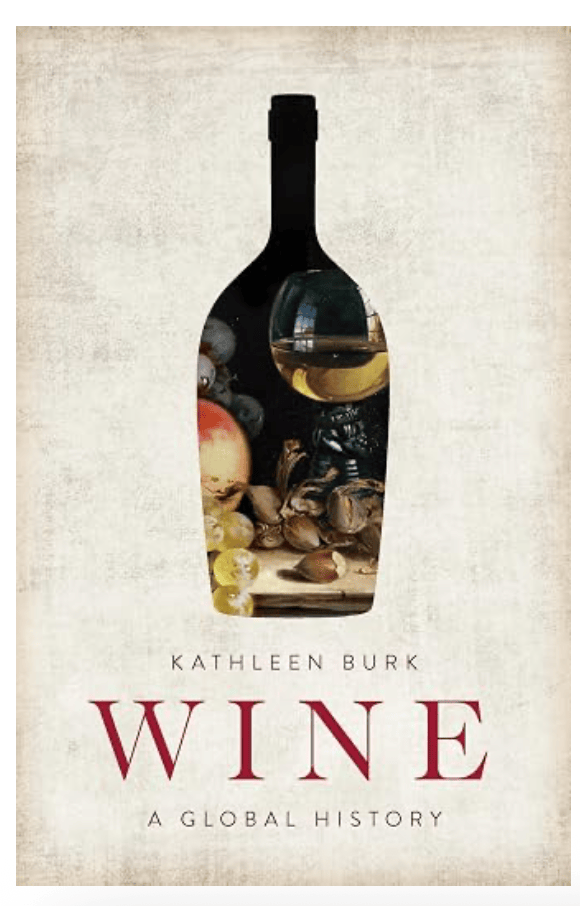
Wine: A Global History is a riveting eight-thousand-year story of wine, nectar of Gods and the pleasure and support of man Wine has always been intertwined with the growth and development of the human race. Over eight millennia, this remarkable drink was influenced cultures, built economies, healed men, and supported armies. Ranging from the Late Stone Age to the present day, historian Kathleen Burk illuminates the rich history or wine. Beginning inn Neolithic-era Georgia in the Caucasus, Burk meticulously traces how wine has evolved over time and place as religious, social, cultural, economic, and even culinary force – including the complicated relationship between Island and alcohol, the rise and decline of France as the World’s wine superpower, and the rapidly growing importance of Asian countries in the world of wine. Through this Burk weaves a comprehensive history not only of wine, but also of the peoples who produce and enjoy it.
Historian and Oenophile, Burk writes “Wine has been a drink, a libation, a medicine and a commodity”. For millennia, it has been seen as “a gift of gods”, with grapes being turned “apparently by magic” into a substance that can change the world for those who drink it. What greater pleasure are there, than sharing a bottle of wine with friends?” she asks. Wine made life better for all our ancestors- it was safe than water, thanks to the fact the process of fermentation kills of harmful bacteria. King Jamshid, a mythical ancient Persian ruler traditionally credited with the discovery of wine. He was upset when his beloved grapes spoiled that he placed them in a jar labelled “poison” – which was drunk by a woman in his harem whose terrible headaches were promptly cured.
Burk explains how vines and wine spread – along the silk routes into the Hunza Valley in modern day Pakistan, as far as Japan, into lands conquered by the Romans and later into Americas by the Spanish, and to South Africa, Australia and New Zealand by the British. North America, referred to by Scandinavian settlers around 1,000 years ago as “Vinland” fir a reason – namely the “vines heavy with grapes”- but then saw a series of planting booms after the arrival of later Europeans. By the start of the 20th century, wine was being grown in 43 of the then 48 states.
Alcohol was being referred to as “the curse of the working man’, with the result that winemakers had to look on as hundreds of thousands of gallons were flushed into the gutter. When prohibition came there is another chapter in views about alcohol- and wine in particular- that could be ambivalent. A drunken argument in Median led to wine being frowned on in Islam though not, as Burk notes, banned: after all, she notes, wine was greatly enjoyed in Arabia and was often consumed in legendary quantities- especially by caliphs who liked to enjoy themselves.
We learn from King Zhou, the last ruler of the Shang dynasty 3,000 years ago, who “filled a large pool with wine and ordered groups of men and women to chase each other in it naked”, which would have appalled Charlemagne, who apart from having an aversion to “see anyone drunk, and especially himself and his own household”, was either a hygiene freak or had friends who were. During his reign between 771-814, instructions were sent out demanding that anyone involved in making wine should pay ‘the greatest attention to cleanliness” and should ensure they wash their hands- and to use wine presses rather than their feet. Gallo brothers of California who built up an empire on the back of Julio telling his brother Ernesto “ I’ll make all the wine you can sell” while the latter promised to “sell all the wine you can make”.
Burk talks about superstar wine connoisseurs like Steven Spurrier and Robert Parker as well as their Roman counterpart, Pliny the Elder, who loved his wines. Greek wine being shipped to Burgundy and the investment in vineyards in Ukraine, Moldova, Croatia and elsewhere.
Burke’s wine suggestion “ I’ll be giving a 1999 Lebanese red, Gaston Hochar, Cháteau Musar, a go before long. She notes “the future of wine is uncertain”. While the young are bracing new trends, including Orange wine, there is also alcohol-free wine. In China, home to more than half the world’s varieties of grapes- as well as to a class of super-rich who had bought quality and quantity since the turn of the century- wine sale went down by almost 25 per cent in 2023 alone, because of economic pressures and fear of being seen to be overindulging.
Wine: A Global History by Kathleen Burk, Profile £30/ Basic Books $40, 640 pages


Wine is massively popular and I am informed grapes grow profusely in China which I did not know. In the right conservative or careful quantities, it can improve health, relaxation and digestion. I know that in the last thirty years wine has become increasingly popular in the UK for home use rather than simply drinking it in a restaurant or pub so for me I have wondered how the grape growing regions has kept up with demand. I think it is a good alcoholic drink used in the correct measures and I am a fan.
LikeLike