

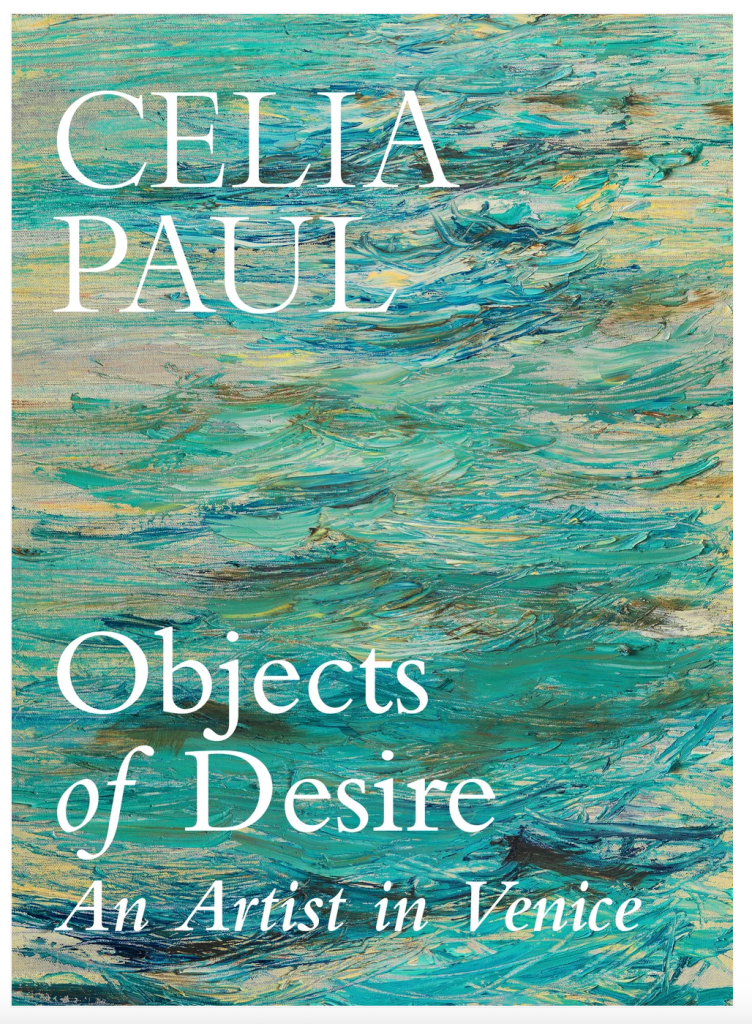
Alone in the lagoon city, Venice, Celia Paul began keeping an ongoing record of her painting. Objects of Desire is a mesmerising account of her perceptions in La Serenissima and of her preoccupations there: female desire and love, mortality, and memory. “Venice resembles a collective brain,” Paul writes, “where other people’s lives – past and present- are transmitted like signals to my own.”
In her reflections of the floating city, Paul finds traces of her last visit with her late husband; in the work of artists Carpaccio and Giotto, forceful depictions of her own emotions; and in the allusive painting La Tempesta by Giorgione, a key to her complex feelings about the past.
Objects of Desire is a radiant record of life devoted to art, a profound portrait of an artist who longs to confront herself and who invites the reader to do the same. Painter Celia Paul is idiosyncratic in her 67th year, won acclaim both for her ethereal, piercing figure studies and as a diarist of fearless intimacy. Her first memoir, Self-Portrait turned on her decade-long love affair with Lucian Freud, with whom Paul had her only child, Frank. Begun when Paul was 18 and Freud 55, the relationship was scarred by Freud’s infidelities and Paul’s obsessive devotion. Paul’s second volume, Letters to Gwen John, fictional epistles to the early 20th-century painter who shared Paul’s weakness for domineering male artists. After a tortured affair with Rodin, John – like Paul – found fulfilment in her own right.
Paul latest Objects of Desire finds her on a seven-week residency in Venice, a grieving widow, having lost her husband, philosophy teacher Steven Kupfer, to cancer. Arriving in April 2023, Paul frames herself as an innocent abroad. Although she has visited Venice before, for 40 years she has not worked in any space other than her Bloomsbury apartment. The Venice studio she reckons will be “intimidatingly different” and that she will be “unable to paint”. Her fears are confirmed when she struggles to turn the key in her studio’s lock and forgets the location of her apartment. “This is the Venice of the senses: timeless, spellbinding and liberated from 21st-century burdens.”
Here Paul shows an unworldly veneer by masking a steely pledge to her vocation. Her space on the Zattere waterfront, is ideal for her to paints up a storm. Her chief muse is Giorgione’s “The Tempest”, which hangs in Venice’s Accademia Gallery. The Painting depicts a nursing mother watched by a handsome young man beneath the streak of lighting. Paul asks of “The Tempest”: “What is it trying to tell ME?” The picture meant lot to her and Freud, whom she refers to throughout as her “first lover”, as if by not naming him she strips him of any residual power he might hold over her. “I was a young single mother. I was once an object of desire” she likens herself to her painted counterpart: “ It arouses her to be so lusted after.”
Memories of Paul’s own mother, who was a widow when Paul gave birth to Frank. Paul hoped her baby would assuage her mother’s grief. Paul writes that Frank became the centre of the aura of “loss and devotion” that surrounded her and her mother. “Force field between us held us apart as completely as it kept us together”. Paul dances between ideas about painting, memories, dreams and her current, often tumultuous feelings. She evokes the ripple of wind on water, bells chiming in a distant campo, her neighbours’ chatter. Her grief for Kupfer is riven with guilt. Freud’s ghost still haunts her. Paul weaves her confessions through explorations of paintings by Giotto, Tintoretto and Carpaccio and writers such as Annie Ernaux. Paul’s recollection of her husband’s last days is startling. “The right dose of morphine” overwhelms other emotions. Paul’s assertion that nurses burst into Kupfer’s room at midnight and shook the “last drops of life out of him” rather than let him wake to “unendurable pain”? Her capacity to reveal and withhold mirrors that of Venice, the most flamboyant yet introvert of cities. Two years later, Paul returns to Venice. She is a woman who now loves “being on my own, and doing what I want, when I want”, Paul begins version of “The Tempest” in which she will be “alone but centre stage”.
Objects of Desire: An Artist in Venice by Celia Paul, Jonathan Cape £20/ New York Review Books $29.99, 144 pages.


This looks like an absolutely fantastic book. I cannot wait to read it.
LikeLiked by 1 person