

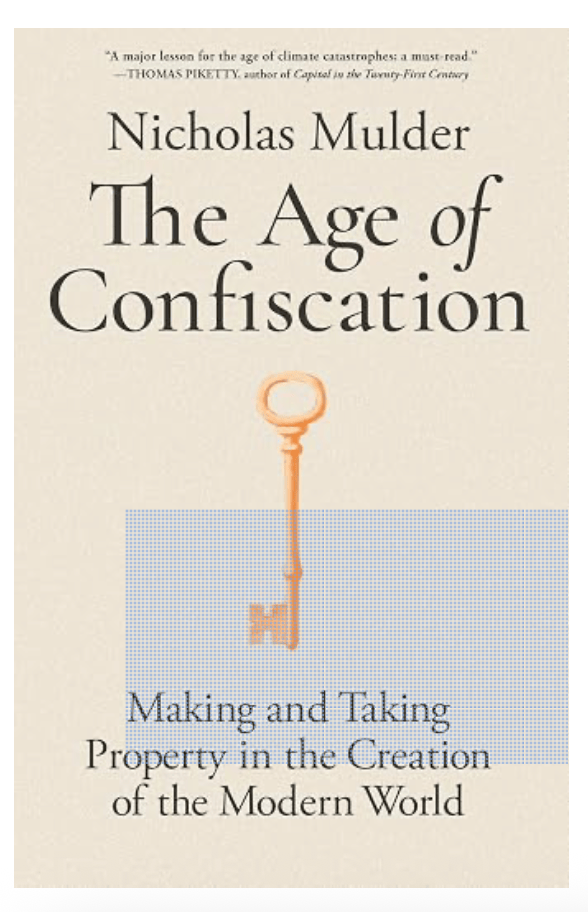
Russian full-scale invasion of Ukraine triggering the largest asset freeze in history, as €210bn of immobilised Russian central bank assets in EU jurisdictions remain mired in political and legal disputes about whether to fully confiscate them. Professor of history at the Cornell University, Nicholas Mulder’s The Age of Confiscation, charts a revelatory account of how the greatest conflicts, atrocities, and social advancements of our time have all hinged on the seizure of property, for readers of Capital in the Twenty-First Century and Why Nations Fall.
Expropriation- the act of forcibly taking property- is usually associated with dictators and unstable countries. But in fact, it has been integral to the political and economic history of the West, enabling the abolition of serfdom and slavery, the Industrial Revolution, and essential parts of the modern welfare state. Much of world today was built through the coercive e acquisition of property, a process that will continue to shape our future. Mulder traces a new path from the eighteenth century to the present showing how governments of all kinds- liberal and nationalist, socialist and fascist, imperialist and anticolonial- have dissolved and redistributed property rights in the service of their ideologies and ambitions. Ranging from the French Revolution to the Russo-Ukrainian war, from railway empires to oil nationalizations and from the confiscation of patents to financial asset freezing. The Age of Confiscation upends our understanding of state-building and economic development, showing how they are at their core a struggle over property: its making and unmaking, transfer and conversion, and theft and restoration.
The Superyacht Amroe Vero linked to Igor Sechin, the head of Russian oil group Rosneft, was impounded by French authorities in La Clotat in March.
Some of the episodes will be familiar. There is Henry VIII’s dissolution of the Catholic monasteries or Egyptian president Gamal Abdel Nasser’s nationalisation of the Suez Canal Company in 1956. The Bolshevik revolution stands out for the pace and sheer enormity of its programme to upend property rights. “In just two months of wielding power, they had initiated the largest takeover of an entire capitalist banking system, and the abolition of private property across a sixth of the Earth’s land surface.”
The suppression of the Jesuits by Europe’s Catholic monarchies in the 1760s. The order had become enormously wealthy and politically powerful, owning plantations, estates and other property across Europe and its empires. Beginning in Portugal, government expelled the Jesuits and seized their assets. The Campaign Mulder argues, provided a template for modern confiscation: a politically threatening group could be dispossessed through the systematic use of state power, while its property was sold or repurposed to strengthen the state itself. Even where the immediate objective was political, the economic consequences were enduring.
The Jesuit suppression helped to break up forms of land ownership that kept property and drove workers into industrialising cities. In revolutionary France, regions where more church land was seized recorded significantly higher agricultural output in subsequent decades. Modern property rights, were sometimes created by violating the property right that preceded them.
“The tension is apparent even in America, with its strong constitutional protections for private property. The Fifth Amendment protect owners, from un compensated takings, but also explicitly recognises the state’s power of eminent domain. The US Supreme Court, according to Mulder, has not substantially limited the federal government’s ability to take private property since 1875.
Legal regimes on both sides of the Atlantic developed around the norm of compensation, conferring legitimacy on the seizures and made confiscations more common and less politically disruptive as the state could buy out owners. The growth of public finance, and debt in particular, provided a mechanism for doing so- and for spreading out the cost. The abolition of slavery was, in effect , an asset swap: Property claims on humans became monetary claims on the British government. Once transformed into public debt, this compensation capital became a financial asset”. Mulder notes periods of high inflation in the 20th century coincided with surges in expropriation. Inflation could erode real value of compensation paid out over time, making assets cheaper for states to acquire.
Mulder reveals that no political project has had a monopoly on the use of confiscation. The same measures could serve strikingly different political ends. In US-occupied Japan, General Douglas MacArthur’s land reforms “pushed through one of the most profound transformations in class structure ever seen in a capitalist society”, later inspiring Che Guevara’s remark that “a certain general of the Army of the United States has been more Communist than us”. The return of the Industrial policy have all expanded the role of the state in private property, while geopolitical rivalry had revived the seizure of foreign assets.
The Age of Confiscation: Making and Taking Property in the Creation of the Modern World by Nicholas Mulder, Allen Lane £40, 768 pages.

