

John McGahern often portrayed as a country farmer who happened to have a talent for writing. One of seven children, he was raised in the Irish countryside in a household ruled by his militant father and haunted by the death of his mother.
On his death in 2006, John McGahern was hailed as the most important Irish novelist since Samuel Beckett. But who was the enigmatic man behind the literary myth?
Some think of him as a radical truth-telling pioneer who shattered Ireland’s censorship culture. In 1990 Sunday Times wrote when his masterpiece Amongst Women was published “his reputation is a puzzle”: McGahern was “notorious” in his home country of Ireland, “revered” in France, “but in England virtually unknown”. Amongst Women changed that -it was shortlisted for the Booker Prize and sold more copies than his previous books combined. He became famous in 1965 when his second novel, The Dark, his first work of Irish fiction that held to the light clerical sexual abuse”, had him banned by the censor, leading to his dismissal as a primary school teacher in Dublin and exile to London. “What entered your head to write that book?” asked the school manager, a priest. It was banned in Ireland for five years. His later books The Leavetaking (1975) and The Pronographer (1979). But it was the fifth novel Amongst Women which was a “pig to write” he told Colm Tóibin; “I thought it had me beaten”. Its portrait of a dying Irish republican veteran who has terrorised his family- again, based on McGahern’s father- was succinct, powerful and revelatory, and in my view one of the greatest novel in English in the second half of 20th century. Its success baffled its author. “I don’t understand it,” he wrote. “Does anybody?”
McGahern’s only child is a son who was born in 1964 following a casual relationship. McGahern “refused to see the child” and had no involvement in his life, later describing the business as “something I have regretted bitterly all my life”. McGahern’s final novel That They May Face the Rising Sun (2002) was a reinvention, intended as “a book about nothing, a book without external attachments held aloft by the internal force of its style.” One character in this book says “literature is a deep pain, but it is also an intense form of life. Any life would be small without literature”.
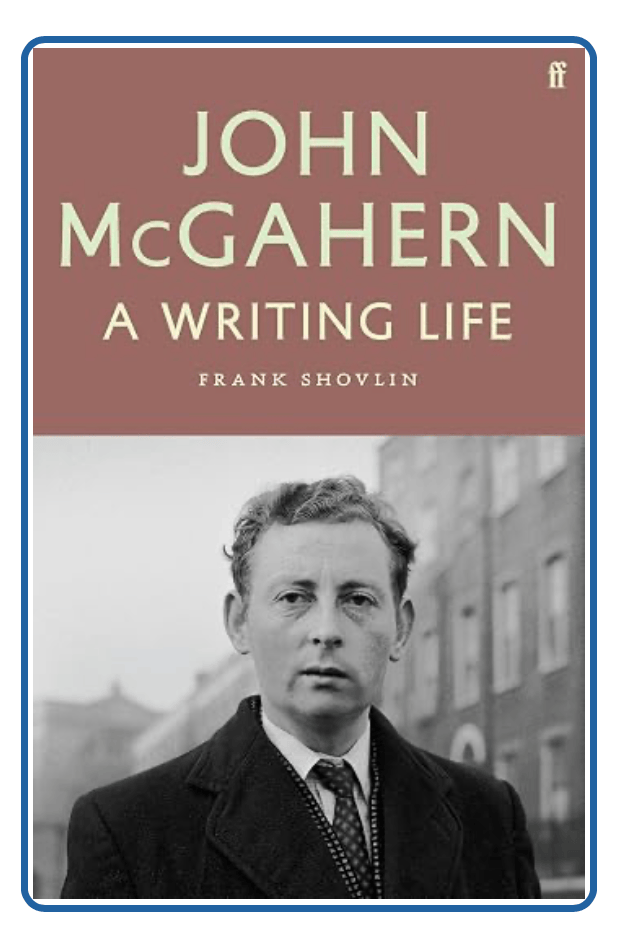
Frank Shovlin, professor of Irish literature at the University of Liverpool and previously editor of McGahern’s collection of letters (2021), in this biography sheds a light on him, by telling us everything we could wish to know about his life, filling the gaps within and beyond McGahren’s 2005 Memoir.
McGahern started out as a controversial and ended as an elder statesman: he had the relative rarity for a writer of his greatest success coming late in his career. “It was failure, I think, which drove me to (writing”, he once said. “Failure to find complete satisfaction in life itself”. That dissatisfaction was embedded early. The central elements are that when McGahern was nine years old, he was not allowed to attend his mother’s funeral- “a moment into which, and from which, all his fiction flow” writes Shovlin and that his father, a sergeant in the Irish police, was unhappy man whose children suffered as a result.
His first novel The Barracks (1963) is about a sergeant and his terminally ill wife. (Who’d read a book about a fucking guards barrack?) asked one friend when McGahern invited him to the pub to help send the £100 advance he’s just received from his publisher. Its inclusion of sex and strong language saw it removed from some libraries in Ireland. McGahern’s determination to tell the truth about life and his country earned him as much condemnation as praise.
John McGahern: A writing Life by Frank Shovlin, Faber £25, 496 pages.

