

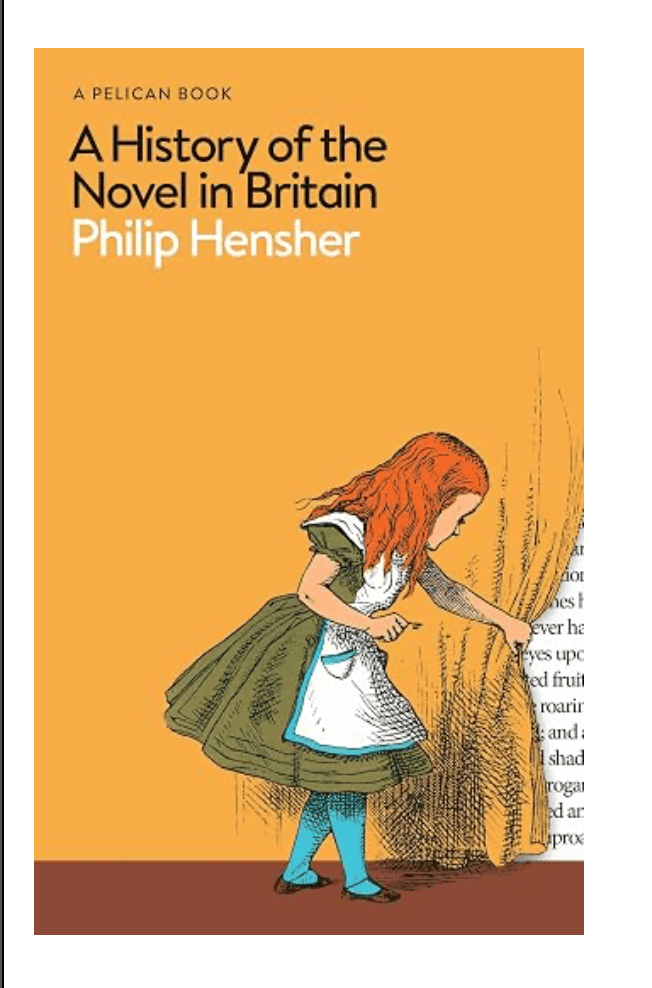
Philip Hensher begins in “A History of the Novel in Britain”, a new history of both an art and an industry, in the eighteenth century, when people began to read in ever greater numbers, seeking words that helped explain their hopes and desires. A new kind of literature was needed for this growing market for readers, one that reflected as many different lives in its pages as there were people to buy them, that could change with the times and do something new: something novel.
Hensher describes how the evolutionary scramble by writers and publishers to get attention drove constant innovation in writing techniques, and produced new ways of printing, distributing, and selling books. Over the course of three hundred years these creative and commercial forces shaped the novel’s form and its future, from Daniel Defoe to Zadie Smith.
Reading widely across the famous, the once famous and the utterly (if unfairly) forgotten, this is a work of investigative verve that makes a serious case for widening the canon. But it is also a gift: Hensher has read untold thousand of books, to create A History of the Novel in Britian which is his hoard of treasure, waiting to be discovered, wondered at and delighted in. His invigoratingly blunt survey makes room for genre classics – Tolkien le Carré, Ballard- alongside syllabus stalwarts, while also unearthing dozens of long-forgotten writers, never hesitating to tell us when it wasn’t worth the bother –“utterly untalented” Algernon Gissing, brother of New Grub Street novelist George, whom Hensher rates little better.
The British novel from 1830 to 1914 was “one of the most glorious phenomena in world history” until modernism came along, Boo to Virginia Woolf’s The Waves (1931), in which “six characters only monologize about their perceptions”; cheers to Charles Dickens, who understood that “human beings are most themselves in their externals, and not in what they happen to be thinking”.
According to Hensher, Thomas Hardy’s Far from the Madding Crowd (1874) “achieves plausibility through dense arena” about sheep shearing and “abstruse botanical surveys”. The Brilliance of Arnold Bennett’s 1908 novel The Old Wives’ Tale is manifest in the minutiae of a restaurant scene set in 19th century Paris: only a true master, says Henshe, would know the cutlery “ought to be steel and not silver”.
Aghata Christie’s Appointment with Death (1938) is mocked for a plot involving “a room in an English country house ( being plunged into impenetrable darkness at 6:30pm during British Summer Times by the lights being turned off”. Jane Austen’s Emma (1815) names a Yorkshire estate Enscombe; but place names in Yorkhsire, where Hensher grew up, “end-thwaite or -gill”.
If reading fiction this way feels like going to a disco and refusing to dance or going to a beach with a suit on, George Eliot’s Danile Deronda (1876) turns on the hero’s discovery that he’s Jewish; Hensher asks, “How was he not reminded every morning in his bath? It highlights the extend to which Victorian novels appeased prusdish circulating libraries, their key market.
Kate Roberts’s gritty Welsh novel Traed mewn Cyffion (Fleet in Chains, 1936) “is to be admired” with no more said – the purpose seems less to inform us about Roberts than to underline his own expertise. In the 19th century – his golden age- politicians worried about children reading too many racy French novels, right now, there’s a government inquiry into why some children aren’t reading at all.
A History of the Novel In Britain by Philip Hensher, Pelican £25, Princeton University Press,704 pages.


I think a good exercise in schools of children in their early to mid teens would be for them all to make a list – say – of their six favorite and recommended books and that could be analyzed and made into an ultimate guide to what informs entertains and educates young people.
LikeLike