

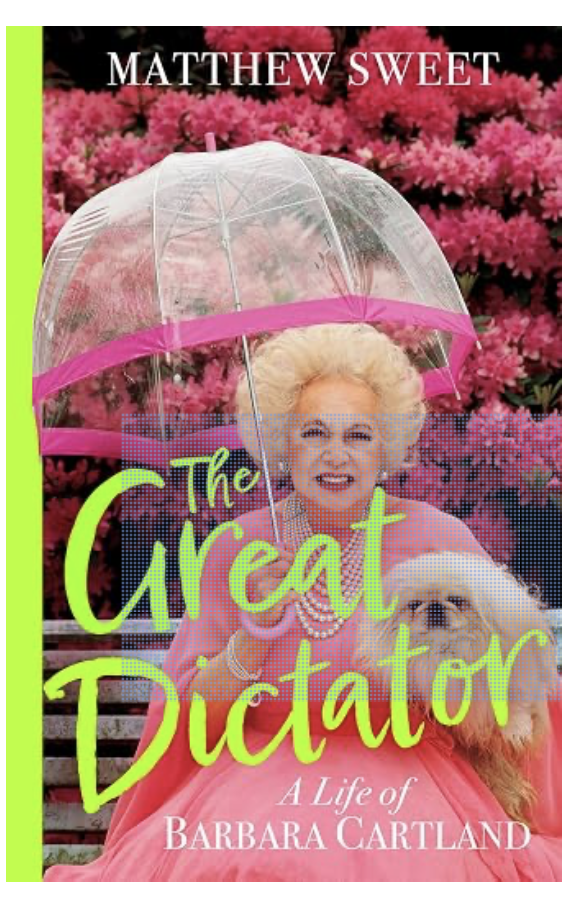
Barbara Cartland’s magic made penniless virgins, Reckless dukes, Flappers, Airmen, Suffragettes fall in love. She wrote 723 books without touching a typewriter 750 million sales: instead she reclined on her sofa with a Pekinese on her lap- and romantic fiction billowed out of her.
This dazzling biography reveals the woman behind the powder and mascara – a clever socially precarious writer navigating a twentieth-century world of war-damaged men, class conflict and sexual peril.
After 49 proposals, she chose the wrong one. What followed was a life stranger than any of her novels.
From country house weekends to Fleet Street offices, from Mayfair bedrooms to the divorce court Matthew Sweet traces Cartland’s extraordinary journey through a century of upheaval. Here are terrorist plots, psychic seances, suppressed scandals, plagiarism battles in the cutthroat world of romance publishing- and a surprising turn as a campaigner for Romany rights.
Drawing on unprecedented access to Cartland’s vast archives and first-hand accounts from those who knew her. Sweet delivers a wonderfully entertaining study of class, fame, scandal and self-aggrandisement. Part satire part biography, part social history, The Great Dictator reveals how a literary legend was made.
Sweet when trying find personalities that encapsulate Britain in the 20th century, the mind doesn’t necessarily go straight to Barbara Cartland, novelist form 1901-2000, born into a Edwardian privilege, self-professed inventor of virgins. The queen of romance novel, a controversial confection of frou-frou pink dresses and boot polish blackened eyelashes, has long been little more than a figure of fun. Sweet however makes a compelling case for her. Wars, class, feminism, politics: Cartland was there for it all. Her privilege came to an abrupt halt with the suicide of her once-wealthy manufacturer grandfather in 1903, a bullet that ricocheted through the family and her future plots, forcing them to live “the life of one class on the income of another. The biography starts with chronicling a young Cartland fighting to maintain this fragile social status amid the drumbeat of the two great wars. She lost her father first, her brothers within two days of each other. “Quite early on, I learned the best way to survive is to pretend that anything unpleasant simply hasn’t happened,” she famously said.
Barbara never let the facts get in the way of a good story. Sweet writes, she transformed herself into an instrument of mass production”. Cartland is not remembered for the quality of her prose. Still, only Shakespeare and Agatha Christie have outsold her even after hers was the first novel ever to be accepted into the House of Commons library,
Reading The Great Dictator, which was shortlisted for the Baillie Gifford Prize for Non-Fiction, one moment Cartland is corresponding with Indira Gandhi, the next with Prince Charles (dining out on her brief role as his step-grandmother-in-law provided her with a new chapter as an octogenarian. Libya’s Colonel Gaddafi puts £50,000 behind the counter of Foyles and asked that Barbara’s books be sent to him’.
Cartland’s own heroines, with their virginity and happy endings, were often mere carboard cut-outs. According to Sweet “ Cartland embodied the real century woman, despite all the affection, Rolls-Royces and badly behaved Pekingese dogs.
The Great Dictator: A life of Barbara Cartland by Matthew Sweet, Hodder & Stoughton £25, 496 pages.

