

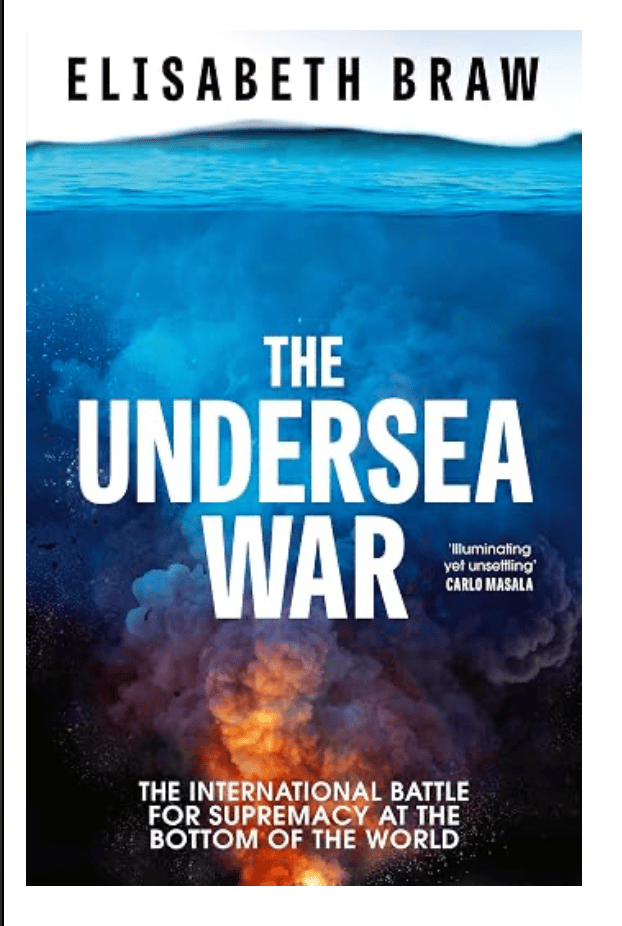
Every nation, button, house and financial market depends on a massive, unseen hidden web of cables across the ocean floor, that sustains our world, but it’s no longer safe. Power cables and pipelines on the seafloor provide the world with energy. This is the newest battlefield where countries must protect their interests – and the functioning of daily life- while rivals test their limits. From the Baltic to the Pacific, sinister ruptures, mysterious vessels and submarine incursions mark a conflict already under way. Elisabeth Braw captures the fragility of an infrastructure that underpins everything from mortgages to cancer research and the global financial system to simple emails after interviewing maritime patrols and access to naval officers, undersea engineers and cable operators.
The stakes are immense as virtually the vital arteries of modern life and all the internet traffic runs through these energy runs in cables and pipelines alongside them – yet the more essential these networks becomes, the more exposed it is. The Undersea war shows that the next great conflict may not erupt on land but in the depths below.
A car park in Liguria in northern Italy has an unmarked building where a 9, 775 km long data cable, about the width of the garden hose, dips into the sea, spools off across the Suez, shoots down the Red Sea and them across to Mumbai, where it connects to another cable linking it to Singapore. On the other side of the “landing stagnation” the fibre optic cable buried deep under the strip of land between the sea and the building, which is surrounded by one metre-thick walls. From here the India-Europe Xpress cable, majority owned by India’s Reliance Jio Infocomm and state controlled China Mobile, links to data centre in Milan, In the other direction it links with Crete, Saudi Arabia, Djibouti and Oman before reaching India. To date there are more than 600 of cables, in use or planned. The longest, circumventing Africa, is 45,000 km and in 2025 there were 17 million kilometres of them. Meta is planning a 50,000 km cable to straddle the planet. As think-tanker Bego points out, “up to 99 per cent of International communications and data traffic from our bank transfers, to our work emails, to our favourite streaming shows travel through these cables on the seabed.
Britain dominated the industry, not least since in the Malay Peninsula and on Borneo the empire possessed most of the gutta Percha trees, which then produced the rubbery, saltwater-resistant substance needed to insulate the first generation of cables. Ever since the first transatlantic underwater cable was laid in 1858 connecting Ireland with Newfoundland, undersea cable security has been an issue. In August 1914, one day after Britain declared war on Germany, a Royal Navy ship destroyed its most important ones, hampering Berlin’s wartime communications and as Bego notes “significantly” undermining its war effort. Dutch Bego and Swedish security expert Braw argues that we need to understand that without these undersea cables all the modern lif would simply grind to a halt, and hence they are the prime targets for our enemies, and for us, if and when the time comes.
In the Baltic Sea off Taiwan there have been several cases of dragging anchors from Chinese and Russian-linked ships cutting cables, electrical interconnectors and gas pipes, but if caught, captains always say it was an accident. Beyond the 12 nautical miles of country’s territorial waters the law of coastal states no longer applies, so policing is hard it not impossible.
Braw tells the story of a Chinese-linked ship sailing from Russia in 2023 that cut two cables and shut down the Baltic-connector gas pipeline linking Estonia and Finland. She describes the events as “ the geopolitical equivalent of Jack Wolta’s horse’s head in bed in The Godfather.”
Braw has a chapter on the Trump administration licensing undersea mining of hard-to-access polymetallic modules, which contain minerals such as manganese, iron and cobalt, and lie deep in international waters, over which the US has no territorial claim. Will this lead to undersea drone wars? It’s a seaweed jungle out there and war is already raging.
The Undersea War: The International Battle for Supremacy at the Bottom of the World by Elisabeth Braw, John Murray £25/ Public Affairs $34, 352 pages.

