

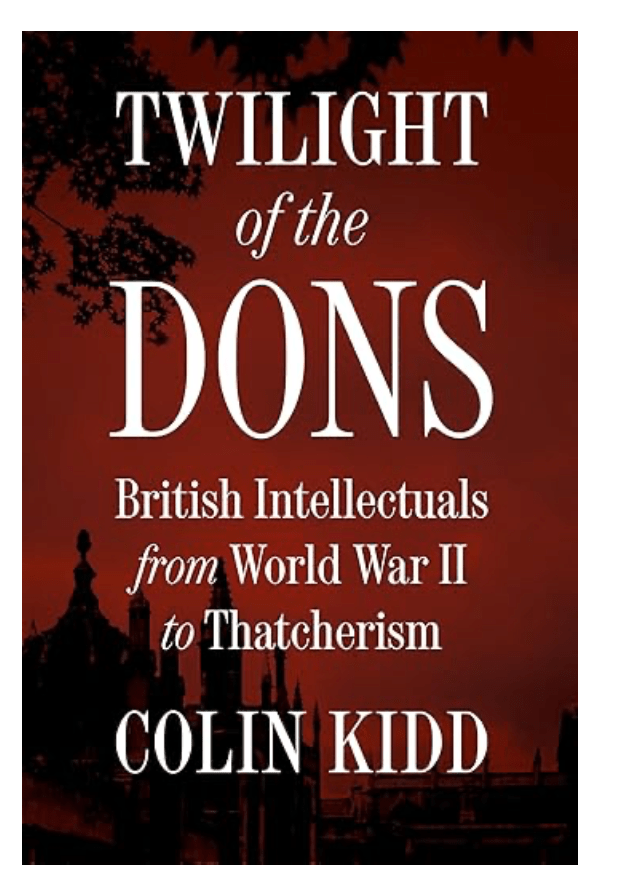
Colin Kidd’s Twilight of the Dons, is about the rise of power and eventual fall from grace of the Oxbridge intellectual. After World war the powerful acdenucs if Cambridge and Oxbridge dons of the 1950s a patrician elite, who formed a progressive force university-based establishment reshaping Britain’s postwar society by connecting intelligentsia. Unlike intellectuals in other countries, often anti-establishment outsiders, the dons of Oxbridge enjoyed secure and even cosy connections with those in power. This is a intriguing history that charts the decline of the “golden age” of intellectuals amid Thatcherite market forces, and how their influence waned when Oxbridge’s links to the establishment began to fray. Kidd explains how dons’ many of the twentieth-century Britain’s famous intellectuals- Elizabeth Anscombe, Isaiah Berlin, Edmund Leach, J.H. Plumb and Hugh Trevor-Roper, their confrontations with student protesters in the 1960s to their reaction to the rise of Thatcherism in the 1980s. the countercultural force of convert Catholicism and the strange phenomenon of Tory Marxism. In January 1985, Oxford’s dons gathered together at their governing assembly, Congregation, and voted 738 to 319 to deny British Prime Minister Margaret Thatcher an honorary degree, revealing the anti-Thatcher campaign, and this official riposte represented the proper level of disapproval for the Conservative government’s funding cuts and free-market education policies. In that same meeting, a similar honour for Italy’s socialist president Alessandro Pertini sailed through unopposed. This certainly stung the prime minister, as in a speech in Newcastle two months later, she caustically noted that nowhere was suspicion of money-making “more marked than in the cloister and common. Room.” while the entrepreneurs who created jobs and wealth “did not speak with Oxford accents”.
In the 1950s both academics of Oxford and Cambridge universities enjoyed high prestige, freedom and confidence, constituting nothing short of a ‘secular clerisy”, entrusted with the maintenance of civilised values and higher truths, and expected to lead debates within British public life. The Oxford dons held deep reservoirs of social capital and political power by hosting college dinners for cabinet ministers to dominating BBC current affairs programming to provisioning the intellectual services with promising students. By the late 20th century, according to Kidd their worldly standing and corporate authority had vanished, “vacating any pretensions to leadership or to shaping a national conversation.” And Britain, is poorer for that.
By the late 20th century, their worldly standing and corporate authority had vanished, “vacating any pretensions to leadership or to shaping a national conversation” writes Kidd.
Critical to the transformation of Oxbridge academics from introverted scholars compromised by the 1930s struggles over appeasement of Nazi Germany into civic leaders was their call-up during the second world war. The Cambridge archaeologist Glyn Daniel set up a training unit at the Army Intelligence School at Karachi. The Oxford anthropologist Rodney Needham served in Burma and rose to the rank of captain in the 4th Battalion of the 1st Gurkha Rifles. EWB Gill, bursar of Merton College and lecturer in Electricity, oversaw Radio Security Service. At the Government Code and Cypher School at Bletchley Park, the university personal came ‘overwhelmingly” from Oxford and Cambridge.
So began the golden age of England’s intellectual aristocracy as the upper echelons of the civil service, BBC, cultural institutions, and universities came under the sway of a Whig-liberal establishment. Philosopher Sir Bernard Williams – Fellow of All Souls, Oxford and King’s college, Cambridge – served on Royal Commissions of inquiry into pretty much every field of public policy. “ I did all the major vices, gambling, drugs, pornography and public schools” he liked to joke. The wit and verbal volley of the Oxbridge Common Room was favourably contrasted to lugubrious German academia, earnest self-righteous American campuses, and French philosophical obtuseness. Lawrence Stone, an early modern historian at Oxford in the 1950s before decamping for Princeton in 1963, “pondered the Malice and hatred” typically found in an Elizabethan village and concluded that the only “modern equivalent” was the Oxford Common Room.
“Thatcherism’s cheese-paring parsimony and authoritarian desire for control brought a depressing end to the golden age of the don.” The shrinking Fleet Street and a fissure between university specialism and trade publications also reduced the space for academic voice in civil society. From Dundee to Nottingham to Exeter, the chickens have come home to roost as the cumulative impact of 40 per cent cuts in per-student funding, a dangerous over-dependence of international MA students, wasteful internal competition, an inequitable student-loan book, and the total absence of strategic oversight are lading to the shuttering of entire departments and the loss of thousands of academic jobs.
The book charts High Table disputes about the wearing of college gowns might seem an indulgence.
Kidd examines the dons’ attitudes towards America and France – as seen in their engagement in the debates over the Kennedy assassination and the awkward reception of Lévi-Strauss’s anthropology. When Oxbridge came under assault, it was first by a modernising, technocratic Left in the early 1960s, then by student radicals in the late 1960s and finally by the Thatcherite Right- in whose rise, Kidd shows, some dons were complicit. As Oxbridge intelligentsia declined, a reassessment of the place of dons in British public life began.,
Twilight of the DONS: British Intellectuals from World War II to Thatcherism by Colin Kidd, Princeton $35/£30, 288 pages.

