

Make Tech products and services with safety, privacy and autonomy
Sir Kier Starmer’s announcement to ban social media for under 16s, echoing measures in Australia that took effect in December. France, Austria and Spain are among other countries planning similar restriction. Beeban Kidron’s Users, is about a inspired global debate on smartphones rewiring children’s brains and links to poor mental health shows Users catching the Zeitgeist.
Baroness Kidron has been campaigning for tech safety, regulation, and children’s rights for over a decade. In her book, she describes the move from a successful career directing films, including Bridget Jones: The Edge of Reason.
According to Kidron, rather than curb children’s excesses, she urges readers and governments to see such steps as constraints on tech companies. Restrictions are a temporary balm not a cure. The efforts should go on making tech behave better through a wide range of measures, including blacklisting or geo-blocking with automatic fines, companies that breach local rules, and designing tech products and services with safety, privacy and autonomy as default.
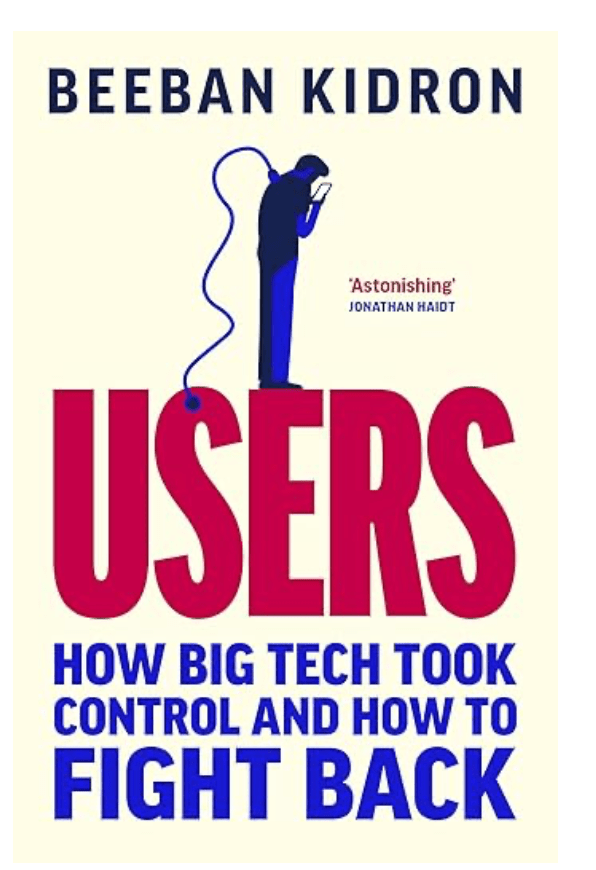
How concerned citizens and parents can take back control. In USERS, legislator and campaigner Beeban Kidron goes on a journey into the world Big Tech has created, from the halls of parliament and the UN to the White House and Silicon Valley. Her encounters with specialist police officers, bereaved parents, lobbyists and tech bros, you will witness the unchecked power of Big Tech, as they avoid rules and regulations, and capture governments that are meant to protect us.
You’ll see how the issue is not technology itself, but its use and abuse. How tools built to connect people are redeployed to divide, punish, distract and control; while our tech overlords come to own everything- but continue to be held responsible for nothing.
The trigger for Kidron’s switch to campaigning was watching teens use their smartphones in her documentary, InRealLife, released in 2013. She writes of filming three girls at home, dressing up, taking selfies, before playing on Chatroulette- a website that would connect users across the internet. “I watched as the girls giggled and squealed, flicking through faces and bodies around the world… Most were adult men… many were masturbating.” The experiences led her to set up a charity, 5Rights, in 2012, when she was also appointed to the House of Lords as a crossbench peer, helping to push through legislation to raise the age of online maturity from 13 to 18, among other measures. In this work she has encountered parents who have lost their children to suicide after being cyberbullied, depressed by horrific images or encouraged by AI chatbots.
The fury at tech’s argument of its exceptionalism steams form the page. After the British schoolgirl Molly Russell died by suicide in 2017 the coroner concluded Pinterest and Meta contributed in a “more than minimal way by serving her streams of self-harm content” Kidron writes.
“If any other (non-tech) company -a hotel chain, a bus operator, a toy manufacturer- had produced a product linked to a child’s death it would have been recalled immediately.”
She is angry at the UK for courting the US tech companies rather than standing up to them when their algorithms pump toxin content at users of misuse personal data.
She praises South Korea and Switzerland’s decisions to build their own large language models (LLMs) , the seedbeds of AI, rather than allowing AI companies to plagiarise creators’ content. She show the way that tech companies lobby and the revolving door between tech, regulator and politics.
Facebook’s partnership with the charity Samaritans in 2014, provides a moral cover according to Kidron. One common tactic deployed in meeting between governments and tech lobbyists is a request for detailed discussions to be “taken offline”, which in effect becomes a way to bury public accountability.
Kidron’s main focus is identifying Big Tech’s harms and arguing it should be treated like other sectors, subject to regulation and pushed to design safer products. She is not anti-tech, acknowledging the “online world has enabled newe forms of self-expression and visibility”.
“If we act unequivocally to protect children, we will have the tools to protect everything else; but if we fail, we will lose democracy itself” Vilified on social media, bullied by anonymous emailers, with friends dismissing her for not understanding the “new rock and roll” she would be forgiven for seizing the moment.
He message is “by cracking down on tech’s harms will enable us to enjoy its benefits”. Kidron implores readers and policymakers to push back against social media and artificial intelligence groups.
Users: How Big Tech Took Control and How to Fight back by Beeban Kidron

