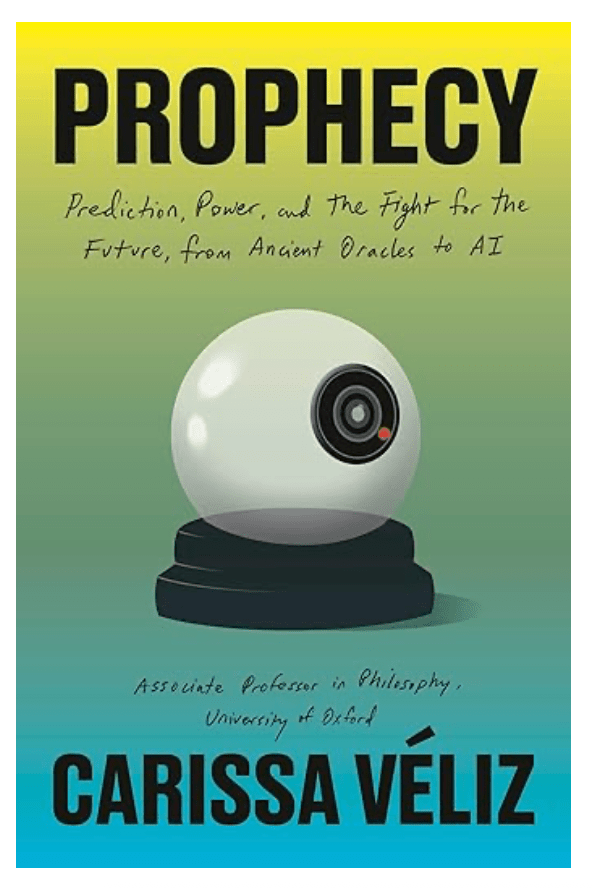
Is future bright or domination over others? Live life on our own terms
Ancient Oracles and medieval astrology that preceded used to be the prophets of the yesteryears which is taken over by the Tech empires. Award-winning University of Oxford Professor Carissa Véliz in Prophecy argues why we must reclaim that power and shows us how.
For thousands of years, oracles, seers and astrologers advised leaders and commoners alike about the future. But predictions are often power plays in disguise obfuscating accountability and stripping individuals of their agency. Today we face the same threat of powerful prophets but under a new façade: tech.
Not only do modern predictions made by tech companies advise on war, industry, and marriages, but artificial intelligence also now determines whether we can get a loan, a job, an apartment, or an organ transplant. And when we cede ground to these predictions, we lose control of out own lives. Have you ever had a job interview done by AI?
Drawing on history’s cautionary tales and modern-day tech companies’ malfeasance- from surveillance and biased algorithms to a startling lack of accountability- Carissa Véliz demonstrates that big tech’s prophecies are just as shallow, dangerous, and unjust as their ancient counterparts’. Véliz’s polymathic survey of predictions from the ancient world to the digital uncovers Artificial Intelligence is increasing risk in business and society while creating a false sense of security. The main promise of prediction is not knowledge of the future but domination over others. Powerful people use predictions to determine our future. Prophecy is an invitation to defy those orders and live life on our own terms.
Thames Tideway Tunnel, London’s new “super sewer” which finally replaced Sir Joseph Bazalgette’s 1875 original last year, which had an elaborate mathematical model to forecast the UK captial’s demographics and hydrology and thus ensure that Londoners would be able to flush their lavatories with confidence for generations to come.
In the era of machine learning we rely on algorithmic forecasting to guide decisions not just in engineering, but in public policy, corporate governanace and our ow personal lives as well.
Véliz argues the human practice of prediction isn’t about discerning truth, but exercising power. Predictions are intrinsically probabilistic, but are accepted a statements of determinate fact because they fulfil the psychological function of assuaging humanity’s innate anxiety about an uncertain future. Véliz observes Artificial Intelligence is subject to a kind of Minsky effect: the more its predictive algorithms succeed in disrupting existing social and economic structures, the less predictable the world becomes.
“Bureaucrats come up with ways to quantify everything” not because they believe it will actually solve anything, but “because both they don’t trust citizens and they are not trusted by citizens in return” writes Véliz.
Prophecy: Prediction, Power, and the Fight for the Future, from Ancient Oracles to AI by Carissa Véliz, Swift Press £22/Doubleday $35, 384 pages.