

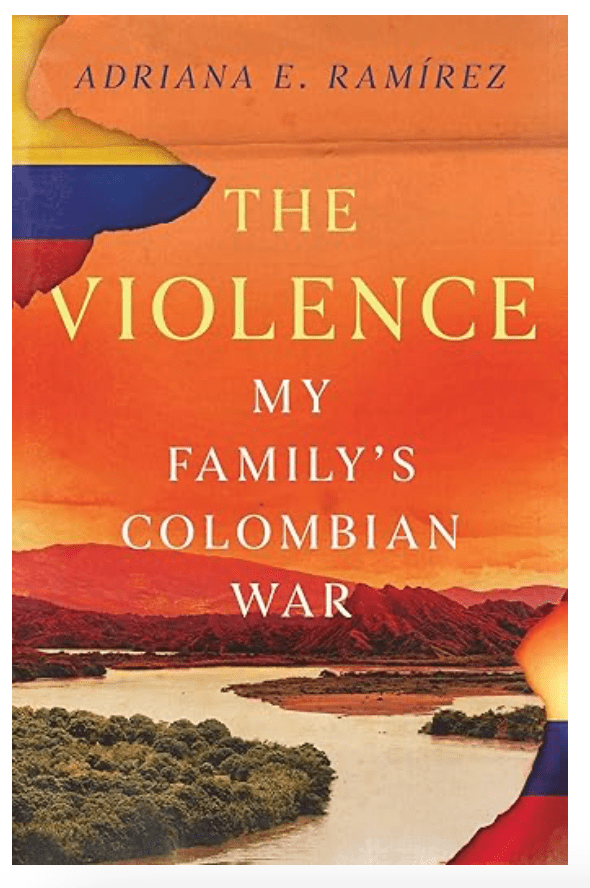
Adriana Ramirez’s, The Violence is a chronicle of Colombia’s descent into decades of civil war of the 1940s and 1950s, through the lens of an intimate, multigenerational tale of upheaval and betrayal. “Neighbor killed neighbors, after years of potlicks worn shot glasses, and dominoes on shaded terraces” Ramirez writes. President-elect Jorge Eliécer Gaitán, champion of the working class and harbinger of a new era of progressive social change, is assassinated on the eve of Colombia’s 1948 presidential election, the capital is plunged into bloodshed. Gaitán’s assassination unleashed a bloodletting across the city , as Liberals blamed the CIA and the police blamed agitators. The diplomats fled. By the end of the day, as many as 3, 000 people were dead. In the hills of Santander, three days by road from Bogotá, Esther Sarmiento head about the rioting on the radio. She switched it off to prevent her family from finding out the new for as long as possible, because she knew what was coming. The Sarmientos were landowners, prosperous but not rich, who had worked the land in that part of north-east Colombia since the 1600s. They were also Liberals, one side of an oligarchy that both contested and controlled power with the Conservatives.
Across the country Conserative landowners started arming their workers, and warning that the Liberals were taking the side of the Communists. On Sundays in the local town, Conservatives would go to mass early, Liberals at 11am. Rich Liberals took reguge in cities. Eventually, the violence arrived, first the manager of one of their farms was killed. Then Esther’s childhood best friend the girl whose hair she had braided for years, disappeared and was later found dead. Esther took to wearing all her jewellery to bed, in case they had to flee in the night. One of the her brothers fell for a girl from a neighbouring town, only to discover she was the daughter of the Conservative mayor. Their romance prohibited, in a drunken fit he put dynamite under her family car to scare the father. But when it exploded, the mother was killed. With a target now on their backs, the Sarmientos fled Santander for the country’s relatively peaceful Caribbean coast.
Ramirez explains vividly how the powerful forces unleashed by the war that opened the way for armed groups that still control large parts of Colombia.
To push Liberals off their land, the Conservatives developed armed groups that were the forerunners of the paramilitaries of the 1980s-90s. They practised ritualised, fetishistic modes of violence on their victims, slicing up body parts for public display. One was called the Colombian Necktie, where the tongue is pulled through a slit in the throat- “a mockery of the long ties worn by Liberal oligarchs on Sunday”.
The Liberals also had their own self-defence forces, some of which were steeped in leftist radicalism and eventually became the Farc, the guerrilla group that controlled an area of Colombia larger than Massachusetts for five decades, surviving through extortion, kidnapping and drugs. A war that started between two branches of old oligarchy spawned a revolutionary moment that tried to bring down the Colombian state, which allowed Colombia’s drug gangs to prosper from the 1980s.
Ramirez writes “ This is what happens, my grandmother noted to me once, when the bullets are in charge”.
So begins a singularly brutal period of Colombia’s history known simply as la violencia- a bloody civil war that spawned decades of turmoil and splintered the country into ever-shifting factions.
The Violence is the intimate history of this conflict- told not from the political centre of war but from the mountainous finca that Adriana E. Ramirez’s family tended to for generations, and through the eyes of her formidable grandmother, Esther, whom she describes as keeping “a blade on her tongue, sharpened and meant to draw blood”.The Violence is expertly done, with illuminating detail mined from her research and delivered with the lightest of touches. Filled with startling lyricism, Ramirez illuminates the spectre of violence – from guerrilla warfare to the brutalities found so often in romantic relationships to the spontaneous and senseless violence steeped into everyday Colombian life during this period, and the threat that it poses to a country and a family, that is trying to stay whole. Gracefully braiding together microhistory, family history, and personal narrative, Adriana E. Ramirez traces these parallel stories of upheaval in a sweeping portrait of a country and family in flux.
The story starts at a moment of hope, on April 8, 1948, the capital Bogotá, was packed with diplomats for the launch of the Organisation of American States- the Western hemisphere’s contribution to the new postwar order.
The city was on edge, riven by labour unrest and a flood of poor migrants to new slums, the one man who could prevent an explosion was Jorge Eliécer Gaitán, leader of the opposition liberal party who was expected to win the presidency in 1950.
The Violence: My Family’s Colombian War by Adriana E Ramirez, Scriber $30, 336 pages.

