
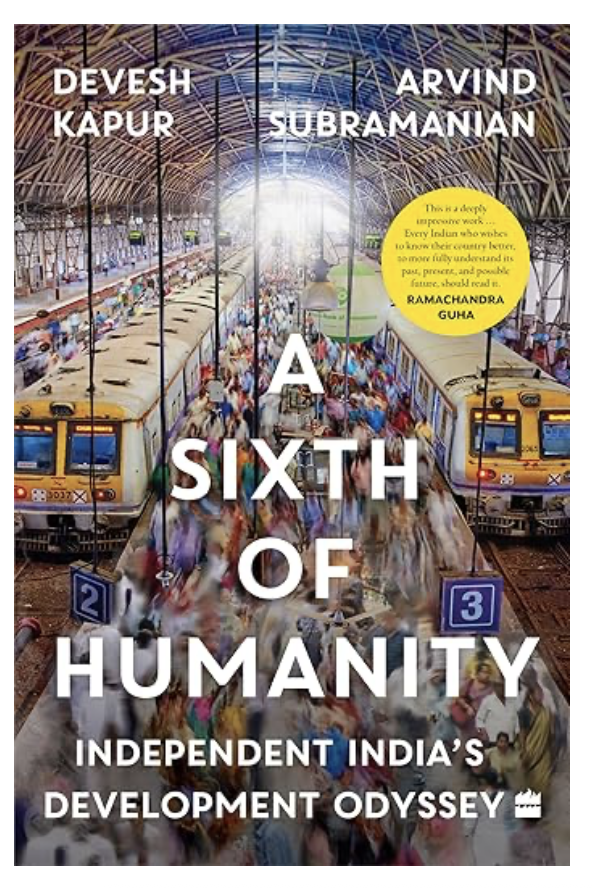
Arvind Subramanian, a former chief economic adviser to the Indian government, and Devesh Kapur, a professor at John Hopkins University, provides a definitive guide to India’s 75-year development odyssey and dramatic growth. Democracy took root upon its independence in 1947, before significant development, social change and nation-building efforts. India’s development path skewed towards high-skilled service jobs, while a majority remain in fragile informal work.
The authors compare relatively successful states such as Kerala with those that have struggled, including West Bengal and Punjab. They reveal diagnosis of a country that has achieved impressive growth while struggling to translate it into broad-based prosperity. India’s journey has been distinctively precocious in comparative terms, a country which promoted high-skilled services before and over low-skilled manufacturing and chose a globalization that favoured exports of talented people and short-changed the poor. The socialist state became an inefficiently capitalist one before providing the public goods of physical infrastructure and human capital resulting with the country achieving success in creating and sustaining democracy, albeit flawed, and maintaining a modicum of order.
Four decades of economic dynamism and the emergence of a somewhat more capable Indian state has meant that it is able to build infrastructure and deliver the essentials of life to its population at scale-still not without disappointments, but a massive improvement over the past. Just as India’s aspiration has lifted to building world-class statutes, temples, bullet trains, airports and digital systems, the undermining of some of the real achievements of democracy, federalism and nation-building stand in the way.
A Sixth of Humanity, an unfinished and deeply consequential for the world, is an attempt to trace how one of the largest and most diverse countries in the world, uniquely and daringly attempted four concurrent transformations-building a state, creating an economy, changing society and forging a sense of nationhood-under conditions of universal suffrage. In illuminating the structural tensions that define India’s past and present, both authors provide one of the most comprehensive analyses of the country’s development journey to date, which often shape outsiders view of India’s meteoric rise.
A Sixth of Humanity: Independent India’s Development Odyssey by Arvind Subramanian and Professor Devesh Kapur, Harper Collins India, Rs 1, 299, 760 pages.
 The neptune Herald
Leave a comment