
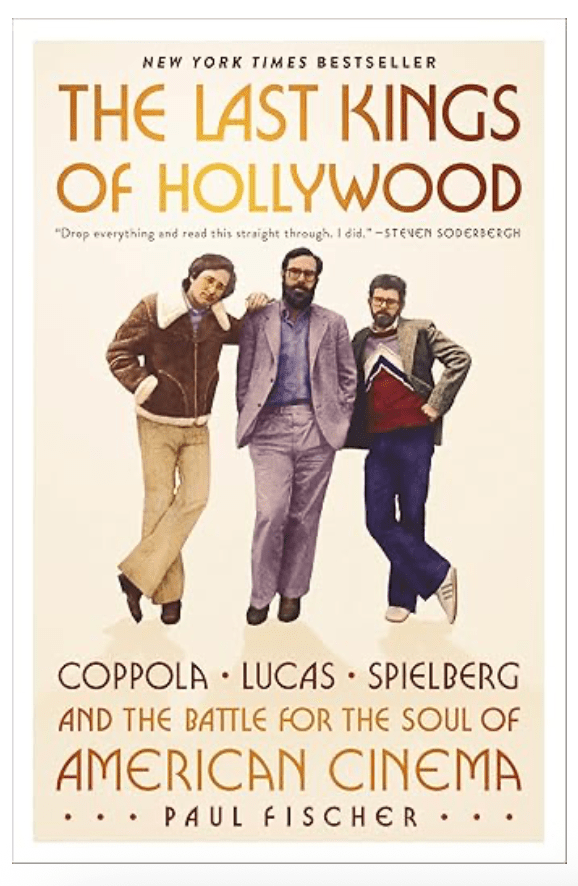
The Last Kings of Hollywood is the untold, intimate story of how three young visionaries – Francis Ford Coppola, George Lucas, and Steven Spielberg – revolutionised American cinema, creating the most iconic films in history while risking everything, redefining friendship, and shaping Hollywood as we know it.
In the summer of 1967, as the old Hollywood studio system was dying an intense, uncompromising young film school graduate named George Lucas walked onto the Warner Bros backlot for his first day working as an assistant to another up-and-coming, largely-unknown filmmaker, a boisterous father of two called Francis Ford Coppola. At the exact same time, across town on the Universal Studios lot, a film-obsessed twenty-year-old from a periodic Jewish family, Steven Spielberg longed to break free from his apprenticeship for the struggling studio and become a film director on his own right.
Within a year, the three men would become friends, Spielberg, prioritizing security, got his seven-year contract directing television. Lucas and Coppola, hungry for independence, left Hollywood for San Francisco to found an alternative studio, American Zoetrope, and make films without answering to corporate capitalism.
Paul Fischer, in The Last Kings of Hollywood tells the thrilling, dramatic inside story of how, over the next fifteen years, the three filmmakers rivalled and supported each other, fell out and reconciled, and struggled to reinvent popular American cinema after doing an extensive research and hundreds of original interviews with the inner circle of these Hollywood icons. Coppola directed The Godfather, then the highest-grossing film of all-time, until Spielberg surpassed it with Jaws – whose record Lucas broke with Star Wars, which Spielberg surpassed again with E.T. By the early 1980s, they were the richest, best-known filmmakers in the world, each with an empire of their own.
The Last Kings of Hollywood is an unprecedented chronicle of their rise, their dreams, and demons, their triumphs and their failures – intimate, extraordinary, and supremely entertaining.
Warner Bros, proudest of all film studios, has just been sold to seeming smaller fry, Seven Arts, The whole American movie business teeters. Timing is critical, as the book starts in 1967 but is published now as Warners changes hands again, bought by another apparent inferior, Paramount, amid industry gloom at AI.
Fischer’s brilliant idea to spotlight the ongoing relevance of Francis Ford Coppola, Steven Spielberg and George Lucas – titan directors of movies that changed movies themselves. Fischer gives voice to the young Spielberg’s revelation: “Directors weren’t scared of the unknown. They led you into it.”
In the 1970s Hollywood in crisis shares the page with something more interior. Wrestling with is Mafia epic, Coppola finds a key idea in the thick of Mario Puzo’s source bestseller: three disparate heirs to one throne.
Coppola the “fat kid” overshadowed by a thwarted father and magnetic older brother; Lucas all American but socially awkward; Spielberg the bullied Jewish boy, stranded in the suburbs.
Aside from the films that changed cinema, we also encounter ones never made. The idea of Spielberg planning a 1969 sex comedy based on Snow White is deeply weird. Filmmakers of such status, in the permissive ‘70s were phobic about sex scenes.
The Last Kings of Hollywood: Coppola, Lucas, Spielberg – and the Battle for the Soul of American Cinema by Paul Fischer, Faber £22, 480 pages.
 The neptune Herald
Leave a comment