
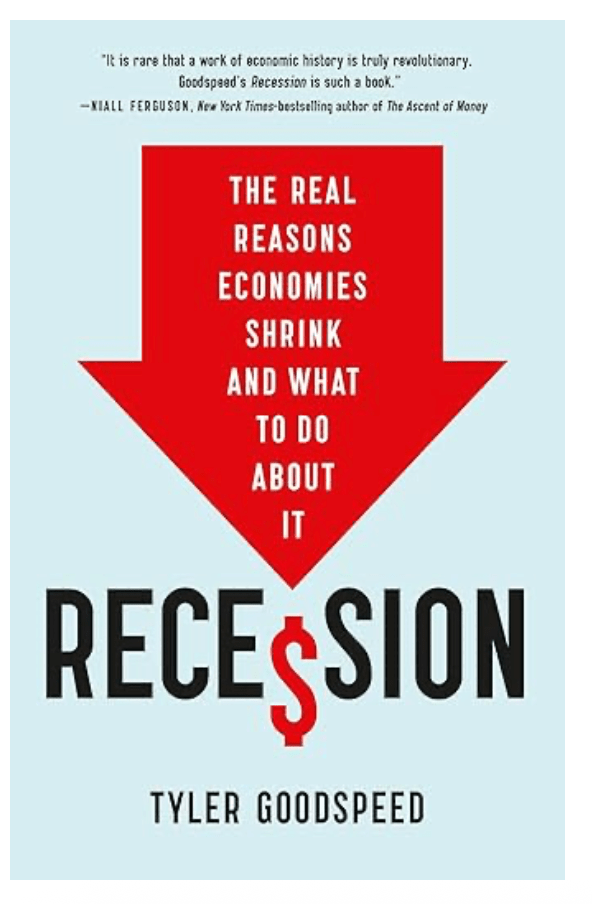
Tyler Beck Goodspeed, a top economist, analyses economic contradictions over the last four centuries, explains why recessions start, how long they last, and how to avoid them in the first place. Do recessions end on their own, or do they require external intervention? Does a recession in one country mean the rest of the world will follow?
Are we in recession now?
Contrary to popular perception, recessions are not the inevitable bust that follows an unsustainable boom, and they do not operate like wildfires that clear out economic deadwood. Recessions are caused by adverse shocks like war and energy price spikes, and far from unleashing gales of creative destruction, post-recession economic growth typically resumes the same trend as before- all pain, no gain. While recessions have become less frequent over time, decisions made by businesses and governments can prolong recessions and Goodspeed offers guidance to avoid making recessions worse. Issuing an important corrective to economic thinking. Recession is essential reading for high-level policymakers and armchair economists.
The former acting chair of the US Council of Economic Advisers during the first Trump Administration and current chief economist of oil group ExxonMobil uses a mixture of history and empirical analysis to reveal recessions are events with a single cause. The Us economy was already in recession when Lehman Brothers went down in 2008. By his telling, “recession are caused by an often rather random, even improbable, interaction of overlapping and interacting factors”, including locust swarms, energy shocks and credit crunches.
Our best leading indicators don’t indicate much, Goodspeed writes, a new record for the tallest building in the world does not mean a crash is around the corner. Recessions are economic comeuppance for greed-fuelled booms. Once they start, their depth is unrelated to the height of the preceding expansion.
Goodspeed explores the idea that recessions do some good, by clearing out inefficient companies and real-locating resources to those that would use them better. He concludes that although creative destruction is an extremely important force in economic growth, recessions are more likely to gum it up, freezing labour markets while crushing high potential companies in their infancy. Governments becoming more robust when it comes to fighting downturns, recessions, in Britain and America have not become shorter. Post-war recession in the UK lasted 1.6 years, not different to pre-war average of 1.5 years, in the US the comparable figures are 1.2 years and 1.4 years.
Though recessions aren’t the result of expansions that die of old age, they can be the consequence of murders. He highlights to prolific serial killers happen to be the ones currently stalking the global economy: energy shocks and wars. Recessions are also ageist, as younger businesses tend to hit hardest by shrivelling credit.
Recession: The Real Reasons Economies Shrink and What to Do About it by Tyler Goodspeed, Basic Books £25/ Basic Venture $18.99, 320 pages.📃
 The neptune Herald
Leave a comment