
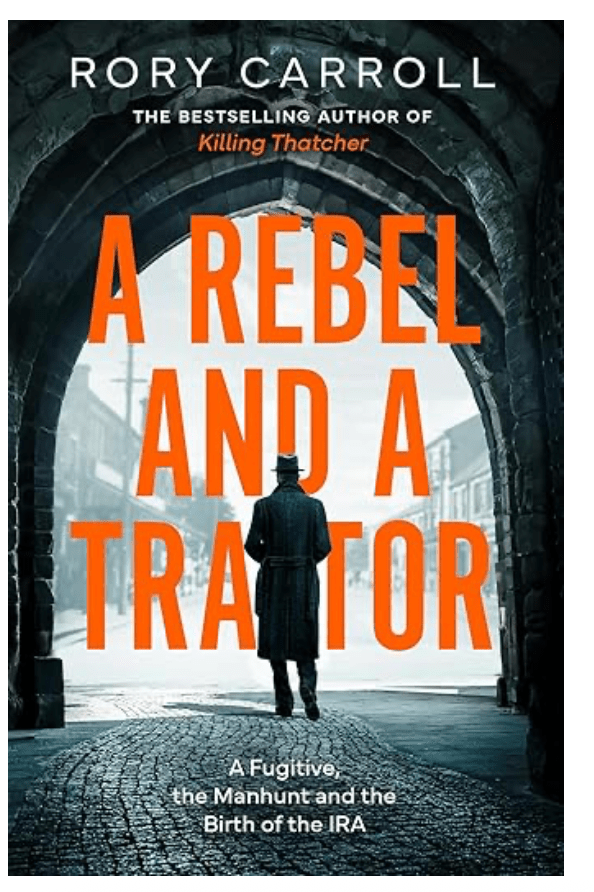
A Rebel and a Traitor is the story of a rogue consul, Sir Roger Casement, a decorated diplomat who turned his back on the British empire and instead joined the rising Irish cause and sought to forge a new nation in the middle of a war- and the mercurial spy chief who sought to destroy him by any means. The manhunt for Casement led by intelligence officer Reginald Blinker Hall, the legendary British spy chief who pioneered codebreaking early mass surveillance and media manipulation. As he did for the critically acclaimed Killing Thatcher, master storyteller Rory Carroll has scanned diaries, letters, police reports, memoirs, court transcripts, secret service archives and declassified government files in the US, Britain, Ireland and Germany to create a page-turning history, and a story that still echoes through Anglo-Irish relations. A Rebel and a Traitor raises profound questions about honour, courage and the price of patriotism.
Roger Casement wrote from Pentonville Prison, in a farewell letter to a friend, “It was only a shadow they tried on 26 June; the real man was gone.” He was facing the hangman, convicted of high treason for his part in Ireland’s Easter Rising of 1916 after he was arrested trying to rendezvous with a German arms vessel in Tralee Bay.
His case caused a sensation in wartime Britain: a former Imperial consul in Africa and South America, knighted for his humanitarian work, consorting with the enemy and attempting to foment treason among Irish POWs in Germany. Dark rumours swirled about his private life, and whispers of his taste for “unnatural vices” circulated in diplomatic and society networks. On August 3 1916 Casement attended early Mass in the prison chapel and received his first communion. Afterwards he calmly walked to the executioner’s cell, his arms pinioned behind his back and died bravely. His statue stands over Dublin Bay and the books about him would fill many shelves.
Casement the son of an adventuring Anglo-Irish British Army officer, and his life was full of contradictions, Notionally Anglican, he had secret Catholic baptism as a child and returned to the Catholic Church in his final days. He had a peripatetic childhood, mirrored in his adult life as he moved from lodging house to hotel to friends’ homes- dangerously, it turned out, leaving personal belongings and diaries along the way- while retaining a deep connection with his Ulster roots. As consul he represented the British Empire, although he grew to despise imperialism, identifying the indigenous people suffering under the depredations of the rubber trade with his fellow, Irish people chafing under the British yoke. He was an active convert, homosexual, whose diaries recorded his enthusiasms and his encounters with frank relish. He was arrested trying to bring German guns into Ireland, yet declined a Mauser pistol for personal protection as the mission went wrong, declaring: “I have never killed anything in life.”
He remained outside the secret society the Irish Republican Brotherhood’s secret military council planning the rising. Although he trusted everyone, but through the long pre-rising conspiracy between Ireland, the US and Germany, no one quite trusted him.
Carroll explains Casement’s earlier life and opens is account in 1914, as the conspiracy to stage a rebellion against British rule gathered pace. As Casement went back and forth across the Atlantic and the North Sea, he was being tracked by Sir Reginald Blinker Hall, the Admiralty director of naval intelligence.
From Room 40, Hall and his team secretly worked to decrypt thousands of German communications, critical to the overall war effort and to Britain’s understanding of what was being planned in Ireland. Carroll entwines the stories-hunted the Hunter- in a pacy, effective narrative, culminating in a thrilling interrogation at Scotland Yard.
On Easter Sunday 1916, Casement offered to make a public appeal to call off the rising, for there was one aspect his hunters had not realised. Casement had lost faith entirely in the rebellion and was returning to Ireland to try to stop it. Sent to Germany in 1914 top win the Reich’s support, his mission failed: without troops or a sizeable cache of weapons.
A Rebel and a Traitor: A Fugitive. The Manhunt and the Birth of the IRA by Rory Carroll, Mudlark £22, 416 pages.
 The neptune Herald
Leave a comment