
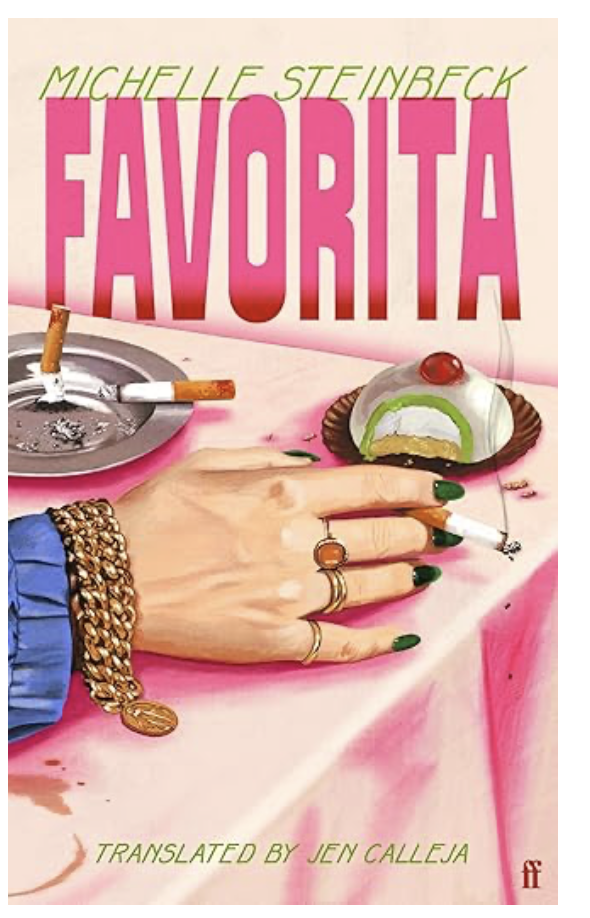
Fila, a protagonist of Michelle Steinbeck’s Favorita, receives an anonymous phone call from Italy telling her that her mother Magdalena is dead, her instinctive feeling is one of relief. Fila hasn’t seen her in years, not since she disgraced their family by advertising her brothel in the newspaper. Fila is already unmoored by the recent death of her grandmother Lavinia, who raised her. In Lavinia’s kitchen in Switzerland Fila now sits, listening to the voice on the “mortadella-coloured rotary telephone” that says “they say it’s because of her liver, but I can assure you that it was not her liver… I’m sorry, your mother was murdered.”
Fila struggles to remember her mother, an imposing figure who travelled the world with a series of partners, occasionally coming home bruised and inebriated to pinch Fila’s cheeks and argue with Lavinia. The arguments culminated in one last blow out after Magdalena advertised her latest business venture -a brothel- on the front page of local newspaper.
Fila collects her mother’s ashes and sets out, urn in two, to retrace the whirlwind life of the woman last known as Favorita.
Part hallucinatory road trip, part feminist revenge fantasy: Favorita is a wild, furious and mischievous novel from an incendiary new European talent.
Steinbeck enjoys playing with absurd and fantastical elements. Fila determines to visit the hospital where her mother died. Hallucinations begin: when visiting a museum, Roman statues come alive, sneering at Fila, the empress Agrippina taunting her: “You both knew that she was in danger, and what you did you do about? You pushed her out, you expelled her, again and again you sent her to her death.” By the time Fila reaches the hospital, her relief has been replaced with guilt and regret.
Fila, bleary from distress and travelling, complains that “waking up is like fighting my way out of hot sweet jelly”, while her mounting anxiety is “a stick of candy floss” twirling in her stomach. Suspicious of the staff at the hospital, Fila seeks out the local “Street of Women”. There she meets Sorella and Crocifissa, who worked for Magdalena, and believe she was killed by her own husband. In their eyes, Magdalena’s murder fits into a centuries-long pattern of brutality by men against women. The introduce Fila to the women’s only fortress built out of an abandoned Salami factory, where they are creating an “Archive of Murdered Women” and preparing for a female-led revolution. Steinbeck reveals the exploration of a grim reality- that entire societies, steeped in misogynistic violence, may facilitate the deaths and disappearances of countless women- with more hallucinatory episodes. When the police raid Sorella and Crocifissa’s sanctuary, Fila escapes in a homemade rocket crafted by women, triggering a journey to a country house where a secret fascist society meets, in a village still haunted by the cold case of a girl, Sisina, who was raped and murdered. A Fila’s rage settles, and she decides to avenge her mother’s carefully obscured murder, she becomes obsessed with this other older killing.
Favorita by Michelle Steinbeck, translated by Jen Calleja, Faber £16.99, 448 pages.
 The neptune Herald
Leave a comment