
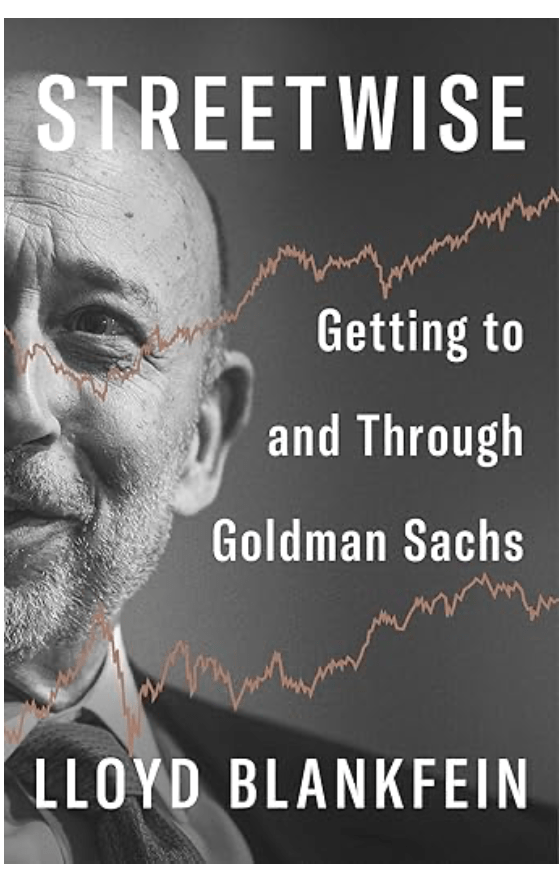
Lloyd Blankfein, head of an institution legendary for its culture of success writes a candid memoir of global leadership in an age of extreme turbulence. Blankfein is quiet scary smart about people, markets, and life generally, as his 10, 000 Small Businesses idea proved to be a huge winner. During the 2008-2009 financial crisis, Lloyd acted decisively and he tells the story of what happened with unique insights. When Blankfein was attacked as a Wall Street fat cat, he had to smile, thinking of his precarious childhood in the notorious public housing projects of East New York, Brooklyn, and attending a school so chaotic he didn’t feel safe leaving class to go the bathroom in his time there. Harvard University was a total moonshot, and his outsider status never wore off, there or at Harvard Law. When he struck people as street, it wasn’t Wall Street they were thinking of. But if chip never quite left Blankfein’s shoulder, neither did a wry, resilient spirit and a lucid, democratic intelligence that saw through airs and found talent and ideas in unlikely places.
Streetwise is honest, sharp and often very funny reckoning with the author’s education- in finance, human nature, and the workings of the world. It abounds with lessons about leading teams of brilliant, aggressive, competitive people and harmonizing them around shared goals, changing when times are hard and when they’re good, managing risk, and knowing a crisis is at hand before it swamps you so you can guide your team to to the further shore. Blankfein is famed for his calm, hand on Goldman Sachs’s tiller during the global financial crisis, and that story is told in full here, among many other decisive episodes.
Suffusing Streetwise is the author’s deep and abiding respect for the partnership culture of Goldman Sachs. We follower the never-ending work to protect and preserve that culture through all sorts of turnout- the challenge behind every other challenge. He is however, open about when he and the firm got it wrong, which was often enough, but the creative, risk-taking spirit was never snuffed -even as the fail-safes put in place to protect the firm and its clients held when they were needed the most. A Powerful blueprint of the wise stewardship of a cause that is larger than yourself, Streetwise will inspire and inform readers throughout the global business community and beyond.
Blankfein was neither one of those clever, self-assured corporate bankers that Goldman mints, nor was he an in-your-face sales guy. Blankfein writes “I was not, and am not, a naturally deferential person”. He ascended Goldman to lead the bank through the global financial crisis and its reputational fall from being the most admired and envied Wall Street partnership, a long way for the boy from a Brooklyn public housing project, and a long way down for Goldman. Blankfein writes, “ Almost two decades later, we are living in a world that the crisis made- an era of intense polarization, distrust of institutions and authority, rising inequality, class conflict, populist movements, and authoritarian government. I would love to have the perspective of a remote observer and recorder of events. Unfortunately, I was right in the middle of it”.
He does not feel too sorry to have been present when Goldman’s near-collapse in the bond turmoil of 1994, to being in its office near Wall Street as aircraft hit the World Trade Centre in 2001, to fighting to defend as conduct after the financial crisis. Blankfein writes “ Crisis decision-making might be unpleasant, but It’s not a hard choice between survival and ruin”.
The rise of the private equity and technology billionaires has since taken some of the heat off Goldman. “ I live in an apartment building with many hedge fund managers, and I was amazed that I could have more enemies than they did” he writes for those days.
Streetwise is a story of culture and leadership, an explanation of how Goldman became such a powerful force by blending individual ambitions with collective purpose. Blankfein, the son of a clerk in the US post office, did not have an elite upbringing. Descended from Yiddish-speaking Jews who grew up in a shtetl in Russia (now Poland), his family lived on the fourth floor of a 14-storey tower in East New York. When he made it to Harvard from his rough Brooklyn school, he found its privileged world “unbridgeably distant”.
“Goldman is a competitive place with very competitive people. But it has always had a “we” culture rather than “I” culture, he writes. After Goldman went public in 1999 and the partners got wealthier (his stake was worth $168m), which lowered people’s thresholds for annoyance and their tolerance for the parts of their jobs they didn’t like”.
This was the bank that barrelled into the 2008 crisis, coming out better than others financially, but with a reputation as the “vampire squid” of Wall Street, which exploited competitiors and clients to make more money for itself. Goldman emerged from that scandal-prone era and its market value has more than doubled in the past two years under David Solomon, his successor as chief executive.
Streetwise: Getting To and Through Goldman Sachs by Lloyd Blankfein, Orion Ignite £25/ Penguin Press $35, 400 pages.
 The neptune Herald
Leave a comment