
Jeremy Grantham entered the investment business in the ’60s, when he brought the thrifty Quaker values and Yorkshire Independence he had been raised with. While other money managers were focused on blue chip stocks, he studied the stock market history and constructed by hand the first indices for small-cap and value stocks. Charting their ebb and flow, he could see clearly the powerful force that would become central to his investment philosophy: mean reversion, “the heartbreaking principle that good times always revert back to more boring, more ordinary times.”
In the early ’70s Grantham was a pioneer of index investing. Soon after, he co-founded GMO and spent the firm’s early earnings on a hard drive the size of an industrial washing machine, becoming the first firm to use a computer for investment analysis. The quantitative style went on to take over the industry. In the late ninetys Grantham acquired notoriety as a “permabear” for refusing to buy into the dotcom mania. Clients left in droves- one called him “ dangerously persuasive and totally wrong”- but he was vindicated when the bubble burst in 2000. Yet while his wealth grew, so did his alarm at the disastrous consequences of short-term thinking not just for investors but for the very future of the planet, and he was directed nearly all his wealth to environmental protection.
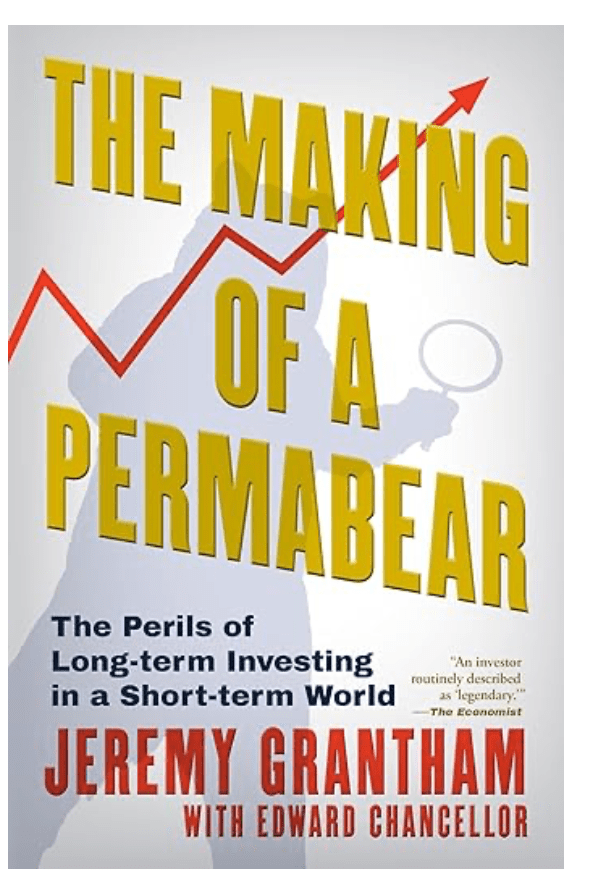
The Making Of A Premabear is written with his former colleague, the bestselling financial historian Edward Chancellor covering six decades of contrarian investment decisions.
Jeremy Grantham using his regular investment letters since Nineteen ninety nine, as well as interviews, to get his views across. That equanimity on saying when to buy as well as exit Japan and the US internet bubble, has endeared him to legions of readers.
Grantham admits that at school, fellow students named him “Gasbag” for his blabbing Speaking out of turn propelled him forward at the right moments, leading him after an economics degree at Sheffield University into a job at Royal Dutch Shell.
At the oil producer in the early ‘60s. he circulated his research note arguing that the US should be a coal-based economy given its huge reserves. “It created a bit of a stir”, and marked him down as either a “nitwit or a troublemaker”.
That attitude only led to his success at Harvard Business School in the early ‘60s. Settling in Boston, he helped start two fund management companies, Batterymarch Financial Management in sixty nine and Grantham, Mayo, Van Otterloo (GMO), just eight years later.
Grantham guides the reader through booms and busts over six decades, more self-congratulatory moments follow. While working as an analyst at Batterymarch after the first Opec oil shock in the early ’70s, he strongly recommended his colleagues and clients buy the cheap end of the stock market, which were small capitalisation companies forgotten in the “Nifty Fifty” bull run for America’s largest blue chip corporations during the ’60s into the ‘70s. These smaller stock outranked the larger cap S&P 500 index until ‘83, which won his accolades. He with his colleague Dick Mayo and a friend Eijk Van Otterloo, chose to break away to start GMO in ’77, whose success followed his break with Batterymarch made Grantham and his colleagues very wealthy. He also helped to pop a couple of market bubbles, in Japan and later the US internet boom. His repearted warnings about market crashes for Japan and at the end of the ninetys the internet stock craze seared him with his brand. Clients left in droves during the latter time, sorely testing GMO and Grantham when almost half of its client funds flowed out.
The book has an entire chapter to Grantham’s vindication at the start of the new millennium. He threw scorn on the then Fed chair Alan Greenspan and sell-side strategists such as Abby Cohen of Goldman Sachs for abetting the mania. It is clear that Grantham and his colleagues won a lot of respect from asset owners after anticipating both the Japanese and US stock market collapses that followed. According to Grantham GMO attracted serious approaches from buyers, including a bid from Banque Nationale de Paris in 2002. The proposal went to warrant a contentious meeting with junior partners who objected to GMO’s potential growth made any sale a bad one. The deal died and that prove the right decision. GMO’s assets under management rose form $20bn in 2002 to $165bn less than five years later.
Valuations can get out of whack and eventually regress towards long-term averages. Grantham’s earliest stock picking and hunting down the financial and macroeconomic data that rivals lacked or missed. His intellectual curiosity, and a willingness to be proven wrong, led to his developing new products for GMO, including some of the earliest quantitative funds in seventy nine, and later an asset allocation product.
Investors always prefer good news, he says, and perhaps he’s a made a decent living delivering bad news.
The Making of a Permabear: The Perils of Long-Term Investing in a Short-Term World by Jeremy Grantham with Edward Chancellor, Grove £25/$30, 416 pages.

 The neptune Herald
Leave a comment