

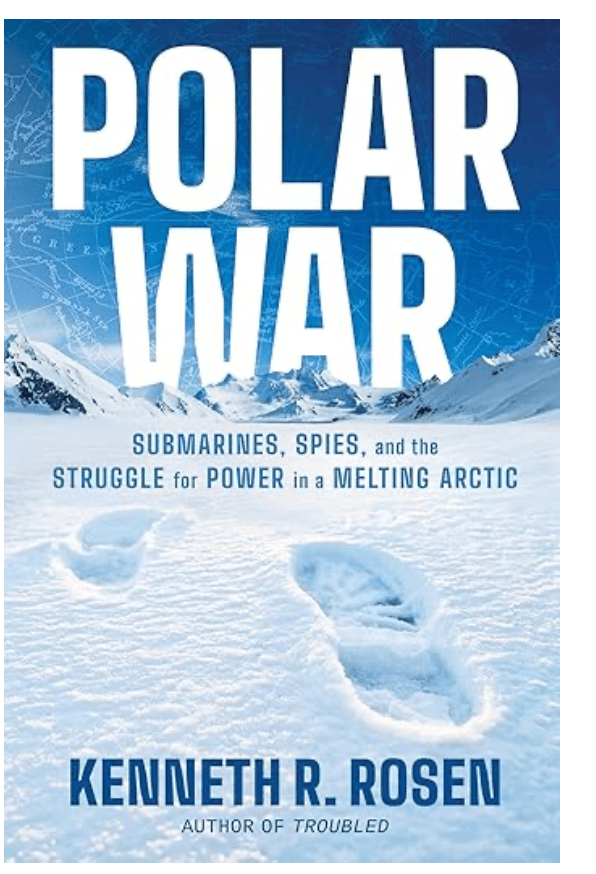
Artic cold war amid melting ice paving way for military led land-grabs for resources. Kenneth R Rosen, in Polar War reveals how climate change, military ambition, and economic opportunity are transforming the Arctic into the epicentre of a new cold war, where a struggle for dominance between the planet’s great powers heralds the next global conflict. “It has been previous administration’s policy that Greenland should be part of the United States” according to Stephen Miller, the White House deputy chief of staff on January 5. Since then the White House released a statement saying that “the president and his team are discussing a range of options to pursue this important foreign policy goal, and of course utilising the US military is always an option at the commnader-in-chief’s disposal.”
Russian Spies, Nuclear submarines, Sabotaged pipelines, Undersea communications severed in the dark of night. The fastest-warming place on earth- where apartment buildings, hospitals, and homes crumble daily as permafrost melts and villages get washed away by rising seas- the Artic stands at the crossroads of geopolitical ambition and environmental catastrophe. As climate change thaws the northern latitudes, opening once ice-bound shipping lanes and access to natural resources, the world’s military powers are rushing to stake their claims in this increasingly strategic region.
We’ve entered a new cold war- and every day it grows hotter.
Rosen takes readers on an extraordinary journey across the changing face of the far north. He reveals the indigenous community leaders representing the interests of twenty-one countries across four continents, and witnesses first-hand how rising temperatures and growing tensions are reshaping life above and below the Arctic Circle. He finds himself on the trail of Navy SEALS training for arctic warfare, embarks on Coast Guard patrols monitoring Russian incursions, participates in close-quarter-combat training aboard foreign icebreakers in the Arctic sea ice, and visits remote research stations where international cooperation is giving way to espionage and the search for long-frozen biological weapons.
Rosen says “Historically, the American desire to control Greenland has existed nearly as long as America itself, and US leaders were bullish on Greenland’s potential to be an arctic surrogate for national defense. A century later the US sent a nuclear-powered submarine beneath the North Pole. The United States saw its future national security potential in Greenland, which welcomed the USS Nautilus after its journey and briefly housed an underground American research station powered by a portable nuclear reactor”.
The Arctic us about more than minerals and potential war, It’s a part of the world where people live, work and die.
Rosen’s three years of reporting from the frontline of climate change and great power competition, gives us vivid immediacy of a travelogue, capturing the diverse landscapes, people, and conflicted interests that define this complex northern region, with an urgent warning about how the race for the Arctic dominance could spark the next global conflict.
Polar War: Submarines, Spies and the Struggle for power in a Melting Arctic by Kenneth R Rosen, Simon & Schuster $29/ Profile £22, 320 pages.
 The neptune Herald
I hope this book spawns many reviews and articles and maybe a television documentary. It seems it contains information vital to the future for many who may have questions answered – partially at least within these pages.
LikeLike