
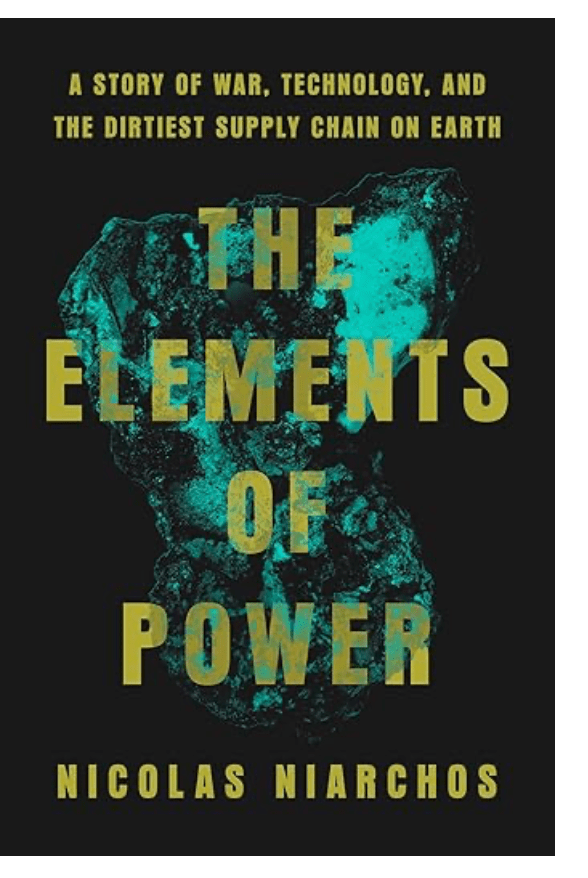
Niarchos in The Elements of Power produces a tale of rapacious colonialism, cold war spy games and extractive capitalism”. Congo the war-torn African country lack basic infrastructure and after many decades of colonial occupation, its people are officially among the poorest in the world. But Congo is rich and hidden beneath the soil are vast quantities of cobalt, lithium, copper, tin, tantalum, tungsten and other treasures essential for the global energy transition- the plan for wealthy nations to wean themselves off fossil fuels by shifting to sustainable forms of energy such as solar and wind. The race to electrify the world’s economy has begun, and China has considerable head start. From Indonesia to South America to Central Africa, Beijing has invested in mines and infrastructure for decades. But the U.S. has begun fighting back with massive investments of its own, as well as sanctions and disruptive tariffs.
In the rush for green energy, the world has become utterly reliant on resources unearthed far away and wilfully blind to the terrible political, environmental, and social consequences of their extraction. If that Democratic Republic of the Congo possesses such riches, why are its children routinely descending deep into treacherous mines to dig with the most rudimentary of tools, or in some cases their bare hands? Why are Indonesia’s seas and skies being polluted in a rush for battery metals? Why is the Western Sahara, a source of phosphates, still being treated like a colony? Who must pay the price for progress?
Niarchos reveals how the scramble to control these materials and their production is overturning the world order, just as the global race to drill for oil shaped the twentieth century. Exploring the advent of the lithium-ion battery and tracing the supply chain for its production, Niarchos tells the story of both of the people driving these tectonic changes and those whose lives are being upended. He reveals the true, devastating consequences of our best intentions and help us prepare for an uncertain future. If you have ever used a smartphone or driven an electric vehicle, you are implicated.
Modern day companies may not be cutting off limns of Congolese as happened during the era of Belgium’s King Leopold II. But in the age of batteries, it is still the Congolese who suffer environmental degradation and back-breaking toil at the wrong end of the global supply chain. Wealthier countries are pursuing supposedly green ambitions from the costs unfolding someplace else, while environmental catastrophe and human rights abuses are being pushed elsewhere. The companies buying, selling and making use of Congo’s minerals from harsh realities on the ground”.
China, through its control of mines, refining and battery technology has come to dominate the 21stcentury’s energy eco-system as the US dominated that of the 20th century.
Once Americans, Japanese and Europeans led in battery science, today companies such as Fujian-based CATL, the world’s biggest producer of lithium-ion batteries, which has 18,000 employees working in its research and development-more battery scientists that in all of Germany writes Niarchos. BYD, the biggest manufacturer of EVs, employed 110,000 researchers reign near supreme. While China’s industrial progress is unstoppable, Exxon sold its battery business in the 1980s – and by “political flip-flopping. According to Niarchos, while the US is betting on technologies of the past, Beijing has already moved to the future. Europe and the UK have also rolled back commitments to accelerate towards net zero, while European industry and the manufacture of EVs. US was much slower to realise the strategic value of Congo’s cobalt, once viewed as an impurity than it was to understand the importance of its uranium. It was fissile material from, the Shinkolobwe uranium mine in Katanga, the province where most of Congo’s cobalt is now found, that was used in the atomic bombs dropped on Hiroshima and Nagasaki. Today, many of Congo’s biggest copper mines, including the giant Tenke Fungurume, once owned by US miner Freeport McMoRan, have been swept up Chinese companies. Niarchos writes “The West is soon going to be as dependent on Chinese batteries as we are now on Middle East oil”.
“The revenge of the miners” companies that were considered anachronistic by many in the 2000s are now roaring back as demand for lithium cobalt, nickel, phosphate, graphite and gold soars. “Mining companies had long been considered dirty, a pollutive anachronism, but, all of a sudden, everyone was realising that they needed people who carved open the earth in search of its riches” Niarchos writes.
Noarchi writes about Francoise Ilunga, the widow of an artisanal miner, hwo is left to bring up her children alone, after her husband is crushed to death in one of the many mining cave-ins. Nitunga Ilunga was wildcat miner known as a creuseur, or digger, who hardly used safety helmets or shoes.
Noarchi also writes of his five-day arrest, along with his Congolese fixer, on the outskirts of Lubumbashi, accused of spying and taken for interrogation to an almost comically decrepit detention centre, where wires sticking out of the walls before being bundled out of the country by plane, after being barred from visiting Congo.
The Elements of Power: A Story of War, Technology and the Dirtiest Supply Chain on Earth by Nicholas Niarchos, William Collins £25/ Penguin Press $32, 480 pages.

 The neptune Herald
Leave a comment