
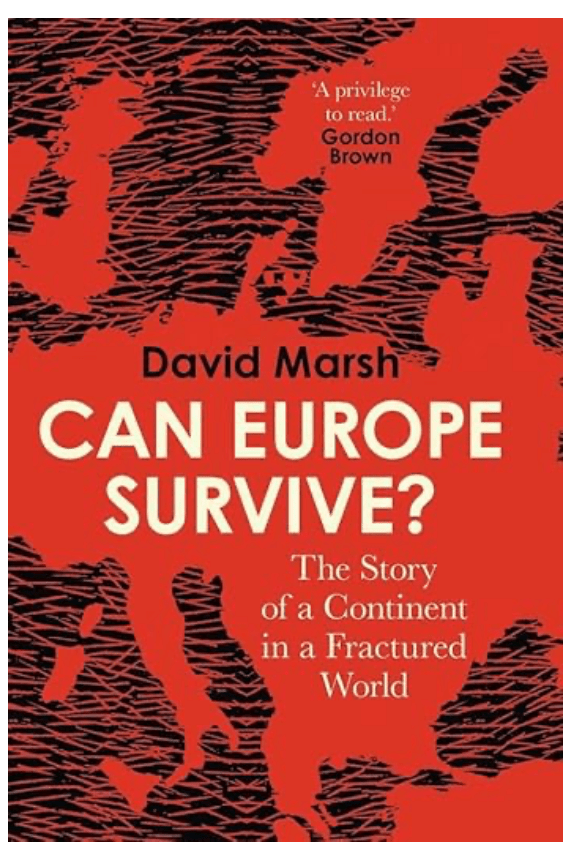
Today, Europe is fast changing, polarised world dominated by Chinese- American rivalry. European Union despite its initial successes after the fall of the Berlin Wall, have failed to implement a strategy for success in the twenty-first century. Britain’s exit from the EU has weakened both sides and Russia’s invasion of Ukraine has thrown these shortcomings into sharp relief. How should states across the continent position themselves in the decades to come? David Marsh investigates Europe’s present crisis, from a march of populism, Franco-German malaise and the breakdown of relations with Putin’s Russia. Fault lines are emerging in the monetary union, while the fight against climatre change has impacted growth. Amid Donald Trump’s America, and their internal crises from immigration to economic stagnation, Europe is struggling to address the “six D’s”: the globalisation, demographics, decarbonisation, defence and debt. David Marsh interviews 260 serving and former officials and analysts , from Condoleezza Rice to Friedrich Merz to come to conclusion Europe can survive.
Although Europe and the US won most of the cold war debates about the supremacy of capitalism over communism, According to Marsh, “Europe has lost many of the new arguments, lost its leadership, and lost its way”. He suggests the transatlantic allies mishandled post-nineteen eighty nine relations with Russia, struggled to address China’s rise and failed to reach agreement on strategic matters such as defence. France and Germany found it difficult to align while the EU mishandled its economic and monetary union. These factors piled up by domestic threats to Europe’s democratic stability and economic prosperity, a side-lined Britain, a semi-reluctant American super-power, and a competitive China.
Marsh recommends revisiting Jacques Delors’ proposal for a Europe of “concentric circles”, reinvigorating the EU;s partnership with the UK, reinforcing ties with the US, cooperating with and constraining China, developing a sustainable energy mix, investing in defence, and fixing the EU’s economic weakness as outline by Mario Draghi’s report.
The current crises could provide an opportunity for growth, and resilience, while Europe’s citizens enjoy a good quality of life, Marsh writes, while resisting the reforms needed for adequate defence and economic growth. The US and China will use divide and rule tactics against a continent lacking unifying spirit and suffering from weak political leadership and low financial strength. Europeans should know what to do and finding the will to do it.Can Europe Survive?: The Story of a Continent in a Fractured World by David Marsh, Yale University Press, £25, 528 pages.

 The neptune Herald
Leave a comment