
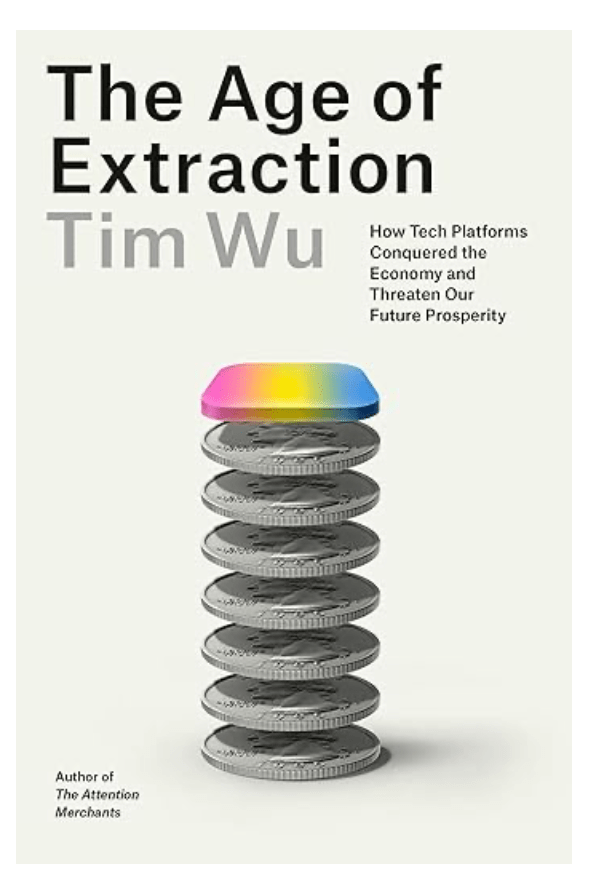
“The magic of Tim Wu’s The Age of Extraction is its simplicity, and breaks down one of the greatest challenges of our age- the unaccountable power of tech platforms, explaining your online life is draining your wallet. Our world is dominated by a handful of tech platforms, who provide great conveniences and entertainment, but also stand as some of the most effective instruments of wealth extraction ever invented, seizing immense amount of money, data, and attention from all of us. An economy driven by digital platforms and AI influence offers the potential to enrich us, and also threatens to marginalize entire industries, widen the wealth gap, and foster a two-class nation. As technology evolves and our markets adapt, can society cultivate a better life for everyone? Is it possible to balance economic growth and egalitarianism, or are we too far gone?
Preeminent scholar and former White House official, Tim Wu, who coined the phrase “net neutrality”- explores the rise of platform power and details the risks and rewards of working in such systems. The Age of Extraction tells us a story of an internet that promised widespread wealth and democracy in the 1990s and 2000s, only to create new economic classes and aid the spread of autocracy instead. Wu explains our current moment with lessons from recent history-from generative AI and predictive social data to the antimonopoly and crypto movements- and envisions a future where consequential proposals for taking back control in order to achieve a better economic balance and prosperity for all.
Wu was President Joe Biden’s special assistant for technology and competition policy as the administration began to attach the power of the digital giants. This record of insight compels all to read The Age of Extraction.
We start back in the 1950s and 1960s, when American antitrust enforcement was much tougher than it became by the 1990s. “Influence by the recent experience of the second world war, American officials believed that fascism and corporate monopoly were linked” Wu writes.
Antitrust enforcement was the chosen means for implementing US industrial policy during these early postwar decades, intervening in markets so that innovative entrants could break in and grow. The 1969 justice department case seeking to break up IBM was a landmark, although the DoJ dropped the case after 13 years, the effect of this long pursuit, Wu says, was explosive growth of companies outside the IBM universe, and hence lasting US dominance of the new software section.
According to Wu “ We are conduction reckless economic experiment that history suggests has rarely gone well. Most dangerous of all, it has a track record of creating conditions conducive to the rise of an authoritarian strongman.”
In the final chapter Wu offers several self-evidently sensible ways to limit and reduce the power of dominant companies. These include tough enforcement of competition policy, but also a wide-ranging neutrality and openness rules for companies that are essential for modern life, enabling countervailing union power, and utility-style regulation of some services. President Emmanuel Macron spoke recently about Europe’s “naivety” in entrusting democracy to foreign social media companies, although the French government seems especially unlikely at the moment to be able to introduce a bold political programme of the kind Wu recommends. While the British government is too eager for inward investment dollars to do anything that might offend the big tech and AI barons.
Wu offers consequential proposals for taking back control in order to achieve a better economic balance and prosperity for all.
The Age of Extraction: How Tech Platforms Conquered the Economy and Threaten Our Future Prosperity by Tim Wu, Bodley Head £25/ Knof $30, 224 pages

 The neptune Herald
Leave a comment