
America was responsible for the existence of nuclear age with the explosion of the first atomic bomb in the New Mexico desert on July 16, 1945. The inauguration of this new era was epitomized by the bomb’s principal creator, J. Robert Oppenheimer, quoting the Bhagavad Gita: “Now I am become death, the destroyer of worlds.” Since then, the era of atom has become the age of the bomb? or two bombs, Atomic and Hydrogen. Three weeks latercame the US nuclear strikes on Hiroshima and Nagasaki, and with them ending of the second world war, triggering the cold war transforming the bomb from an American monopoly into the organising principle of international relations. Global security now tested on a series of paradoxes – Nuclear weapons were both deterrent and provocation, guarantors of national sovereignty and humanity’s greatest threat. Public anxiety pressured governments to regulate testing while fear of destruction drove those governments to expand their arsenals. The prospect of mutual annihilation simultaneously increased and limited adventurism. As the US, and China are now locked in a rivalry whose nuclear dimension is only beginning to take shape, and Iran remains close to a nuclear weapons capability. Fear of nuclear strike has always acted as a self-correcting force, propelling humanity to the brink and pulling us back again.
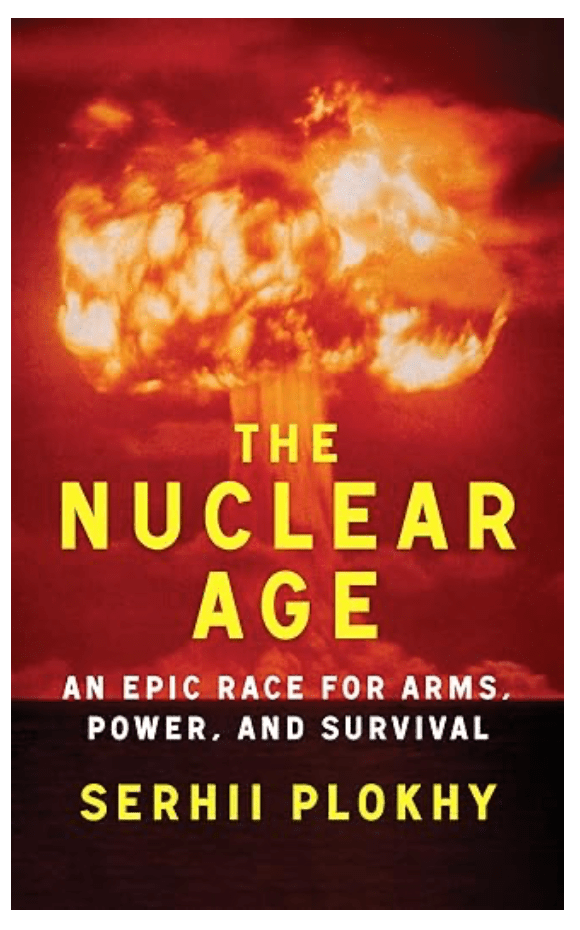
Serhill Plokhy, one of the preeminent Cold War historians and professor of Ukrainian history at Harvard University, explores in The Nuclear Age, why governments have acquired and stockpiled nuclear weapons and reveals the global failure to each meaningful nuclear arms treaties. Plokhy reveals how, since the Cuban missile crisis of 1962, the risk of nuclear war has never been so high: Russia threatens nuclear aggression in its war on Ukraine; China is constructing hundreds of new missiles silos; and India and Pakistan are locked in ongoing nuclear competition. Plokhy also examines how more countries than ever have come within perilous reach of acquiring nuclear arms, while new technologies such as hypersonic missiles and artificial intelligence, make the nuclear landscape increasingly unpredictable.
The Nuclear Age reveals the fear that governs the proliferation of nuclear weapons, from Hiroshima, Nagasaki, and the Castle Bravo test in 1954, to the rapidly developing nuclear programs of North Korea and Iran. Plokhy also profiles the global players who have diagnosed, stoked and influenced this fear, from H. G. Wells to Nikita Khrushchev and Vladimir Putin, and outlines what we might learn from our past to control today’s arms race. As the danger of nuclear war remains imminent, The Nuclear Age diagnoses our era of rearmament.
For almost 80 years nuclear weapons technology has defined the outer limits of both human endeavour and human folly, as governments and publics alike have lived with the knowledge that almost all life on Earth can now be ended in an afternoon.
Plokhy writes, from his authoritative 2018 account of the Russo-Ukraine war to Chernobyl: History of a Tragedy that became a successful HBO series. The fear of nuclear attack by another state or of superior conventional forces possessed by an adversary – that is the most common reason states acquire nukes.
Plokhy writes now “in a more dangerous situation today than we have been since the Cuban Missile Crisis”. He believes the return of nuclear confrontation makes subject newly pressing and moral dimension – especially fear – that drives nations to seek the bomb.
The fear that surrounds it acts a self-correcting force, propelling humanity to the brink and back again. Once Soviet development of a secure, second strike capability (a state’s assured ability to launch a nuclear retaliation even after absorbing a full-scale nuclear attack, had neutered the US security guarantee, a French bomb was probably inevitable. But Sweden and other states facing the same threat refrained. As Charles De Gaulle told Dwight Eisenhower in 1959, a France without global responsibility was “unworthy of herself, especially in the eyes of Frenchmen” and she would therefore “provide herself with an atomic armament.” Paris needed nuclear weapons not just to respond to Moscow, but as a symbol of its self-perceived global status.
Fear of a Nazi bomb drove the Manhattan Project and then sustained the Soviet push to match it. The UK pursued the bomb in dread of the Soviet threat and with waning faith in US guarantees, China sought it in response to the risk of American attack during the Korean war and Taiwan Strait crisis, Israel built its secret programme to counter Arab hostility; the 1965 Indo-Pakistan war convinces Pakistan’s Zulfikar Ali Bhutto, Islamabad would need to respond in kind, whatever the cost: “We will eat grass” Bhutto said, “But we will get one of our own.” India’s subsequent 1974 nuclear test prompted Bhutto to formally launch Pakistan’s nuclear weapons programme.
The Nuclear Age: An Epic Race for Arms, Power and Survival by Serhii Plokhy, Allen Lane £30/ WW Norton & Co $32, 432 pages.

 The neptune Herald
Leave a comment