
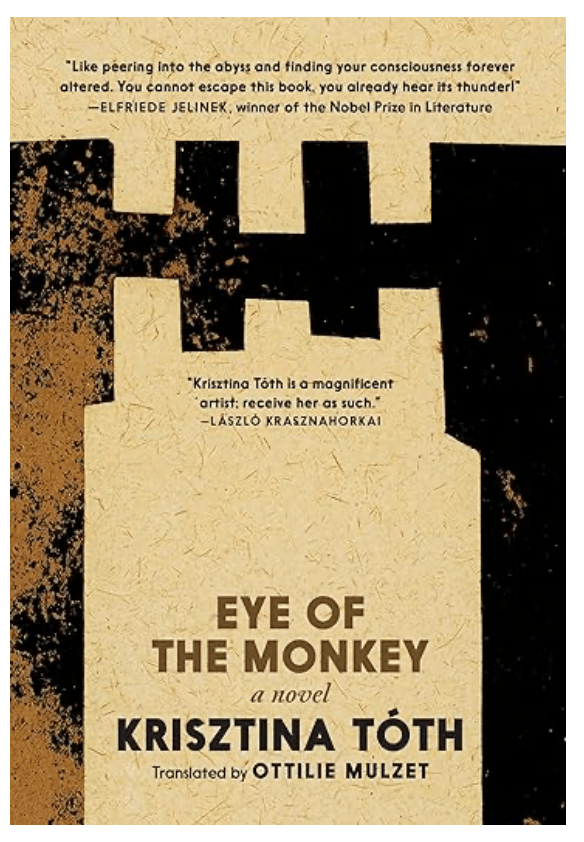
Award winning Hungarian author Krisztina Tóth’s new novel, Eye of the Monkey, is a delicate tale of human in crisis, a dark humor animate, set in an unnamed dystopian country amid a devastating civil war that led to the formation of the United Regency, an autocry . The ravages of war are sweeping, and the populace has been divided into segregated zones, where the well-off are under mass surveillance and the poor are phantom presences, confined and ghettoize. . In 1970 an experiment which resulted in the first successful simian head transplant. “The monkey seemed to sense its surroundings, its gaze conveying near human feeling” according to the narrator. The suffering being inflicted upon the creature and the suffering from within -the monkey’s awareness of the horror of its situation, of displacement, disembodiment and alienation. On the verge of a nervous breakdown after being followed by a young man for weeks, Giselle, a history professor at the New University seeks the help of Dr Mibály Kreutzer, a psychiatrist who is navigating divorce and the recent death of his mother. They soon begin a torrid love affair, but everything is not what it seems, As Giselle begins to unpack her family history and the possible root of her psychological crisis, Dr. Kreutzer, who has ties to some of the most powerful people in the country, possesses ulterior motives of his own.
In Tóth’s deftly woven, polyphonic, and dystopian novel full of twists, turns, and treachery- we plumb the depths of a fractured, disturbed, and isolated society, as well as the underbelly of social perversions such a society produces. In this intricate wen, stories within stories reveal the complicated lives of women and men who struggle to negotiate the networks of power and poverty that have shaped their lives and their relationships to one another.
A doctor-patient love affair goes awry in this near-future dytopian novel, is no story of romance and redemption, where there is constant external hum of danger. We are in a unnamed country bearing the hallmarks of autocracy: mass surveillance, the collapse of independent journalism, a paranoid leader, the ghettoization of the poor. Tóth’s prose translated by Ottilie Mulzet, long time collaborator of Hungarian write who this week won the Nobel literature prize – is choppy and prone to sudden gear shifts. Tóth is highlighting what happens when the boiundaries between one another, between truth and artifice, between freedom and compulsion, become impossible to discern. Personal upheaval of Giselle, a professor and Mihály Kreutzer, a psychiatrist. Giselle’s husband is the kind of fellow who always knew what the temperature would be that day. Tóth writes “Man hands on misery to man”. The novel concludes with a gesture towards justice, of guilty parties facing the truth, but it arrives after too much damage has been done. We are left with the impression of the alienating effects of authoritarianism, but a cautionary tale about self-deception, and remember true awareness is painful.
Eye of the Monkey by Krisztina Tóth, Translated by Ottille Mulzet, Seven Stories Press £14.99, 320 pages.
 The neptune Herald
Leave a comment