
1989-born Carlos Manuel Alvarez, whose ideals of the Cuban revolution turned sour. His novel The Fallen (2019) painted a portrait of family life in rural Cuba, where revolutionary dreams are dead, freedoms are curtailed, and opportunities are scarce.
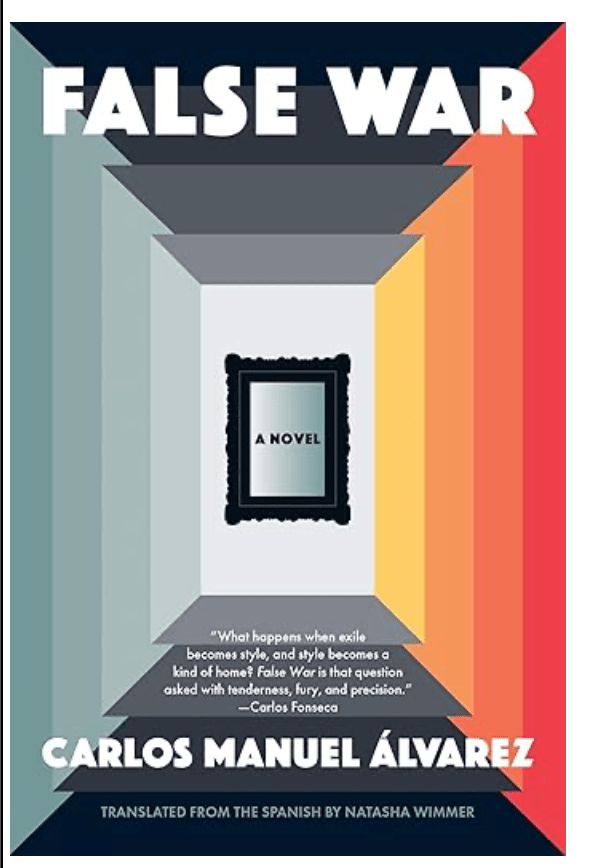
False War is sequel published in Spanish in 2021, and now translated by Natsha Wimmer examines the destinies of some of those Cubans who have fled the embattled island. The common themes of Cuban migrants in Miami, New York, Mexico City, Paris and Berlin, their loss and longing of lives uprooted and grafted elsewhere, borne on oceanic currents of escape and return. The characters in False War are ambivalent castaways living lives of deep estrangement from their home country, stranded in an existential no-man’s land. Some of them want to leave and can’t, others do leave but never quite get anywhere. Some toiling in a barber shop, roaring in Yankee Stadium, lost in the Louvre, intensely competing in a chess hall in Cuba, plotting a theft , or on a junket of émigré dissidents in Berlin, as these characters learn that while they may seem to be on the move, in reality they are paralyzed, immersed in a fake war waged with little real passion.
His characters in the novel are introduced to “the Barber”, “the Instrumentalist”, “Client”, “Adolescent”, “the dissident”, as Alvarez describe the specific aspect of the Cuban and Latin American diaspora.
“You don’t belong to a place until you despise it” says one of his characters reflecting on his relationship with his former island home. “Exile means the perpetuation of a country, not the renunciation of it, and hatred became a travelling practice”.
Some washed up in Florida fleeing oppression, others fleeing the ruins of their previous lives. “I was a sad man, a genuinely devasted man” explains another narrator. The Mexico City earthquake have destroyed part of my building and practically my whole apartment… lots of things had gotten buried under the rubble. Clothes, dishes, the art on the walls- my youth, too, in a way. And my fiancée. I’d been about to get married”.
“The dissident” has become “the exile” and finds himself travelling back to Cuba after his sister’s death. I’m still young, thinks the exile, and already people are dead, people hwose faces I’ve seen many times”. The island that was once home is now an island of ghosts. The crumbling Cuban capital, come sharply into focus as a place of despondency, “a city of many stray sadnesses” where everyone appears to have a hustle. This failed homecoming allows the exile to reflect movingly on the fate of the ones left behind. Walking past a park where people are making satellite video calls, he notices a grandfather talking to grandchildren across the sea. “The Grandfather can see them clearly, but it’s night now and the grand children can’t see him at all. You’re a dark shadow , Grandpa, they say, and the grandfather is upset.. The exile understands this man, you’re less interested in seeing the person who left than in having them seeing you.”
False War by Carlos Manuel Alvarez, translated by Natasha Wimmer, Fitzcarraldo £14/ Graywolf $27, 268 pages.

 The neptune Herald
Leave a comment