
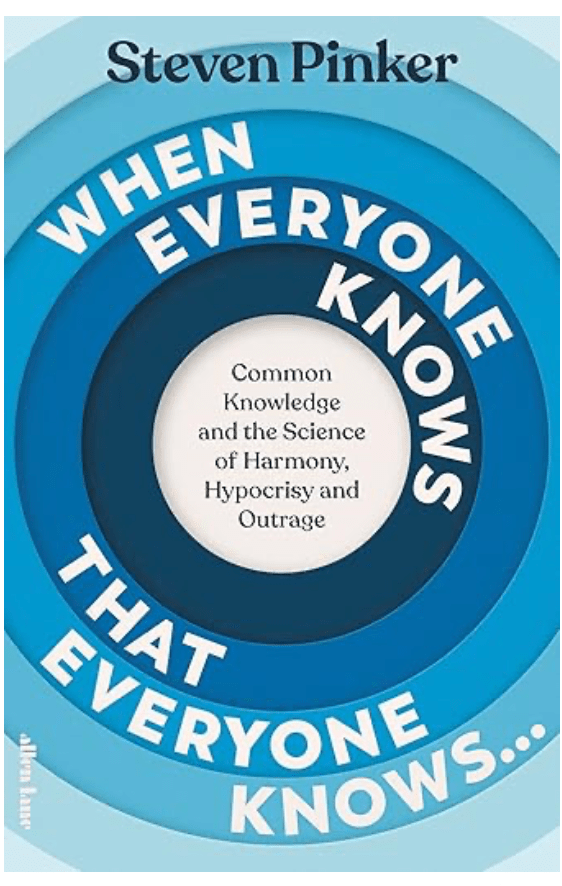
Harvard psychologist, one of the world’s greatest thinkers, and cognitive scientist, Steven Pinker, in When Everyone Knows that Everyone Knows, explores common knowledge- a concept deriving from game theory that describes the state in which not only does everyone knows something, but everyone knows that everyone knows that everyone knows. This idea according to Pinker “illuminates many enigmas of our public affairs and personal lives” and constitutes “a keystone in understanding the social world”.
Pinker shows us how we think about each other’s thoughts, ad infinitum, it sounds impossible, but we do it all the same. This awareness which we experience as something that is public or “out there” is called common knowledge, and it has a momentous impact on our social, political and economic lives.
Pinker can make sense of many of life’s enigmas: financial bubbles and crashes, revolutions that come out of nowhere, the posturing and pretence of diplomacy, the eruption of social media, shaming mobs and academic cancel culture, the awkwardness of a first date. But people go to great lengths to avoid common knowledge- to ensure that even if everyone knows something, they can’t know that everyone else knows they know it. And so we get rituals like benign hypocrisy, veiled bribes and threats, sexual innuendo, and pretending not to see the elephant in the room.
In exploring the paradoxes of human behaviour, when Everyone Knows that Everyone Knows… invite us to understand the ways we try to get into each other’s heads, and the harmonies, and outrages that result.
Pinker writes: “the difference between private knowledge, even widely shared, and common knowledge is not a mere logical nicety but can unify knowers in co-ordinated action and sometimes explode a social status quo”. Pinker argues that common knowledge is not only vital for human co-ordination and co-operation, but also provides a logical explanation for all sorts of seemingly irrational human behaviour: economic bubbles, manias, deliberately indirect or direct vague speech, social media shaming mobs.
He demonstrates the crypto companies were willing to pay so much- upto $7million per 30 second clip reportedly- for adverts during the 2022 Super Bowl was that, just like the US presidential debate, this event was an “instant common-knowledge creator”. Given that value of cryptocurrency relies entirely on the value everyone else assigns to it, making it known that everyone was simultaneously being made aware that everyone knew about it as a great marketing ploy. Pinker further points out “none of the exorbitant ads praised or even mentioned the virtues of crypto currency. Instead they paid celebrities to generate a common expectation that other people were investing in crypto, so they should too”.
Pinker contends, just as common knowledge is vital for holding a society together and for establishing and maintaining norms, avoiding it is another important driver in human behaviour. Pinker tells about a man in the Soviet Union arrested by the KGB for handing out leaflets, which turn out to be blank sheets of paper. “What is the meaning of this? They demand. The man replies, “What is there to write? It’s so obvious”.
When Everyone Knows That Everyone Knows…. Common Knowledge and the Science of Harmony, Hypocrisy and Outrage by Steven Pinker, Allen Lane £25/ Scribner $30, 384 pages.

 The neptune Herald
Leave a comment