
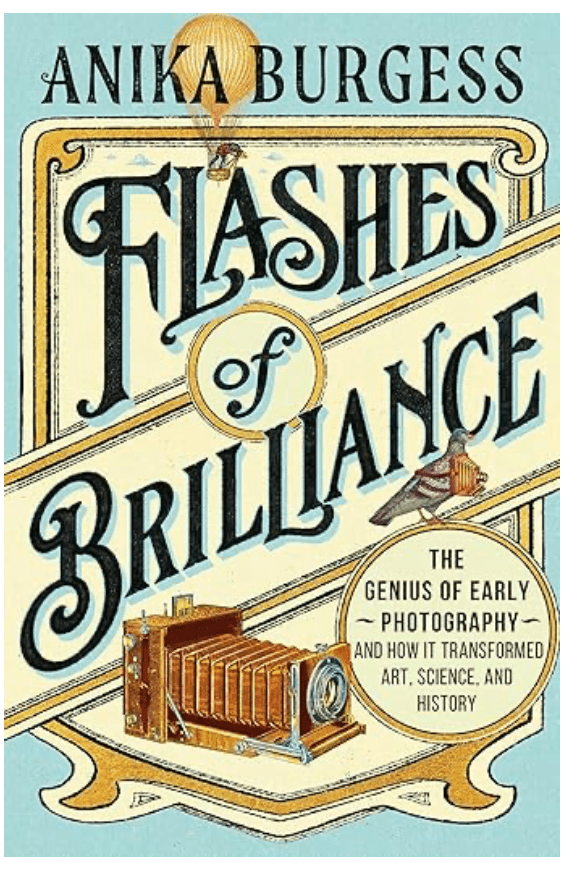
Flashes of Brilliance is the story of the wildest experiments in early photography and the wild people who undertook them. Spare a thought when you take photos from an airplane window, or using a camera underwater, watch a movie or view an X-Ray. These inventions made such things possible were experimental revelatory, and sometimes dangerous- and many of the innovators, entrepreneurs, and inventors behind them were memorable eccentrics.
Did you know, the earliest photographers didn’t just take snaps in the studio, or did dull sepia plats of formal gardens, or took staged portraits, but they were detectives, baloonists, deep-sea divers.
Writer and photo editor, Anika Burgess blends art, science, and social history to reveal the most dramatic developments in photography from its birth in the 1826 to the early twentieth century by surveying a world of invention and action teeming with chancers, pornographers and others to name a few. Writing with verve and an eye for compelling detail, Burgess explores how photographers uncovered new vistas, including catacombs, cities at night, the depths of the ocean, and the surface of the Moon. She describes how photographers captured the world as never seen before, revealing for the first time the bones of humans, the motion of animals, the cells of plants, and the structure of snowflakes. She takes us on a tour of astonishing innovations including botanist Anna Atkins and her extraordinary blue-hued cyanotypes and the world’s first photobook, Eadweard Muybreidge and Étienne-Jules Marey’s famed experiments in capturing motion and their long legacy, large format photography and photographs so small as to be visible to the naked eye; and aerial photography using balloons, kites, pigeons, and rockets. Burgess also delves into the early connections between photography and society that are still with us today: how photo manipulation- the art of “fake images”- was an issue right from the start; how the police used the telephoto lens to surveil suffragists; and how leading Black figures like Sojourner Truth and Frederick Douglass adapted self-portraits to assert their identity and automony.
Richly illustrated and filled with fascinating tales, Flashes of Brilliance shows how the rise of a new art form transformed culture and our view of the world.
Photography celebrates its bicentenary in 2026, making the moment around 1826 when Nicéphore Niépce- a French Inventor who tinkered with the notion of a motorcycle- shot a blurry composition of rooftops in eastern France, View from the Window at Le Gras was preserved on a pewter plate treated with bitumen and lavender oil. Burgess give a clear and fascinating whistlestop history from the 1830s through 1910, of the various technical advances, culminating in the near in conceivable innovation of the X-ray (now photographers could capture what couldn’t even be seen). Every aerial photography displayed outrages hopes over reason. Samuel Cody, an expat American living in England, designed kite shaped like giant bat that could carry a photographer. In Germany a pharmacist and pigeon fancier called Julius Neubronner patented light weight cameras that could be strapped to a bird’s breast. Time-delayed shots were taken on the wing resulting in panoramas fringed with feathers, The peacock in this squadron of flying photographers was a French showman Nadar ( Gaspard-Félix Tournachon). He took his first sky-high shots while dancing from a balloon in the nude . Later, he built Le Géant, a vast balloon that stood 196ft high and carried a two-storey basket that slept 12 passengers and housed a darkroom, kitchen and naturellement, a fully stocked wine store. In 1863 it crash-landed in the countryside and was dragged through the undergrowth for 20 miles, which narrowly missing an oncoming steam train, and finally slammed to halt, sending Nadar’s wife flying of the basket and into a river. Nadar took photographs of Paris Catacombs, home to six million skeletons. Questions of voyeurism, privacy and obscenity surfaced. During divorce cases, detectives used secret cameras to gain evidence of cheating Victorians. In 1908, at Bow Street magistrates’ court, the suffragette Emmeline Pankhurst was snapped in the dock by a press photographer using a camera hidden in a hat. In 1870 the Society for the Suppression of Vice declared that it had helped the police to seize 134,000 naughty pictures ( one of arresting offcers was an Inspectors genitals).
Flashes of Brilliance: The Genius of Early Photography and How It Transformed Art, Science, and History by Anika Burgess, Norton £25.99, 320 pages.
 The neptune Herald
Leave a comment