
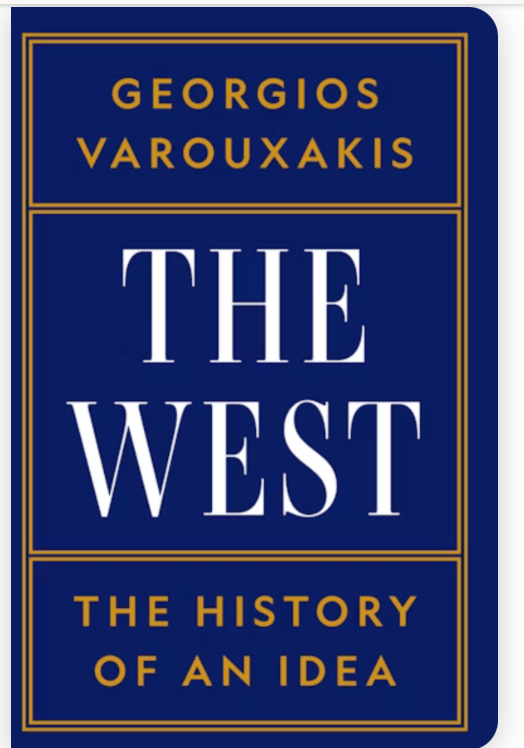
“We cannot rebuild western civilisation” vice-president JD Vance warned in March shortly after entering the office. The west people are so worried about has a familiar story behind it: It originates in the ancient world in the conjoining of classical Greek philosophy and the Hebrew Bible and then weaves its way through medieval Christendom or coined by nineteenth-century imperialists? Neither writes Georgios Varouxakis in The West, his ambitious and fascinating genealogy of the idea. “The West” was not used by Plato, Cicero, Locke, Mill or other canonized figures of what we today call the Western tradition. It was not first wielded by empire-builders. It was, Varouxakis, a historian of political thought at Queen Mary University of London, who shows, decisively promoted in the 1840s by the French philosopher Auguste Comte (whose political project, incidentally, was passionately anti-imperialist. The need for the use of the term “the West” emerged to avoid the confusing or unwanted consequences of the use of “Europe”. The two overlapped, but were not identical, with the West used to exclude certain “others’ within Europe as well as to include the Americans.
How did “the West” come to be used as a collective self-designation signalling political and cultural commonality? When did “Westerners” begin to refer to themselves in this way?
Varouxakis traces the many and often surprising changes in the ways in which the West has been understood, and the different intentions, and repercussions related to a series of these contested definitions. While other theories of the West consider only particular aspects of the concept and its history (If only in order to take aim at its reputation), Varouxakis’s analysis offers a comprehensive multi-layered account that reaches to the present day, exploring the multiplicity of current and prospective meanings. He concludes with an examination of how, since 2022, definitions and membership in the West are being reworked to include Ukraine, as the evolution and redefinition continue.
In the 17th and 18th centuries things were very different: When the old notion of Christendom was replaced by a secularised concept of Europe as the home of civilised life, the continent itself was conceptualised chiefly in terms of a northern and southern half. But this slowly dropped out of use and the “West” began to be used more broadly in the years after Napoleon’s defeat in 1815, when it came to refer to two distinct but interconnected sets of ideas.
Some Europeans are more worried than before about the rise of Russia- the Tsar’s troops had reached the gates of Paris- and questioned whether it really belonged at the heart of the continent’s affairs. At the same time, others looked across the Atlantic where they saw a new future for humanity beckoning as a result of successful American struggle against European colonial rule.
According to French philosopher Aguste Comte, his dream of a modern world order in which a “Western Republic” based on new spiritual values would unite “the vanguard of Humanity”, and usher in a world without conquests or empire, in which civilisation was spread by example and benevolence. But others in the 19th century found the idea of the “West” a vehicle for their own some-what different obsessions.
The West: The History of an Idea by Georgios Varouxakis, Princeton £35/$39.95, 512 pages
 The neptune Herald
Leave a comment