
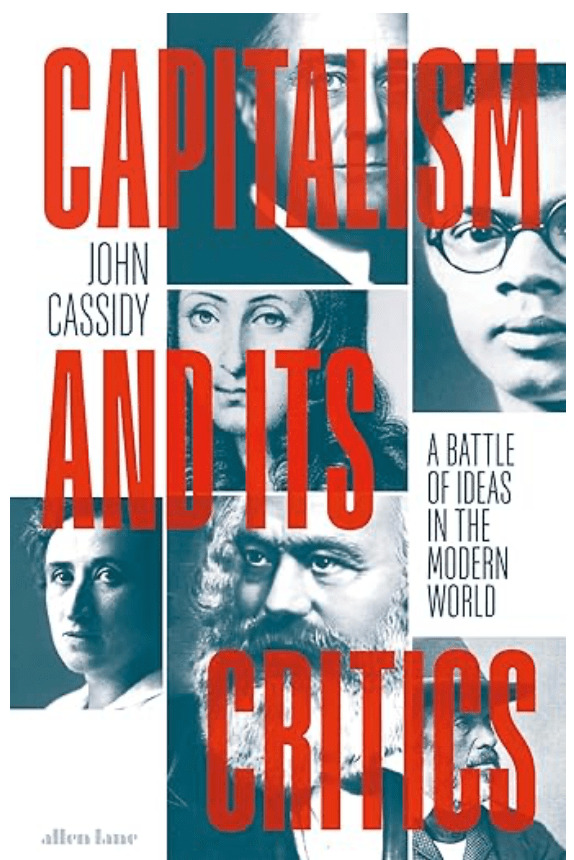
We are faced with fundamental questions about the sustainability and morality of the economic system, Capitalism and its Critics provides a kaleidoscopic history of global capitalism, from colonialism and the Industrial Revolution to the ecological and artificial intelligence.
British-American staff writer and economic journalist at the New Yorker, John Cassidy author of Dot.con, which examined the dotcom bubble of the late 1990s, and How Markets Fail, which illuminates the origins of the great financial crisis of 2007-08.
Cassidy starts with the colonial monopoly capitalism of the East India Company, as seen through the critical eyes of William Bolts, a disgruntled employee of the company in the 18th century. It ends with contemporary alarms over inequality, financial crises, pandemics, wars, climate and artificial intelligence. Any market-based economic system in which the means of production were owned by private proprietors who hired management and workers, a system which delivers perpetual revolution.
Adam Smith makes an early appearance as an opponent of mercantilism, monopolies and joint-stock companies. Many are protesters against injustice. One is a group of whom almost everybody has heard – the early 19th century Luddites. Others again, were proponents of co-operative socialism.
Cassidy tells stories of women fighting for political, economic and social equality: Anna Wheeler, Flora Tristan and Silvia Federici, who argued for wages for housework. Other important 19th century figures he discusses are Thomas Carlyle, Henry George and John Hobson.
The great crisis of the first half of the 20th century brought forth two path-breaking books, published in 1944 , The Road to Sefdom by Hayek, argued that socialism had led to the dictatorships and would do so again. The other, The Great Transformation, by Karl Polanyi, argued au contraire, that the global free market had itself led to the authoritarian and collectivist reaction.
Dependency, theory, which argued that full integration into the capitalist world economy could only reinforce poor countries’ backwardness. Samir Amin, a Marxist of Egyptian origin, held similar positions. The Nobel-laureate Joseph Stiglitz and Dani Rodrik, orginally Turkish, advanced some not dissimilar arguments.
Cassidy refers to JC Kumarappa, who advised Mahatma Gandhi, and Nicholas Georgescu-Roegen, Romanian-born founder of ecological economics, who argued it would not be enough to halt growth: output and consumption had to be radically reduced.
Eric Williams and Stuart Hall were both of West Indian origin, argued that slavery had accelerated the industrial revolution; and sought to explain the failure of traditional left-wing politics to halt “Thatcherism”.
From eighteenth-century weavers who rebelled against early factory automation to Eric William’s paradigm-changing work on slavery and capitalism, to the Latin American dependistas, the international Wages for Housework campaign of the 1970s, and the modern degrowth movement, this absorbing narrative traverses the globe.
Capitalism and its Critics illuminates the deep roots of many of the most important issues of our time by giving us a blending biography, panoramic history, and lively exploration of economic theories.
Thomas Piketty’s work on inequality has had an enormous impact in bringing the Marxist idea that capitalism inevitably increases inequality back to life.
“From its earliest days, industrial capitalism has zigzagged between periods of prosperity, when it seems all-conquering, and episodes of panic and contraction. Indeed it is barely hyperbole to say that capitalism is always in crisis, recovering from crisis, or heading towards the next crisis”, writes Cassidy.
The prediction that capitalism would perish in unmanageable economic and social crises has yet to be borne out, Cassidy notes.
The rise of autocracy seems to be breaking what seemed just three decades ago to be a strong marriage between capitalism and democracy. This domestic transformation in the US, is driving the collapse of the liberal global order and disintegration of the historic alliance of western democracies.
The time for the development of artificial intelligence heralds huge changes in economic and political life.
Wolfgang Streeck, the German economic sociologist insist that this time is different: Capitalism will end. Cassidy reject such pessimism, but the system cannot rest as capitalism’s permanent revolution will continue.
Captialism and its Critics: A Battle of ideas in the Modern World by John Cassidy, Allen Lane £35/ Farrar, Straus and Giroux $35, 624 pages.

 The neptune Herald
Leave a comment