
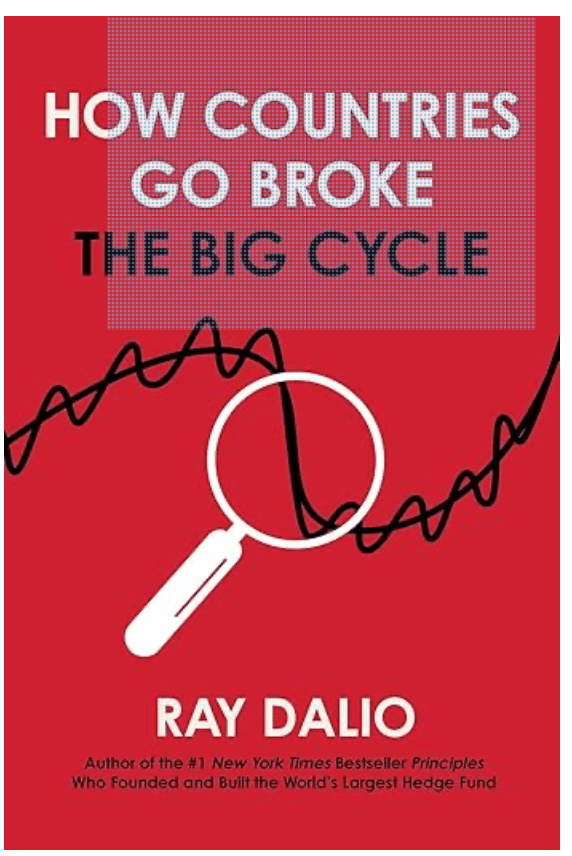
Ray Dalio, who founded Bridgewater Associates five decades ago and one of the greatest investors of our times who anticipated the 2008 global financial crisis and the 2010-12 European debt crisis, shares for the first time his detailed explanation of what he calls the “Big Debt Cycle”. Understanding this cycle is critical for helping policymakers, investors, and the general public grasp where we are and where we are headed with the debt issue. Dalio’s model points towards surprisingly straightforward solutions for dealing with the debt problems, that the US, Europe, Japan, and China face today.
Global macro investors make bets on countries, riding the currents of exchange rates and interest rates, as their trades often require taking a much longer-term view than the typical investor, eye not only to a country’s monetary and fiscal policy, but often to its politics and institutions.
Dalio emphasises the importance of looking at a very long historical data sets in order to be able to distinguish epoch waves, sometimes a century long- including what he calls the “Big Debt Cycle” – from typical cyclical business ups and downs which are smaller and less consequential.
Dalio writes : “Big debt crises are inevitable, because of imperfect lending decisions that result in too much credit. Throughout history only a very few well-disciplined countries have avoided them”. Others have been destroyed by them. To avoid such a fate, Dalio claims that by using metrics- which involve debt, income, interest rates, saving and growth. The book is illustrated by charts, equations, and highlighted action points illustrating how a country might “go broke”.
There are some well known indicators in the case of a country debt crisis, these include an overvalued exchange rate, sustained large government budget deficits and current account deficits, and high indebtedness to foreigners. If most investors don’t have Dalio’s unique talents to time debt cycles policymakers do well to pay attention to his concerns when he states by my measures the US and most major countries (the other G7 countries and China) are… in the late stages of their Big Debt Cycles” and if “not controlled in some way, the profitability of an unwanted major restructuring monetization of debt assets… is very high… something like 65 per cent over the next five years”.
Dalio brutally critiques Japanese policymakers for failing to force debt writedowns after the country’s early 1990s financial crisis. They allowed debt overhand to hamstring the financial system and sap two decades of growth.
Dalio argues that the ticket to stability is simply to pare the US deficit down to 3 per cent of GDP ( it was 6.4 per cent in 2024).
How Countries Go Broke: The Big Cycle by Ray Dalio, Simon @ Schuster £30/Avid Reader Press $35, 400 pages.
 The neptune Herald
Leave a comment