
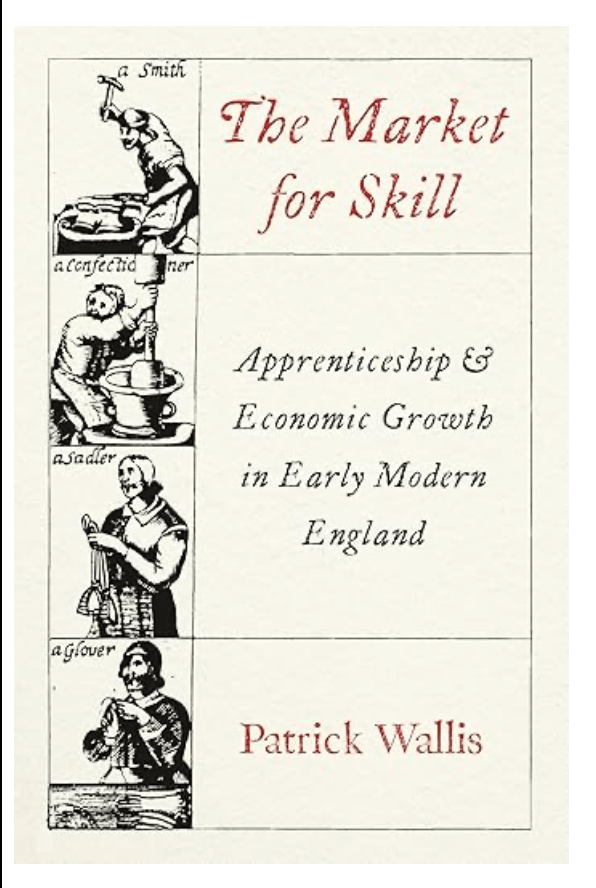
Apprenticeship dominated training and skill formation in early modern Europe. Years spent learning from a skilled master were a nearly universal experience for young workers in crafts and trade. In England, when apprenticeship reached its peak, as many as a third of all male teenagers would serve and learn as apprentices. In the Market for Skill, Patrick Wallis, professor of economic history at the London School of Economics, shows how apprenticeship helped reshape the English economy. He shows non-agricultural work in England was “anything but hereditary between the sixteenth and eighteenth centuries”. Some historians see apprenticeship as a key ingredient in the industrial revolution, other agree with Adam Smith in seeing it as wasteful and conservative, exploiting cheap labour. Adam Smith’s view in The Wealth of the Nations (1776), that apprenticeships restrained competition between businesses. Wallis shows that neither these perspectives is entirely accurate. He offers a new account of apprenticeship and the market for skill in England, analysing the records of hundreds of thousands of individual apprentices to tell the story of how apprenticeship worked and how it contributed to the transformation of England. Wallis details the activities of apprentices and masters, the strategies of ambitious parents, the interventions of guilds and the decision of town officials. He shows how the system of early modern apprenticeship contributed to the grow of cities, the movement of workers from farms, to manufacturing and the spread of new technologies and productive knowledge.
John Stuart Mill wrote in his Principles of Political Economy, published in 1848, before industrialisation, jobs were “almost equivalent to an hereditary distinction of caste, each employment being chiefly recruited from the children of those already employed in it”.
Wallis writes “This was an economy and society in flux. Cities and towns were expanding industry and services were growing. New types of work were appearing. For this to occur sons and daughters could not simply take on the family trade”. It was apprenticeships that enabled changing demand in the economy to be met with an appropriate supply of labour. Apprenticeship records taken from guild, urban and national sources, and take us back to the world of tallow chandlers, girdlers, glovers and barber surgeons.
The Elizabethan law introduced in 1563, the “Statute of Artificers”, made a seven-year formal apprenticeship a requirement in many trades outside farming. The law was designed to limit the flow of workers from agriculture into other commercial activities and thereby keep agricultural wages down. Wallis writes “Early Elizabethan London was, in truth, a city built on apprentices.” The requirement of apprentices to complete seven years of training remained in place until 1814 although apprentices often did not complete seven years with one master, having the option to move on early or switch to a different trade. Apprentices rarely stayed on as a permanent employee, but left to ply their own trade, as this flexibility was a brilliant strength.
Wallis’s ground-breaking study, reveals that apprenticeship succeeded precisely because it was a flexible institution which allowed apprentices to change their minds and exit contracts early. Wallis points out, it is the acquisition of tacit knowledge, as much as skills, that counts. Wallis states instead of seeing it as an exploitative system, he offers a more positive interpretation: “Most apprentices might instead find themselves places that offered them the chance to learn trades from masters who had proven their abilities and would not treat them as low-cost labour”.
The future human capabilities amid the world of AI.
The Market for Skill: Apprenticeship & Economic Growth in Early Modern England by Patrick Wallis, Princeton University Press £38, 480 pages.
 The neptune Herald
Leave a comment