
“Stagflation” of the 1970s – the improbable combination of high unemployment and runaway inflation- proved painful and protracted, but explains the U.S. stock market’s remarkable forty-year run of 12 per cent average annual returns since then. Why is Japan still mired in a decades-long recession- and the Chinese economy in a tailspin? What account for the resilience of U.S. stock and labour markets in the wake of the Covid-19 pandemic and in the face of the Fed’ record interest rate hikes?
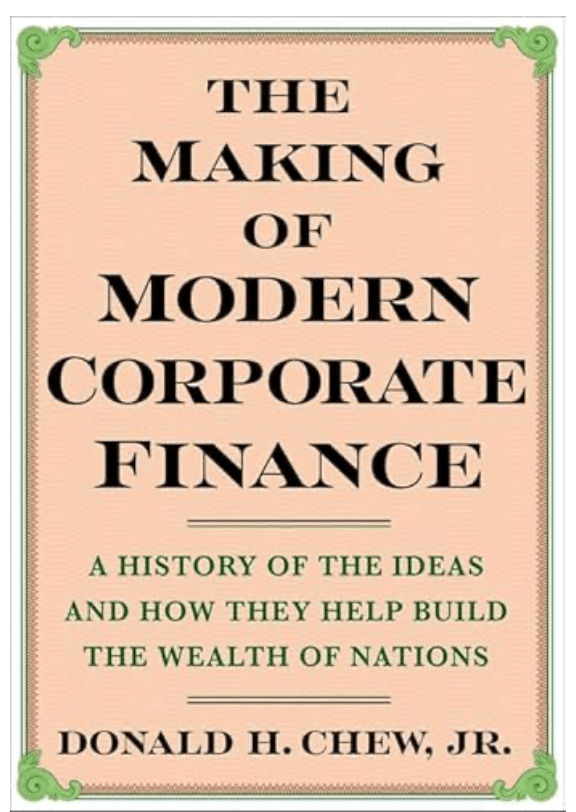
Donald H Chew, editor of the journal of Applied Corporate Finance, traces the revival moment of America’s corporate and stock market fortunes, invention of ‘modern corporate finance,” and attempts to update Adam Smith for the 21st century: “For as Smith suggested nearly 250 years ago, it is the efficiency gains from finding commercial use for new technologies by mostly private enterprises that end up footing the bill for the health, education, and other forms of general well-being that most of us value most.”
Chew describes what was wrong with the “old-fashioned corporate finance” of 50 years ago. By the late 1970s, he writes, most large US companies were conglomerates. General Mills expanded from making breakfast cereals into an “all-weather growth company”, buying manufacturers of toys, Play-Doh, “even small submarines”.
At one point in the 1970s, the S&P 500 lost almost half its value; by the end of the decade, two professors at Rochester University wrote a paper called ‘ Can the Corporation Survive?”.
As America continued to struggled in the 1980s, while Japan inexorably rose; the Nikkei 225 reached a record 39, 000 at the end of 1989 (compared to today’s index around 34, 000). In 1992, 25 academics accused US companies of systematically uninvesting compared with their Japanese counterparts. The Nikkei fell 60 per cent in the 1990s and did not regain its 1989 peak until February 2024, while S&P 500’s total return in the US was more than 3, 000 per cent.
Chew, highlights the principles and methods of “modern corporate finance”, ideas and formulated and tested by finance scholars – notably, an efficient stock market in which prices reflect the long-run values of public companies and a “market for corporate control: that exerts continuous pressure on management- informed and spurred the investor-driven capitalism that has created the world’s most productive and valuable companies, Drawing on his career-long relationships with leading academics and practitioners, Chew profiles key figures in the development of modern corporate finance while emphasising their counter-intuitive lessons for shareholders, companies, and countries. Corporate efficiency and value creation, he contends, are the fundamental source of the social wealth essential to addressing challenges such as poverty and climate change. How the success and failure of companies affect lives of ordinary people.
Chew outlines the benefits of environmental, social and governance (ESG).
A striking thing about the Magnificent Seven – Apple, Alphabet, Amazon, Meta, Microsoft, Nvidia and Tesla. Nvidia, has four times more cash on its balance sheet than debt. The seven have not produced all this value through complex financial engineering.
Major innovations – railways, electrification, the internet, AI – all have caused surge in productivity that in turn enabled stock market bubbles. Technology companies were 37 per cent of America’s market capitalisation in early 2025, but railways accounted for 63 per cent of it in 1900. The railway bubble collapsed, but the railways it financed continue to be part of the backbone of the US economy. The Magnificent Seven after significant correction- so far this year their market value has fallen by more tyhan $e trillion, which is in fact more than all the companies in the FTSE 100 are worth. But their technologies will continue to change the world.
Private equity rose as dollar interest rates fell from 20 per cent in 1980 to zero in real terms 40 years later, making a few financiers look like innovative geniuses for replacing equity with cheaper debt.
The mercantilist proponents of the tariff war unleashed by the US President Donald Trump have no truck with Smith.
The Making of Modern Corporate Finance: A History of the Ideas How They Help Build the Wealth of Nations by Donald H Chew, Columbia University Press £30/$35, 328 and pages.

 The neptune Herald
Leave a comment