
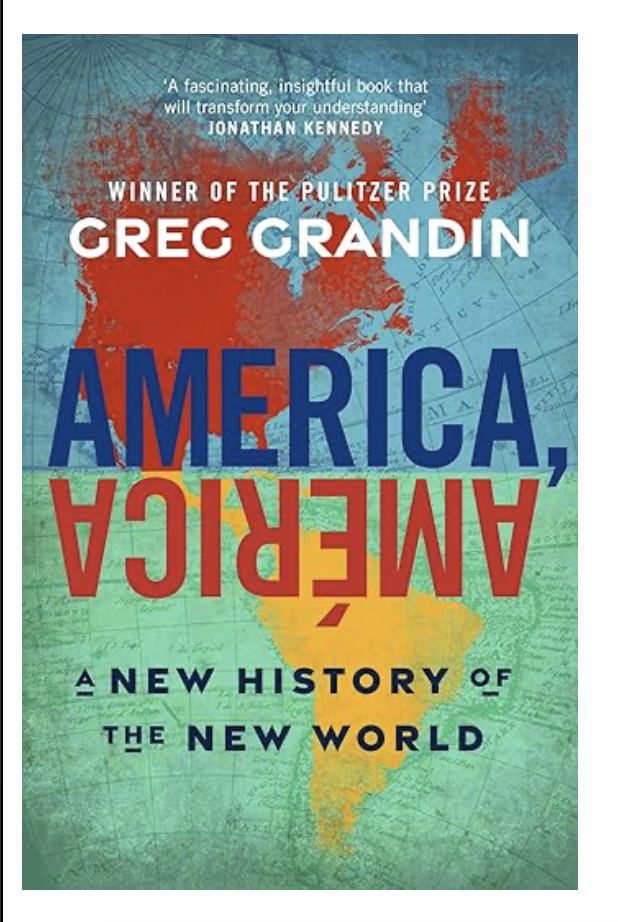
Yale professor, Greg Grandin, a Pulitzer-winning historian comes America, América, the first definitive history of the western hemisphere, a sweeping five-century narrative of North and South America that redefines our understanding of both continents- perfect for reader of How the World Made the West. The story of the United States’ unique sense of itself was forged facing south – no less than Latin America’s was indelibly stamped by the looming colossus to the north.
Grandin reveals how the Americas emerged from constant, turbulent engagement with each other, shedding new light on well-known historical figures like Bartolomé de las Casas, Simón Bolivar and Woodrow Wilson, as well as lesser-known actors such as the Venezuelan Francisco de Miranda, who almost lost his head in the French Revolution and conspired with Alexander Hamilton to free America from Spain.
Grandin whose previous work has explored the US frontier, Henry Kissinger, and the Ford plantation-city in the Amazon. Spain’s colonies in the Americas are crucial to the outcome of the US revolutionary war. Spain provided aid and up-to-date weaponry to George Washington’s beleaguered army, and fought Britain in the Caribbean as far north as Lake Michigan. Spain’s support, Grandin reminds us, relied on its colonies’ infrastructure, its mineral wealth, its plantation economy and public goodwill (funds for the decisive battel of Yorktown, were raised in Havana.
In 1923, after the independence of most of Spanish America, US President James Monroe warned European powers not to interfere in the western hemisphere. The Monroe Doctrine, ambitious and ambiguous, was initially welcomed by the fragile new republics, who feared reconquest. What the Monroe Doctrine didn’t do, however, was prevent interference by the US. By the mid-1820s, as southern slaveholders sought more land, the US was already exploring taking Texas from Mexico. After the Mexican-American war of 1846-48, it had captured more than half the neighbour’s territory. US-Latin American relationship, was particularly cordial under the Democrats Woodrow Wilson (1913-21) and Franklin Roosevelt (1933-1945). Wilson compensated Colombia $25 million for the US-arranged separation of Panama in 1903, and took the America’s tradition of international collaboration as his blueprint for Europe after the first world war.
Roosevelt’s administration owed a major debt to Latin American ideas, since in 1933, two months into his tenure, with US stuck in the Great Depression, hemisphere-wide negotiations in Montevideo led (against the wishes of many US industrialists) to the reduction of tariffs. Along with the devalued dollar, which kick-started US exports and helped to “save the New Deal. The President of Brazil (Getúlio Vargas) and the President of the United States”, according to Grandin.
Roosevelt’s good relationship with the rest of the hemisphere was critical during the second world war. Allies in central America allowed US vessels untroubled access to the Panama Canal, which linked the campaign in the Pacific and the Atlantic.
For the supply chain, like petrol, copper, platinum, tin and rubber, the US relied on the South American and Central American countries for commodities. John Foster Dulles, Dwight Eisenhower’s secretary of state, said that without Latin America, “there would have been no NATO.” Winston Churchill went further: “There would have been nothing.” In return, the Latin American nations, whose economies were overly reliant on the natural resources that had underpinned the war efforts, asked President Harry Truman for industrialisation subsidies similar to the Marshall Plan. They didn’t get them.
The US’s refusal was part of its general shift in priorities. With the exception of trying to contain communism, the US began to think less about the western hemisphere, and more about world as a whole.
Grandin says “The region fell out of mind. What mattered was a renewed Washington-London alliance, with a focus on a rebuilt Western Europe and, now that Mao was in Peking, a Japan-centred Asia.”
Latin America remains integral to US interests, but is usually overlooked except when politicians want to challenge immigration, appeal to anti-socialist diasporas, or complain about its neighbours’ ties with China. Grandin wants the US, as the dominant power, must take the lead, to reinterpret the New World order.
America, América traverses half a millennium, from the Spanish Conquest- the great mortality event in human history- through the eighteenth-century wars for independence, to the coups and revolutions of the twentieth century. This monumental work of scholarship fundamentally changes our understanding of Spanish and English colonialism, slavery and racism, the rise of universal humanism, and the role of social democracy in staving of authoritarian impulses.
America, América: A New History of the New World by Greg Grandin, Torva £30, Penguin Press 435, 768 pages.

 The neptune Herald
Leave a comment