
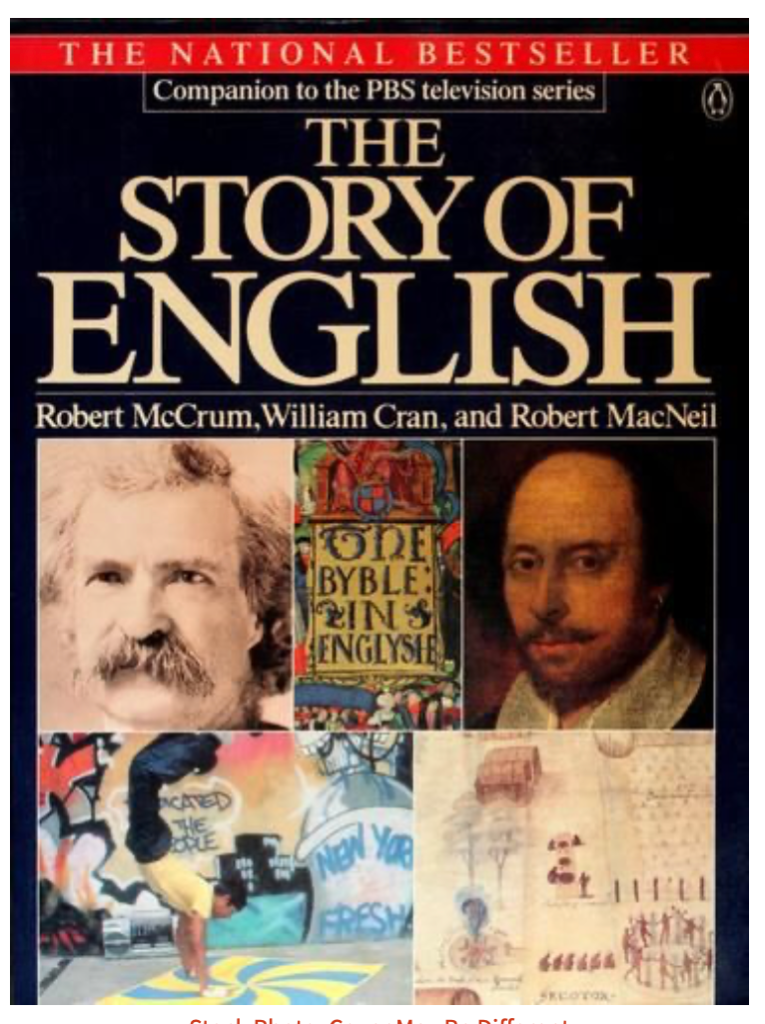
Would you believe it, two thousand years ago English was confined to a handful of savage tribes on the shores of north-west Europe, today, in one form or another, it is spoken by a billion people around the world. More widely scattered, written and spoken than any other language in history, English has become a global phenomenon. Exploring this amazing success, The Story of English is an essential companion for student and general reader alike. The Story of English discusses the influence of William Shakespeare and the King James Bible on the English language as well as how Early Modern English took root in the American colonies and its influence on contemporary American English.
“William Shakespeare put the vernacular to work by filling a universe with words. Accommodation, assassination, dexterously, dislocate, indistinguishable, obscene, pedant, premeditated, reliance and submerged are not just a handful of the words that make their first appearance in the Folio. Shakespeare’s impact on the patterns and stuff of everyday English speech has been memorably expressed by the English journalist Bernard Levin.”
If you cannot understand argument, and declare “It’s Greek to me”, you are quoting Shakespeare, if you recall your salad days, you are quoting Shakespeare; If you act more in sorrow than in anger, if you wish is father to the thought, if your lost property has vanished into thin air, you are quoting Shakespeare, if you lost property has vanished into thin air, you are quoting Shakespeare, if you have ever refused to budge an inch or suffered from green-eyed jealousy, if you have played fast and loose, if you have been tongue-tied, a tower of strength, hoodwinked or in a pickle, if you have knitted your brows, made a virtue of necessity, insisted on fair play, slept not one wink, stood on ceremony, danced attendance (on your lord and master), laughed yourself into stitches, had short shrift, cold comfort or too much of a good thing, if you have seen better days or lived in a fool’s paradise – why, be that as it may, the more fool you, for it is a foregone conclusion that you are (as good luck would have it) quoting Shakespeare; if you think it is early days and clear out bad and baggage, if you think it is high time and that is the long and short of it, if you believe that the game is up and that truth will out even if it involves your own flesh and blood, if you lie low till the crack of doom because you suspect foul play, if you have your teeth set on edge ( as one fell swoop) without rhyme or reason – then – to give the devil his due – if the truth were known ( for surely you have a tongue in your head) you are quoting Shakespeare, even if you bid me good riddance and send me packing, If you wish I was dead as a door-nail, If you think I am an eyesore, a laughing stock, the devil incarnate, a stony-hearted villain, bloody-minded or a blinking idiot, then – by Jove! O Lord! Tut, tut! for goodness’ sake! What the Dickens! But me no buts- it is all one to me, for you are quoting Shakespeare. Old English or Anglo-Saxon is the earliest recorded form of the English language, spoken in England and southern and eastern Scotland in the Early Middle Ages. It is brought to Great Britain by Anglo-Saxon settlers in the mid-5th century. In the early stages of the English language, including the Old English, whose literature dates back from the mid-7th century. After the Norman Conquest of 1066, English was replaced for several centuries by Anglo-Norman (a type of French) as the language of the upper classes. This is regarded as marking the end of the Old English Era, since during the subsequent period the English language was heavily influenced by Anglo-Norman, developing into what is now known as Middle English in England and Early Scots in Scotland.
“The social and linguistic parallels between Black America and East End Cockneys in Britain are striking. While the socio-political muscle of Black Americans is obviously far greater, the two groups have a lot in common Both were outsiders in their own society, both had an immensely rich and vital cultural tradition, expressed in speech and song, both found from of self-expression through the entertainment business and sport, especially boxing, and both suffered considerable stereotyping in radio, film and later television. Both Blacks and Cockneys have contributed some of the most vivid words and phrases to the language. Both are exceptionally good at describing the nuance of personal relationships, of feeling. The London Language has deep historical roots. The word cockney from Coken-ay, a cock’s egg, an inferior or worthless thing- is as old as Chaucer, and the original use of Cockney had little to do with the idea of ‘bad English’. In the sixteenth century, Cockney was simply the language of all Londoners who were not part of the Court, and was spoken by all sorts and conditions of people, craftsmen, clerks, shopkeepers and tradesmen. One of these, a funeral furnisher name Henry Machyn, kept a diary, and it is clear from the spellings he uses that he was talking about”the London Language”. He left hs off words because he never heard people pronounce them. So “half” appears as alffe, and Ampton is Machyn’s spelling of Hampton. Many of his other spellings suggest Cockney frustration for thrust, farding for farthing, and Fever stone for “Featherstone”. He would also add a t to make orphan and sermon. For the words we know as chains, strange and obtain, he wrote chynes, Strynge and obtain. Henry Machyn’s English had its roots in the Anglo-Saxon regions of East Mercia, East Anglia and Kent, the English of Shakespeare’s Mistress Quickly, and later of Same Weller in Pickwick Papers,. It was the speech of the working Londoner” writes McCrum.
The book also discusses the Scottish, Irish, Canadian Black community’s influence on the English language. The Muvver Tongue discusses Cockney dialect and Australian English.
The Story of English by Robert McCrum, Robert MacNeil, William Cran, Penguin Books New York first published in 1987, 384 pages.
 The neptune Herald
Leave a comment