
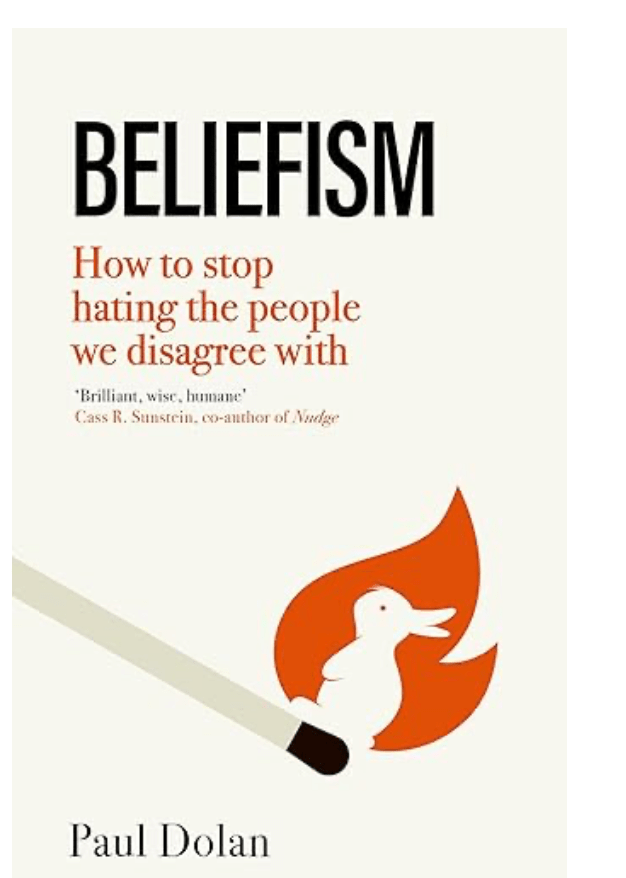
Paul Dolan, a professor of behavioural economist at the London School of Economics, defines Beliefism as a discrimination against those with different beliefs to us. In today’s civil discourse, one exacerbated by the anger-stoking effects of digital doomscrolling and the perverse incentives the media has constructed for political discourse (Anyone who changes policy in response to criticism, for example, is gleefully reported to have performed a “humiliating U-turn”.)
The citizens of the US and UK are becoming more polarised and inclined to avoid altogether those who aren’t their ideological comrades. Do you really avoid people who are strongly against immigration? Or strongly for trans rights? Against abortion? For Drug legislation? We might think we’re tolerant, but many of us struggle to engage with people whose opinions differ strongly from our own- even if they might have something useful to contribute to the debate. We’re really falling victim to Beliefism: discrimination against those with different beliefs to us.
Dolan reveals how easy it is for us to divide ourselves into opposing camps- and how harmful that can be. Using the central metaphor of the duck-rabbit illusion- where the same image can be viewed as one animal or the other- the book shows that looking at an issue from only one perspective can lead to bad decisions and unnecessary conflict. The world would be better place if there was less beliefism and Dolan shows how more tolerance is only possible “by design”. We need to embed less beliefism into our organisations and lives and he provides a checklist called EMBRACE to help us to that.
Combining curiosity, irreverence and warmth, Beliefism is a definitive behaviourial science take by a leader in his field. Whether it’s among friends, at University or at work, being less beliefist will make you a better partner or parent, and a more effective buddy or boss.
Dolan observes, that a person who takes up a social identity that is anti something is more concerned with maintaining boundaries between “us” and “them” thatn with the truth. ( He is refreshingly scathing about what he calls “ performative activism”.) He cites the following staggering statistic. “ The endorsement rate for the statement “ I am an important person” has increased from about nine in ten now.” We are all narcissistic babies now.
You can’t reduce polarisation, it turns out, simply with clever nudges that randomly expose Democrat voters to Republican tweets and vice versa. This is vulnerable to “backfire effects” and people end up more partisan than before. Dolan argues inventively that it would be better to take inspiration from aviation and medicine by structuring arguments around checklists of policy consequences. “ Discussion about which items should go on a checklist are likely to involve more detachment and less hostility than arguments about what the policy decision should be” he says.
According to Dolan, the decisions on social-distancing measures during the pandemic took account only of their likely effect on Covid transmission rates, but such a checklist might also have included “the impact on loneliness, educational inequalisties, and so much more”.The fine principle that whatever position you wish to argue on an issue, you must be honest about bad effects, as well as good, will follow – “to measure the full flow of costs and benefits” in so far as that’s possible. Every political position is a compromise and if we were upfront about what compromises we were making, the conversations could be more fruitful. “We can quite reasonably downplay someone’s beliefs when they refuse to acknowledge trade-offs,” he reassures us.
He asks “How cognitively diverse is your friendship group? Let’s treat mistakes as opportunities for learning, or let’s have nicer conversations by “ harnessing the power of calmness”
Beliefism How to Stop Hating the People We Disagree With by Paul Dolan, Bridge Street £16.99, 240 pages

 The neptune Herald
Leave a comment