
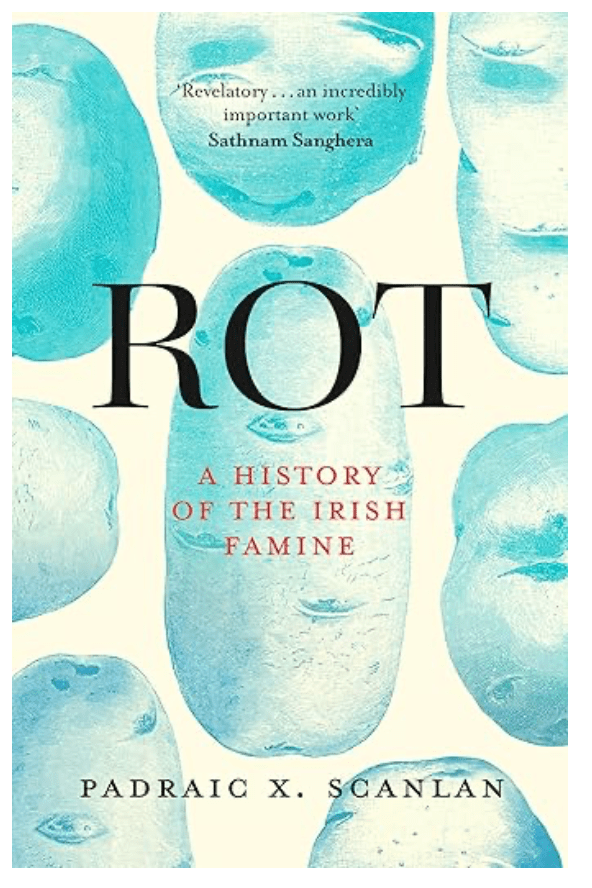
In the 1800s, as Britain became the world’s most powerful industrial empire, Ireland starved. In 1847, Richard Webb, the rector of Caheragh, County Cork, sent a group of men to check on his parishioners. On arriving at a cluster of cottages, they were turned back by farmers who told them, “those houses are cursed”. Webb persisted sending another emissary who discovered the corpses of the Barry family there, half-eaten by dogs. The cleric wrote: “I need make no comment on this but ask, are we living in a portion of the United Kingdom?”. The Great Irish famine fractured long held assumptions about political economy and civilisation, threatening disorder in Britain. Ireland was a laboratory for empire, shaping British ideas about colonisation, population, ecology and work. In Rot, Padraic X Scanian, a historian and associate professor at the University of Toronto, makes an insightful and disturbing account of the Irish famine, as nowhere in Europe, over the world, did the working poor depend as completely on potatoes as in Ireland. British observers believed potatoes were evidence of a lack of modernity among the Irish. Ireland before the famine more closely resembled capitalism’s future than its past. “The Great Hunger” reverberates deeply in the Irish cultural psyche, akin to the Great War for Britain. From 1845-1952, about a million people died mostly though not exclusively in the Irish speaking west and the south; as many as 2 million emigrated as a direct result, effectively depopulating the island for generations. Recent generations have rediscovered the catastrophe, and culture wars wage on whether or not it was genocide. While poverty before and during the Great Famine was often blamed on Irish backwardness, it did in fact stem from the British Empire’s embrace of modern capitalism.
Rot reshapes our understanding of the Famine and its tragic legacy, by uncovering the disaster’s roots in Britain’s deep imperial faith in markets and capitalism.
Scanlan points out that 19th century Ireland was part of the UK and not a colony, as often claimed by Irish nationalists. This exposes the Union as a fraud, the relationship between England and Ireland was one of parasite and host.
When Black ’47 arrives – the worst year of the famine – a chapter named “The End of the World”. Family homes become charnel houses. Evictions were rife in a land mostly owned by a few thousand primarily Protestant, often absentee, landlords; an estimated 250,000 were evicted. Other homes were “uproofed”, exposing families to the elements. Martial law was imposed. There were only few choices for those fortunate enough to survive starvation, were predatory workhouses, the humiliation rituals of relief, or exile. Of the unlucky, “most died in secret”.
“The laws of political economy could never fail, but they could only be failed.” Rather than admit failure and culpability the government doubled down, treating victims as sinners who had brought ruin upon themselves. In England, some suggested hunger would be “a spur to effort, innovation, and eventually, prosperity”. Scanian writes. Cyclical logic was key-human beings robbed of dignity were then judged for their fallen state. Scanian implies the much debated “Irish Question” was actually a British Question. Its solution required dismantling of a profit-driven system, and admitting its human cost. While millions starved, grain was hoarded to appreciate during a boom.
The British saw themselves as a civilising force; industrious and rational compared with the slovenly superstitious natives, Yet a land dominated by landlords, money lenders and speculators, epitomised extractive capitalism, and its resistance to a safety net when the potato blight came. There was little admission of a connection between London’s thriving markets and Ireland’s immiseration, despite inadequate aid ships passing those exporting bountiful food out of Ireland. “The Irish poor did not live beyond the market, they were in its teeth” Scanian argues.
Rot: A History of the Irish Famine by Padraic X. Scanlan, Robinson/Basic Books £25/$32, 352 pages.

 The neptune Herald
Leave a comment