
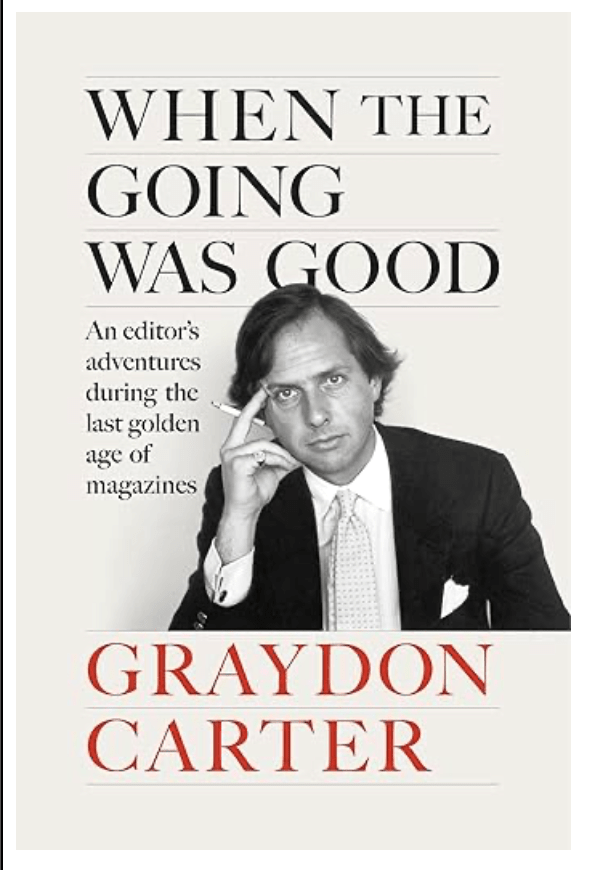
Graydon Carter’s brilliant raconteur of his own life of how he made his mark as one of society’s most talented editors and shapers of culture. Carter born in 1949, arrived in New York from Canada with little more than a suitcase, a failed literary magazine in his past and a keen sense of ambition. He landed a job as a floating writer at Time magazine in New York, selling 4 million copies a week, with salaries and expenses to match. After five years he was reassigned to Time’s sister magazine, Life, which “had become a zombie monthly, close to dead”. He went on to work at Life, co-founded Spy Magazine and edited The New York Observer before catching the eye of Condé Nast chairman Si Newhouse, who tapped him to run Vanity Fair in 1992. You’d walk out of work having put in maybe six hours if you discount long lunches, possibly carrying a load of free make-up and clothes on “loan” from the fashion department, and see a line of black Lincolns in front of the HQ on Madison Avenue. You’d hop in one and head straight to free five-course tasting dinner at some hot new Spanish restaurant, or a film screening, or to the airport to take a first-class flight on Aer Lingus to a five-day luxe tour through Ireland’s best distilleries. Graydon’s nostalgic memoir about his adventures “during the golden age of magazines”. He rightly cites the “magical realism” if Time, a place where “there was a person for every conceivable need. Nurses, Doctors, Psychiatrists. Long-distant phone calls could be made for free. Bureau chiefs overseas lived as well as US ambassadors”. In an era where glossy magazines projected the luxury, fun, wealth and desirability of American culture across any number of genres. Newsmagazine in those days, populated with the kind of sharp young men – except the fact checker of course, who were women- who might have been in the character line-up of The Best and the Brightest, David Halberstam’s fabled account of the “whiz kids” of the Kennedy era.
As the editor of Vanity Fair from 1992 to 2017, Carter was at the top for a long time. At Spy, a satirical monthly, which would be a cross between Private Eye and Mad Magazine, he created with Kurt Anderson, a kind of smart alecky insider-outsider brand that poked fun at elites while also, selling to them. Its launch issue in the autumn of 1986 carried a list of the Ten Most Embarrassing New Yorkers including Donald Trump. Graydon first came across Trump when he wrote a challenging profile of him for GQ magazine and mentioned in passing that he had abnormally small hands. His Vanity Fair combined the edgy wit of essayist such as Christopher Hitchens, Sebastian Junger, Bryan Burrough and James B Stewart whose pieces were very often turned into top-selling books and movies. Carter writes about one contract negotiation with Annie Leibovitz that came down to a $250, 000 difference between her agent and the magazine. Condé Nast owner Si Newhouse tells Carter, “ Oh, give it to her. We don’t want to nickel-and-dime them.”
Eventually the brightness fades and get thinner, as does Carter’s temper. “I had to make the culture less poisonous,” he writes about his own staffing and general good humour post-Tina Brown, who many people feel did a great job with the publication. “ You could feel the venom in the corridors”.
The town cars have gone home, even Carter has gone digital with his online publication Air Mail. Technology comes for all of us eventually . But I’ve still got those snake skin Blahniks from the fashion closet.
When the Going Was Good: An Editor’s Adventures During the Last Golden Age of Magazines by Graydon Carter, Grove Press £20, Penguin Press $32, 432 pages.

 The neptune Herald
Leave a comment