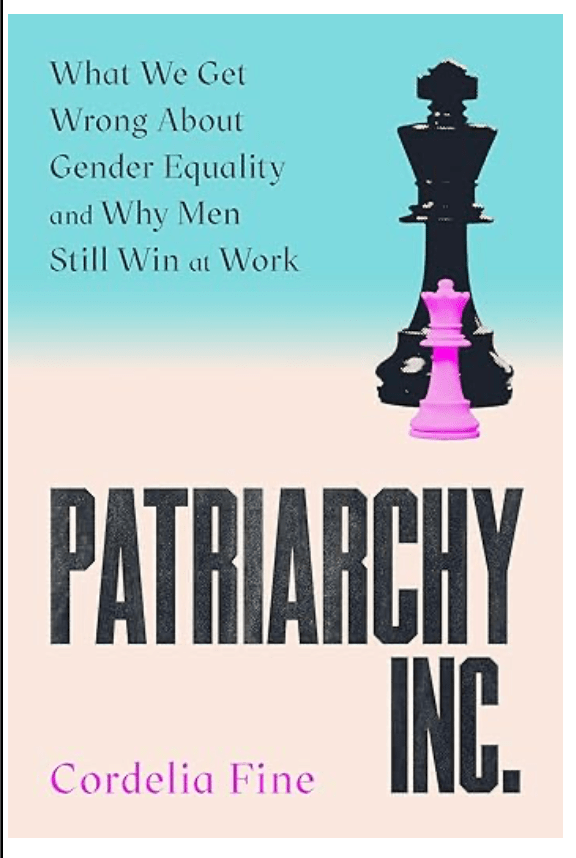
Inequality in the workplace impacts all areas of our lives, from health and self-development to economic security and family life. But, despite the world’s richest countries’ long-avowed commitments to gender equality, there is so much to fix – and so much we don’t see. The most lucrative industries are male-dominated- yet half of men think they’re the ones being discriminated against. Women work more hours than men and accumulate less wealth- while many children want more time with their dad. Patriarchy Inc, reveals how the status quo is harming us all, in our working lives and beyond. Drawing on social and cultural history, examples from hunter-forager societies to high finance and the new thinking in evolutionary science, she dismantles the existing, inadequate visions for gender equality and charts an inspiring path towards a fairere and freer society. 

Human labour is valued like great deal for lawyers, very little for carers. We strive for fairness in our personal dealings, workplaces can be arbitrary, primal places where people’s worst instincts are exposed. Fine, a professor in the history and philosophy of Science at the University of Melbourne, offers the reader a rare gift humour. She writes “ What diversity, equity and inclusion are actually for: creating a more just society, with the gay abandon of someone who will not be held accountable for implementing them”. Fine is not a fan of corporate DEI, “has a contradictory heritage as if a social justice activist had mated with a business tycoon”. Its economic goals, that often cited “ business case”, are not about fairness, she says: “ Despite the feel-good rhetoric, in DEI  as it relates to women, that issue is framed as an underutilization of female human capital.” The popular “Fix the Women” strategy hasn’t got results: there is little evidence, for example, that leadership courses for women actually work. Once men decide they wanted to a job in large numbers, she argues, it becomes high-status.  Fine reveals the early history of software programming, when women were considered suited to its demands  as “ a kind of puzzle solving-like crosswords”, and held senior roles .  In 1957, Elsie Shutt, programmer became pregnant and was forced to leave her job at Raytheon  Computing in Massachusetts. She carried on freelancing, recruiting other mothers as her workload grew. Shutts, successfully founded Computations Inc, was rooted in collaboration between “physically dispersed part-time workers, in the days before email and Zoom”. According Fine, women fell away from programming after peaking it in the mid 1980s – 37 per cent of computer science graduates in the US in 1984 were women. Software programming was rebranded as “software engineering” to get more men to rush in. Men hoard the roles for other men, the same would happen whenever there is a dominant group, because of inbuilt affinity for others like “homophily’.  

Patriarchy Inc: What We Get Wrong About Gender Equality and Why Men Still Win at Work by Cordelia Fine, Atlantic Books £22/ WW Norton $29.99, 352 pages.

One response to “inadequate visions of gender equality”

  1. pennynairprice avatar
    pennynairprice

    When women want “it all” – respect and high positions in the workplace which may take up more hours per week than average, and also have children and a marriage with her (usually) husband, then she and her husband must generally employ staff – housekeepers and nannys – expensive staff which the children become extremely close to, the dynamics of a family obviously are changed. Performance and suitability to the job are the main criteria for someone taking a working role – male or female. However increasingly in my lifetime, women have striven to garner positions which were in the main but not solely occupied by men. Having studied hard and increasingly less needed to run a houshold due to electrical appliances (hoovers, dishwashers, washing machines) and fast food, plus the constant campaign for womens rights and suitability to major work roles, women have taken some top jobs. Certain women, with the constant subtext of the importance and deservability of women to have prime jobs, will never cease to remind us they are women, which singles them out therefore for being possibly “feminists”. In some cases in the past, such as very many years ago in the art world, women painters would rather join a feminist group and even become lesbians in their fight to get noticed and appreciated in the art world. “For every action, there is an equal and opposite reaction” – this is not a quote I personally made up but what about the people especially children affected by career mums? Children will identify with their nannies or housekeepers as mother figures and both mother and children will not have the cherished special time with the mum when they are young if their mum is working. Of course once the children reach secondary school age the goalposts change. My mother was a full time GP. I went to boarding school as did my sister and brother, and had staff including live in staff do a lot of the “chores” which a parent would perform,. Lets not leave fathers out here! A father loves and needs and wants quality time with his children as well as his wife. In the main, the father is the chief breadwinner in a family often with his wife also working full time but maybe earning less. In other situations you may find a single parent both rearing children and working.

    My belief is that children and parents “suffer” if they do not spend quality time together. Working mothers must work extra hard to maintain a strong bond of family closeness and unity and in some cases, working mothers feel conscience pangs at their lack of full impact on their childrens’ lives. The results may mean that the children suffer depression or need counselling in their later lives.

    Just so this piece of writing is not all negative, there is also a theory that it is very beneficial for young and growing children to meet and mingle and mix with a lot of different people and it is character building and boosts confidence and self esteem. Nurseries is a particular example and some are run from 8 til 6 daily for working parents and the children get a great start in life with stories, games, meals and mingling. Margaret Thatcher did not always have the people who run them and the children who go to them in mind as some of them are state run and do a fantastic job where also mums and dads can meet up if they have parties for the parents on occasions.

    Carol Thatcher daughter of Margaret Thatcher and a jounalist did not always see eye to eye with her mum. Nancy and Ronald Reagan’s daughter wrote a derogatory book about her parents. Swings and roundabouts. Peace Aymen.

    Like

Leave a comment

Trending