
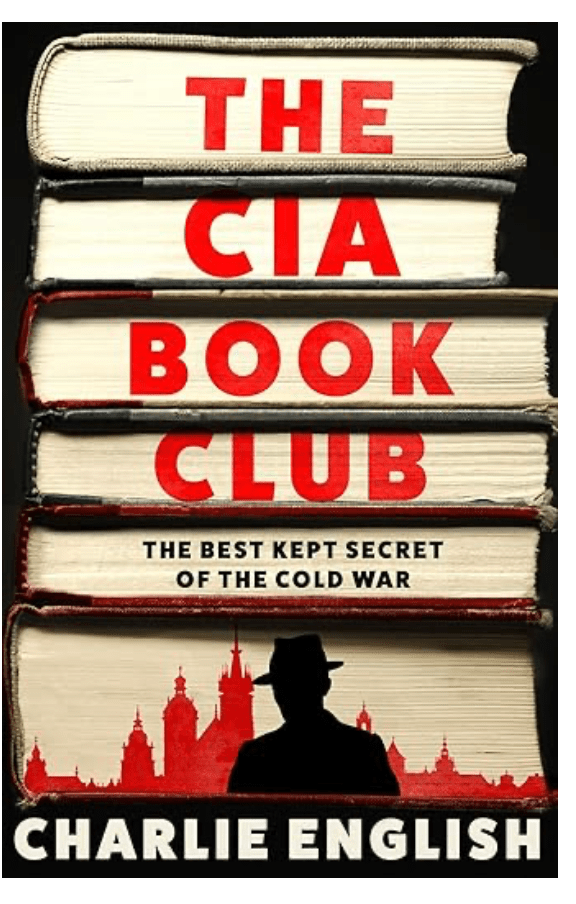
Charlie English explains how the CIA helped Poland’s underground print banned books, as over ten million books that were smuggled across the Iron Curtain. In 1950s Polish émigré Jerzy Gledroye was running out of cash, after launching a literary review in Paris to save Polish literature from the communist onslaught. In France, funding was scarce, and the Polish people stranded there after the Second World War were improvised and many French intellectuals were enamoured with the USSR. Giedroyc went in search of money in America, as the CIA officers who were keen to undermine Soviet Union censorship, offered him $10,000 a year to support his magazine Kultura, based in Paris, becoming cultural equivalent of the Polish-government in exile in London, beginning a 40-year co-operation. He had a CIA code name QRBERETTA – resulting in gasps of surprise. Pioneer works by the Hungarian political scientist Alfred A Reisch, and the American academic Seth G Jones, whose A Covert Action: Reagan, the CIA and the Cold War Struggle in Poland has been translated into Polish. The CIA paid publishers for books that were then smuggled to Poland. Five decades after the Second World War, Europe was divided by the longest and most heavily guarded border on earth. The Iron Curtain, a near-impenetrable barrier of wire and wall, tank traps, minefields, watchtowers and men with dogs stretching over 4, 300 miles from the Arctic to the Black Sea. No physical combat would take place along this frontier: the risk of nuclear annihilation was too high for that. Instead, the conflict would be fought in the psychological sphere. It was a battle for hearts, minds and intellects.
No one clearly understood this more clearly than George Minden, a British-Romanian aristocrat, the head of a covert intelligence operation known as the “CIA books programmer”, which aimed to win the Cold War with literature. From its Manhattan headquarters, Minden’s global CIA “book club” would infiltrate millions of banned titles into the Eastern Bloc, written by a vast and eclectic list of authors, including Hannah Arendt and Aleksandr Solzhenitsyn’s The Gulag Archipelago, Aldous Huxley’s Brave New World, Boris Pasternak’s Doctor Zhivago, Nadezhda Mandelstam, Joseph Brodsky, John le Carré, Kurt Vonnegut, George Orwell and Agatha Christie, Gone with the Wind. Parcels arrived carried by couriers in their luggage, hidden in car boots or screwed into the ceilings of train toilets like contraband cigarettes. Volumes were smuggled on trucks and aboard yachts, dropped from balloons, and hidden in the luggage of hundreds of thousands of individual travellers. Police tails were evaded using subterfuge copies from Gene Hackman in The French Connection. Once inside Soviet block, each book would circulate secretly among dozens of like-minded readers, quietly turning them into dissidents. Latterly, underground print shops began to reproduce the books. By the late 1980s, illicit literature in Poland was so pervasive that the system of communist censorship broke down, and the Iron Curtain soon followed.
Gledroyc commissioned Polish writer Witold Gombrowicz, whose talent was withering in a bank job in Buenos Aires, and enabled him to produce Diary, a masterpiece of European modernism. Czeslaw Milosz went on to win the Nobel Prize for literature.
Tens and thousands of readers waiting for books and a brilliantly organised distribution network. Funding was nearly cut more than once, but Jimmy Carter’s national security advisor Zbigniew Brzezinski and CIA Soviet expert Richard Pipes both had polish origins.
The CIA Book Club: The Best Kept Secret of the Cold War by Charlie English, William Collins £25, 384 pages.
 The neptune Herald
Leave a comment