
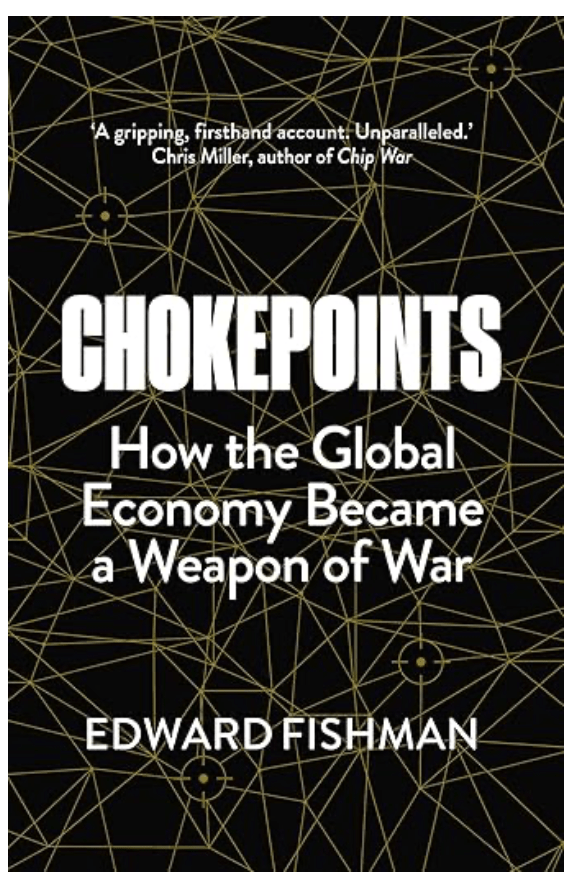
Chokepoints is one of the most pivotal geopolitical shifts of our time. As Russia, China and Iran have sought to upend the international order, America and its allies have mounted unprecedented economic retaliation. Now the global economy is a weapon of war. Globalisation was once hailed as the great leveller, bringing prosperity to all.
Former top US State Department official and a scholar, at Columbia university, Edward Fishman, takes us into the back rooms of power around the world, meeting an eclectic group of innovator: the diplomats, lawyers, and financial whizzes who have masterminded a fearsome new arsenal of economic weapons, exploiting Western dominance in global finance and technology, and harnessing the power of Wall Street, the City of London and Silicon V alley to confront a rising authoritarian axis.
The sanctions against Russia might be the biggest coordinated act of economic warfare we have seen, but it won’t be the last. Control over modern-day chokepoints – such as the US Dollar, advanced microchip technology and critical energy supply chains – has become key to geopolitical power in the twenty-first century. There is an economic arms race among great powers and a fracturing global economy. It is critical to understand the forces that will shape our world for decades to come.
Even the French complained of America’s exorbitant privilege of Dollar hegemony. The global financial crisis wreaked havoc, China called for a shift away from the dollar. American Empire has foisted the US dollar on a prostrate world.
It was former US president Richard Nixon who severed the dollar’s link to gold in 1971, terminating the last vestiges of the Gold Standard. One senior White House economist said at the time, needed to eliminate the dollar’s reserve currency role. In the heart of the dollar empire, policymakers developed plans to downgrade the greenback’s status and make it more like any other currency.
Dollar remained king through, the 1970s and beyond. Washington was unable to free itself from the responsibilities of monetary hegemony. With exchange rate floating and the disappearance of the gold standard, the US could print dollars and send them around the world without having to give an ounce of gold in return.
The dominance of Dollar, the power it grants are the core essence of Chokepoints which zooms on geo-economics, studying the growing role of sanctions, largely under-pinned by dollar dominance, have played in US foreign policy.
It is essential to access the dollar system for governments and businesses around the globe, Washington could punish adversaries without firing a bullet by blocking their ability to transact in dollars. According to Fishman, when Iranian students stormed the US embassy in Tehran in 1979, President Jimmy Carter imposed sanctions in the first application of the International Emergency Economic Powers Act, the 1977 law that provides sanctioning authority to this day. Carter’s response included a freeze of some $12bn in Iranian assets, which ultimately helped Tehran to the negotiating table and the hostage crisis to an end. This event showed that dollar was no longer just a currency, but a weapon that could augment US power. Washington’s reliance on that weapon has only grown. Policymakers have embraced sanctions as a go-to tool, transforming US foreign policy and the global economy in the process.
Fishman divides the age of economic warfare into four phases: the campaign against Iran’s nuclear development; the response to Vladimir Putin’s first incursion into Ukraine; the technological battle with China; and the relation against Russia’s full-scale invasion of Ukraine in 2022. Fishman writes the world engaged in a “ scramble for economic security that redraws the geopolitical map and ends globalisation as we know it”. Smart women and men, dedicated to public service, working long hours at the State and Treasury department in high stress situations, enduring gruelling international negotiations – all for relatively low wages, but design innovative solutions to seemingly intractable challenges, like devising a price cap on Russian oil to limit Moscow’s energy revenues while keeping the production flowing.
Fishman writes “ American economic warriors often shoot from the hip, forced to react to crises without much advance planning.” Fishman concludes that the sanctions against Russia after its annexation of Crimea in 2014 were too weak, thereby emboldening Putin, and provides some recommendations, such as the establishment of an economic war council. But Putin’s butchery continues, while China’s Artificial Intelligence sector is making rapid progress, rogue regimes in Iran, Venezuela, and North Korea remain in power. The might of America’s economic arsenal hinges on continued dollar dominance, although he warns that erosion of the rule of law on the Federal Reserve’s independence could reduce the dollar’s popularity.
Chokepoints: How the Global Economy Became a Weapon of War by Edward Fishman, Elliot & Thompson £25/ Portfolio $40, 560 pages.
 The neptune Herald
Leave a comment