
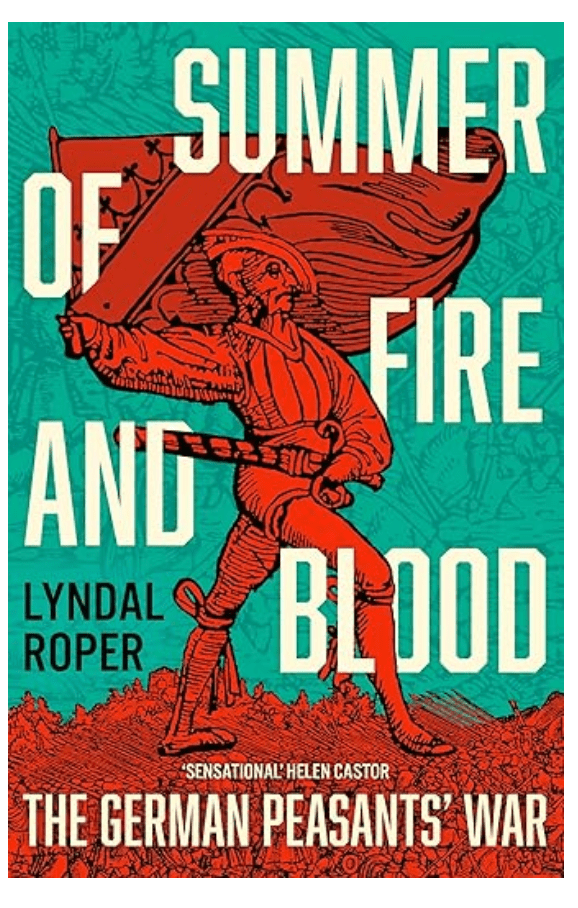
The German Peasants’ War was the greatest popular uprising in Western Europe before the 1789 French Revolution. In 1524 and 1525, it swept across Germany with astonishing speed as thousands of people massed in armed bands to demand a new and more egalitarian order. The peasants took control of vast areas of southern and middle Germany, torching and plundering the monasteries, convents, and castles that stood in their way. But they would prove no match for the forces of the lords, who put down the revolt by slaying somewhere between seventy and a hundred thousand peasants in just over two months.
In 1525, German artist Albrecht Dürer designed a monument with farm animals lying at the base of a pillar made up of hoes, pitchforks, a keg of butter, a milk jug and other everyday items of rural life. Atop the pillar sits a peasant in a Christ-like position with a sword plunged on his back.
Peasants’ war were complicated by ideological battles between West German liberals and East German communists. For easterners, it was a sort of “early bourgeois revolution” – a rigid Marxist line that vastly overstated the relevance of class-based analysis to 16th-century German society.
In Summer of Fire and Blood, Regius professor of history at the University of Oxford, Lyndal Roper reveals a comprehensive survey of the uprising, with gripping narrative and assessments, and places religion at the heart of her story. The Peasants’ War was “the giant Trauma” a the centre of the Reformation, which had started less than a decade earlier, she writes: “ And the war, in turn, cannot be understood if it has been severed from the heady atmosphere of religious excitement in which it took place”.
The war was extraordinary destruction of lives and property. Fired up by the Reformation’s ideas about divinely ordained social justice, the peasants – at first in south-western Germany, then further afield- took their revenge on oppressive landowners and reduced hundreds of monasteries and castles to ashes and rubble. As the forces of law and order regained the upper hand, they annihilated the peasants’ ragtag armies. There was certain strain of antisemitism to the rebellion. For some radicals “preaching the gospel was inseparable from attacking the injustice of charging interest and fleecing the poor” something, for which monks and Jews were blamed. The belief held by mystical rebels like Thomas Mintzer, that the end of the world was imminent. Among complaints, this denounced lords’ ownership of peasants, insisted on a community’s right to choose its own pastor, demanded fair access to forests and called for the abolition of death taxes, and tithes on animals.
Social radicalism went way too far for Luther, infamous anti-rebel tract Against the Robbing, Murdering hordes of Peasants. Luther took the view that there were slaves in the Old Testament, so to abolish serfdom would be to deprive lords of what was rightfully theirs.
Luther claims the survival of his less extreme version of the Reformation required that the authorities should not associate his new religious ideas with calls to upend the social order.
The lasting consequences of the Peasants’ War was the destruction of numerous monasteries and convents, which accomplished one of the greatest transfers of land and property ever seen in the German region, the German beneficiaries were secular rulers, Roper writes.
The peasants were put back in their place and the winners were the German states and their bureaucracies.
Summer of Fire and Blood: The German Peasants’ War by Lyndal Roper, Basic Books £30/$35, 544 pages.

 The neptune Herald
Leave a comment