
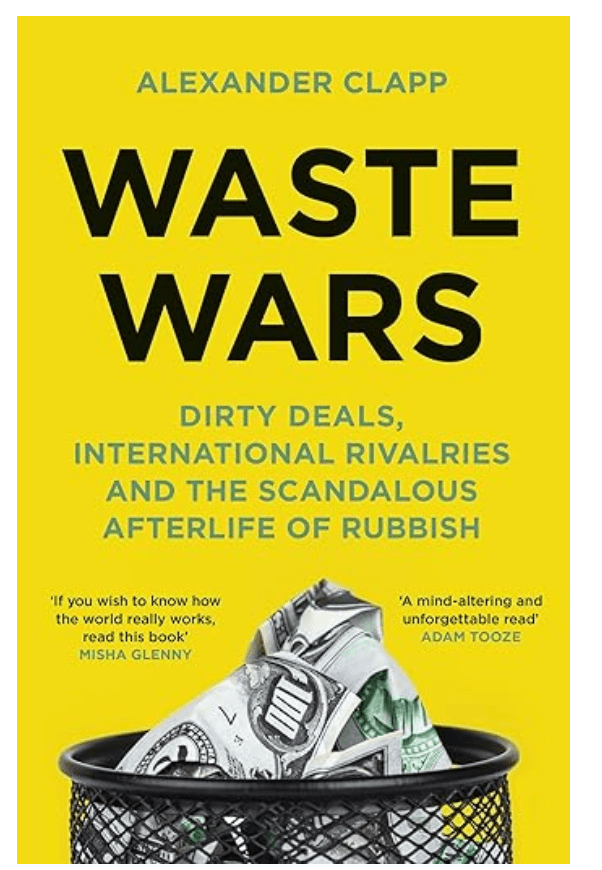
We in the west should think we’ve become more responsible about our waste and the way it’s managed. In Britain, government pats itself on the back for reducing the amount of thrash going to domestic landfill sites by more than half over the past quarter century.
Millions of tonnes of garbage generated every day have given rise to waste wars, cons and cover ups across thousands of mile and multiple oceans, as dumps and landfills around the world are overflowing. Running across five continents, Alexander Clapp delves inside the world of Javanese recycling gangsters, cruise ship dismantlers in the Aegean, Tanzanian plastic pickers, whistle-blowing environmentalists in the jungles of Guatemala, and a community of Ghanaian boys who burn Western cellphones and televisions for cents an hour. Clapp reveals how most of our thrash actually lives a secret second life, getting shipped, smuggled or dumped from one country to another, with devastating consequences for the poorest nations of the world.
Waste Wars is a exposé of how and why, for the last forty years, our garbage has spawned a massive global black market, one that offloads our consumption footprints onto distant continents, pristine landscapes, and unsuspecting populations.
Obscuring the far less virtuous reality prevents us from understanding how far the consumerist ‘global north” is from responsibly managing its waste.
Clapp explains how history of trash became an international trade and with America’s attempts in the 1970s to clean up its act and raise environmental standards. One consequence was to make it much more expensive to dispose of hazardous waste domestically and so companies looked for alternatives, and found in the Caribbean, Latin America, and Africa, where asbestos could be dumped for a few dollars a ton rather than the $250 prevailing in the US. Ships started looking for willing or even bribable recipients. Clapp tells the tale of the Khian Sea, a rusting freighter that departed the Delaware Bay in 1986 with a shipment of toxic ash, like the flying Dutchman, sailed the world for years looking for somewhere desperate or corrupt enough to take it. Clapp said “Waste morphed into something that was not merely to be disposed of within nature, but to be offloaded onto another society, an object of exchange rather than mere detritus”.
Khian Sea ended up throwing much of its cargo into the ocean, as the US Congress frowned at the trade, fearing the blowback on America’s cold war foreign relations. Garbage brokers, refined the offer instead of waste for dumping, they rebadged the trade as a recycling opportunity.
Western thrash has embedded itself firmly in local economies. In Ghana, whole districts of the capital Accra have sprung up focused on rubbish, where workers are paid a few dollars to eviscerate old smart phones for valuable metals inside them. Ship breaking yards of Turkey, workers engage in the death-defying act of pulling giant cruise ships apart, and bury the toxic materials in the countryside.
Once the treasures are harvested, the remaining smartphones end up being burnt. In Indonesia, paper mills import used paper from overseas to use as feedback, the recovered bales which generally contains masses of plastic waste. Clapp finds Javan villages that trade in the discarded plastic, drying and selling it as toxic waste fuel for Indonesia’s many tofu factories, which is “unbelievably dangerous” to human health, according to Clapp.
Although moving thrash across borders might bring some money to developing countries, the cost of rampant corruption and grotesque environmental degradation – the dark side of west’s self-regarding clean-up. Rich countries failed to stem the tide of garbage they are ejecting, mostly from plastic waste that is non-biodegradable and resistant to recycling. “The solution must start at the point where such a systemic problem begins requiring waste’s perpetrators – tech companies, petrochemical conglomerates, cruise ship operators – to become financially liable for the fate of that which they insist on overproducing.”
Waste Wars: Dirty Deals, International Rivalries and the Scandalous Afterlife of Rubbish by Alexander Clapp, John Murray £20, 400 pages.
 The neptune Herald
Leave a comment