
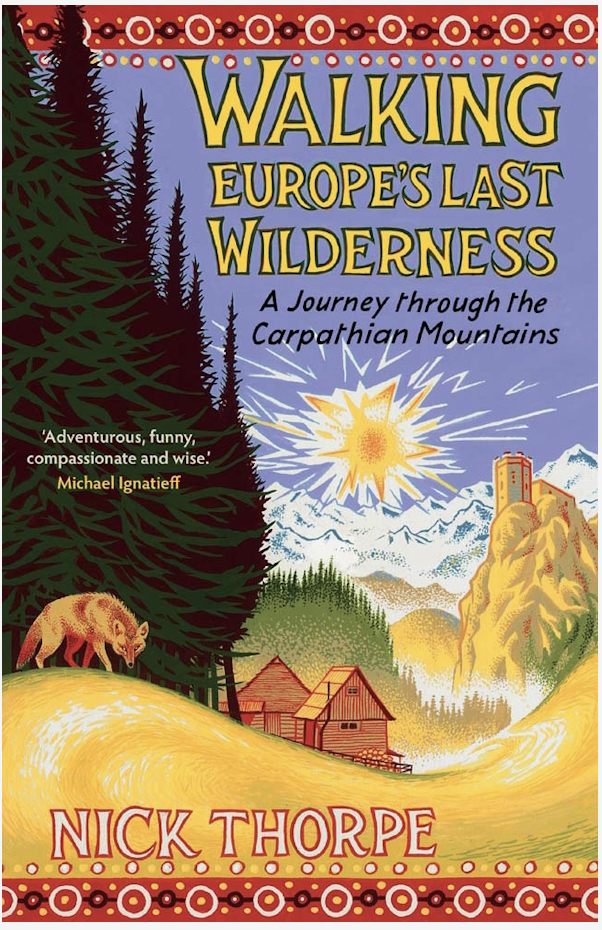
BBC journalist and film maker, Nick Thorpe makes an evocative voyage through the Carpathian mountain range of Poland, Slovakia, Romania, and Ukraine, in a “dark ring” or “magnificent horseshoe” some 1500km long, with its threatened landscape, people, history and talks woodland management in the ancient forests of northern Romania, with an expert nicknamed Ion Barbu; “Beardy John” A landscape of great spruce and beech forests, grass meadows, and ancient villages, it’s people contend daily with the elements- as well as Europe’s last large carnivores. But this fragile ecosystem is now under threat, from climate change and illegal logging. The Silvi-culturist spots a tall fallen fir, which has reached that stage called in German Zerfallsphase – “ a period of decay, when large trees fall, but remain important on the forest floor”, as generous hosts for fungi and wildlife.
Much of the vast terrain Thorpe crosses in this travelogue-cum-history of the mountain range that arc around south-eastern Europe seems to have arrived at its own Zerfallsphase.
Journeying from the banks of the Danube to Transylvania, Nick Thorpe guide us through the history and ecology of the watershed of Europe, between the Black Sea and the Baltic. For thousands of years the Carpathians have been a place of refuge, of identity and belonging, where powerful rulers and dynasties fought to gain control over rich gold seams and the unruly inhabitants of strategic valleys. Today, its inhabitants struggle to protect is vast in habitants from urban sprawl as well as logging.
Thorpe sheds light on a neglect part of Europe-where bears, wolves, chamois, and lynxes still roam.
From the alder woods of the “Little Carpathians” in Slovakia right around, in an epic loop, to the Iron Gates gorge on the Danube between Romania and Serbia, Thorpe rides through landscapes stained or scarred by bitter history. Episodic and digressive, with leaps from place to place and trip to trip.
Romania hold two thirds of the continent’s “old-growth forests”: its burolic Transylvania now attracts a rapidly swelling crowd of ecotourists. In southern Ukraine, a green activist tells Thorpe, “there was always some kind of imperialism” on hand to blight the idyll of self-sufficiency in tune with soil and climate.
Overlords from Austria, Hungary, Germany and Russia carved up the Carpathians into imperial or post-imperial blocks although the hills “ have no nationality”. Boykos, Lemkos, Hustsuls, Gypsies, Jews, Saxons all crammed into its rigid frames. Today, “The older you are .. the narrower the place you identify as home. One of several written in the aftermath of Russia’s 2022 invasion show how Ukrainian draft-avoiders embark on a perilous crossings over snowbound peaks into Romania, “For me, my family matters more than my country”.
Since the collapse of communism, rapacious foreign investors, along with homegrown cronies, view in these woods, meadows, and rivers a resource gold-mine ripe for plunder. The campaign to halt the renewal of gold extraction at Rosia Montanå in Romania’s Apuseni range, where Roman legionaries once dug.
Walking Europe’s Last Wilderness: a Journey Through the Carpathian Mountains by Bick Thorpe, Yale University Press £20, 377 pages.

 The neptune Herald
Leave a comment