
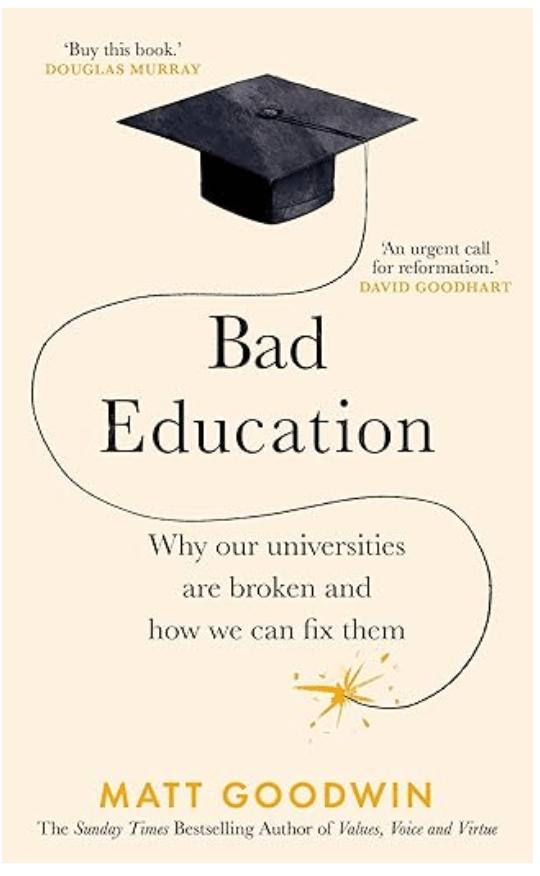
Why our universities, established as sanctuaries of truth and higher learning are broken and are failing a generation of young people. Consumed by funding and admission crisis, mired in political scandal and governed by self-interest, their founding principles have been corrupted. Matt Goodwin spent decades working as an academic in some of the world’s leading universities including professor of politics at the University of Kent, delivering underfunded courses to increasingly disengaged lecture theatres, sitting on rudderless committees, counselling depressed colleagues and concerned students, watching standards slip and academic integrity decline. He argues that diversity of opinion is under threat in universities which “are no longer protecting and promoting things like free speech”. There is clear evidence to support his case – from attempts to monitor “micro-aggressions” to shocking attempts to suppress the views of gender critical academics such as Kathleen Stock and Jo Phoenix.
The intellectual climate, shaped by universities, where critical theory began and flourished. A theory which appeals to academics because it says that words matter: language is a tool of oppression. So, our language and the curriculum have to be decolonised in order truly to deliver diversity, equality and inclusion. What people earn and what access they have to public services. There were always left-wing academics – as well as some of a more conservative disposition. University as an institution was not engaged in their arguments and did not take a view. There are universities where advocates of critical theory have recruited university administrators who use university-wide EDI programmes to advance their agenda and try to require academics to comply.
The intense transgender debate, exacerbated in the UK- by misinterpretation of the Equality Act, as too many universities, perhaps influenced by the LGBTQ+ rights charity Stonewall, interpreted the Act to mean any form of self-identified gender is a protected characteristic. The Reindorf review of problems at the University of Essex is a clear and authoritative account of serious mistreatment pf academics as a result. It was published in 2021, and not British university should repeat such behaviour.
The psychologists Jean Twenge and Jonathan Haidt have persuasively argued that the rise in access to social media is leading to mental health issues for young people. This can lead to trigger warnings and a belief that freedom of speech is less important that protecting people’s feelings. Higher education appears to provide some resilience to these pressures, lowering the risk of young people withdrawing from work because of mental illness. Young white working-class men are even less likely to go to university that many ethnic minority groups. The real luxury belief is advantaged graduates saying there is no point in going to university when for many young people from disadvantaged backgrounds it is the most powerful tool of social mobility we’ve got.
At the heart of this crisis is an increasingly politicised campus. Once batons of free speech, forums for open debate and incubators of bold new ideas, our universities are increasingly becoming monocultures, ruled by an ideology that is silencing respected voices, stifling discussion and violently shutting down diverse opinion, betraying intellectual freedom and failing to deliver the very basis of an education.
Matt Goodwin gives an insider’s view of how the founding principles of academia are in decline and why we should all consider what this means for the students of today, tomorrow and the world they will shape.
We have never known what free speech code is that does not permit some legal free speech. There is a great American tradition of academics worrying that the modern university is rejecting the culture which nurtured it. Goodwin blends different problems up together and then calls it a row between right and left.
Risk-averse administrators have grown in size and income, with vice-chancellors awarding themselves huge pay rises while academics are often on precarious low-pay contracts. The conviction that students need to be protected from anything that might conceivably upset them does need to be challenged. Attitudes of many universities towards authoritarian China, source of much revenue, is hypocritical. Bankruptcy threatens many universities, and several graduates believe their degrees are worth the fees.
Bad Education: Why Our Universities Are Broken and How We Can Fix Them by Matt Goodwin, Bantam £20, 256 pages.

 The neptune Herald
Leave a comment