
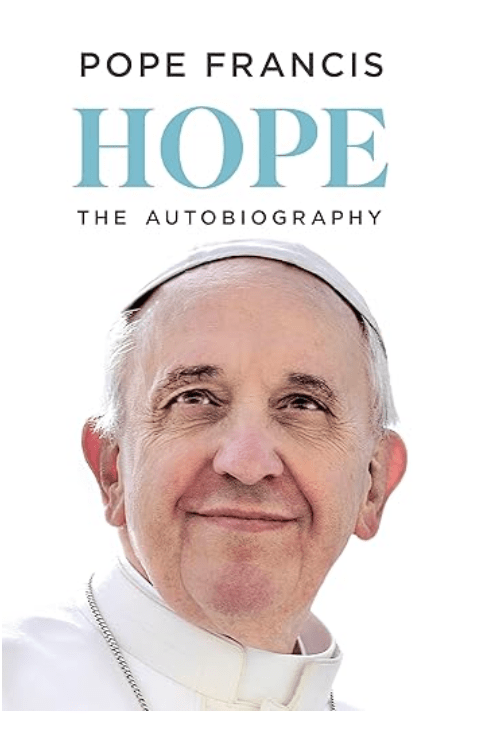
Hope is the first autobiography in history ever to be published by a Pope. Pope Francis, the first Latin American and the first Jesuit to head the Catholic Church, goes where no pontiffs have not dared, originally intended this book to appear only after his death, but the needs of our times and the 2025 Jubilee Year of Hope have moved him to make this precious legacy available now. Written over six years, this complete autobiography starts in the early years of the twentieth century, with Pope Francis’s Italian roots and his ancestors’ courageous migration to Latin America, continuing through his childhood, the enthusiasms and preoccupations of his youth, his vocation, adult life and the whole of his papacy up to the present day.
88-year-old, frail, Pope Francis’s election in 2013 breathed a new life into the church, replacing froideur with friendliness, a focus on sexual behaviour with an embrace of humanity and the poor. Last week, he appointed an opponent of Donald Trump’s migration policies as archbishop of Washington.
Pope Francis is the first memoirist ever to say he want to lower his own reputation: “My strongest sentiment” he writes, is that he has a “public esteem of which I am not worthy”.
The experience of growing up “respectably poor” in a multi-ethnic Buenos Aires neighbourhood, bred in then Jorge Mario Bergoglio a respect for Jews and Muslims which familiarised him with the lives of prostitutes and prisoners. Hope which is elegant calls for spiritual renewal a counterpoint to the more pervasive genre of self-help.
Francis’s grandparents and father nearly drowned fleeing from fascist Italy to Argentina, the boat on which they were due to travel sank, but they had been delayed and draws parallels with current migrant deaths today in the Mediterranean.
Pope Francis, once intrigued by Argentine strongman Juan Peron, he opposes today’s sectarian populism. For him, god can be found in humour, football and Fellini films. Above all, it’s in the willingness to talk and listen to others with respect: “the culture of encounter” Francis often mentions old acquaintances whom he still remembers to call regularly.
About his unexpected election as Pope, how initially undecided cardinals including himself began by supporting unviable “stop-gap” candidates while they gauged the winds. When elected, Francis ensured to call his newspaper delivery man in Buenos Aires to cancel his order. One of his greatness has been admitting his own sins and errors, including using homophobic language. The book concentrates on his 33 years before becoming a priest than the 50-years since. He was a divisive leader of Argentina’s Jesuits in the 1970s, with an authoritarian style and a dislike of liberation theology, the branch of Catholicism focused on systemic injustice, during a period of wilderness, along with economic crisis in Argentina, changed his perspective, as major controversies were dealt with briefly. This book strives to revive the early glow around his papacy. His message is that a church should look outward and forward. Clerics should have less power; women more. Traditionalist approach to Catholicism often tend to “ clerical ostentation”. Better to learn languages of migrant worshippers – Vietnamese, Spanish – than Latin, he suggests. Sexual sins “ are really not the most serious, compared with, for instance, pride and fraud. Homosexuality is “ a human fact”.
The Pope is still Catholic, and condemns gossip and swearing. He watched virtually no TV, even his beloved football, since being outraged by an undisclosed sordid scene in 1990. He emphasises his continuity with his conservative predecessor, Benedict XVI. Francis offers no detailed account of his Vatican reforms or his battles with US Conservatives. A secretive property deal, which led to the conviction of the Pope’s chief of staff for embezzlement and fraud, was “truly terrible” he says, without elaborating in detail.
Francis influenced by his Italian grandfather’s experience of the first world war, he denounces war as “ always useless massacre”.
In the last chapter he turns to people’s loss of faith. More than a quarter of Americans say they are atheist, agnostic or similar, Church attendance has fallen sharply in Europe. He insists “there is no more secularisation in the Church now than in former times’.
Francis says: “ Catholics should distinguish themselves less by their piety and more by their example: that is, less by whether they are believers and more whether they are believable.
Pope Francis candidly and fearlessly writes about some of the most important and controversial questions of our present times; war and peace (including the conflicts in Ukraine and the Middle East), migration, environmental crisis, social policy, the position of women, sexuality, technological developments, the future of Church and of religion in general. The “story of a life” and, at the same time, a touching moral and spiritual testament that will fascinate reader throughout the world and will be Pope Francis’s legacy of hope for future generations.
Hope: The Autobiography by Pope Francis with Carlo Musso translated by Richard Dixon, Viking £25. Random House $32, 320 pages.

 The neptune Herald
Leave a comment