
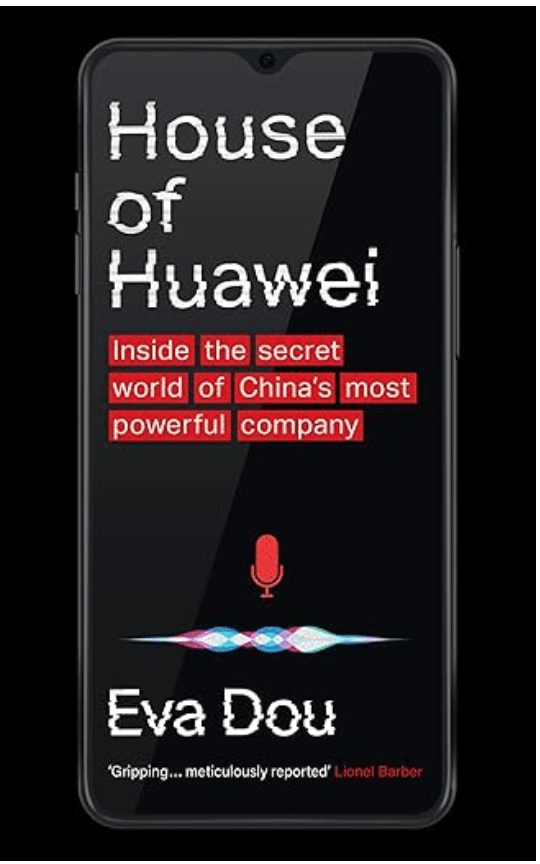
This is the untold story of the mysterious Chinese telecom company that shook the world from the coast of southern China, eccentric entrepreneur spent three decades since its founding in 1987 in Shenzhen, shaping one of the world’s most powerful technological empires without anyone noticing. But December 2018, when the detention of Meng Wanzhou, Huawei Technologies’ female scion, sparked an international hostage standoff, poured fuel on the US-China trade war, and suddenly thrust the mysterious company into the international spotlight.
In House of Huawei, Washington Post technology reporter and former China correspondent Eva Dou, writes an authoritative and remarkable portrait of Huawei’s reclusive founder Ren Zhengfei and how he built a sprawling corporate empire – one whose rise Western policymakers have become increasingly obsessed with halting. The book dissects the global web of power, money, influence, surveillance, bloodshed and national glory that Huawei helped to build- and that has also ensnared it. The Chinese technology giant sells a variety of consumer electronics, from TV’s and smart home systems to smartphones and its telecommunication networks and Huawei Cloud data centres ( Hohhot City, Mongolia in November 2023) keep the population online, its autonomous driving solutions are embedded in a growing number of electric cars. It designs semi-conductors, builds solar panels, even has hotels, and also operates surveillance systems for local governments, while harnessing its vast purchasing and distribution power to pressure suppliers and competitors.
Along the way it has attracted increasing scrutiny from governments outside China who fear that Huawei’s network equipment enables Beijing’s spying.
Dou explains why Washington and Beijing are at loggerheads over the fate of a company that had done so much to bolster China’s technological ecosystem and extend its influence overseas. Washington pressured allies to stop using Huawei’s 5G equipment, which the UK initially resisted before relenting, ordering the equipment to be stripped from public networks.
Donald Trump first sanctioned Huawei in 2019 during his first presidency, restricting some US companies from doing business with it over national security concerns. President Biden continued to further tighten restrictions on the company. The Chinese government lavished Huawei with lavish subsidies, pressured customers to buy its products over imported alternatives after it was cut off from critical foreign technology that it used in its products.
Marco Rubio, Trump’s present choice for secretary of state in the incoming US administration, guarantees another turbulent four years for Huawei.
Huawei insists it is a private company and that the government does not interfere with its business or security of its products.
Ren Zhengfei gave interviews to foreign media as part of a charm offensive to aid his daughter’s case. Dou gives an insight into Ren’s life – from his childhood growing up in poverty in Guizhou, a mountainous province in south-west China, to run the world’s largest telecommunications equipment maker – in a way that helps the reader understand what motivates this notoriously ruthless engineer.
Huawei’s first business was importing telephone switches before building its own cheaper versions, copying foreign designs and later benefited from a government policy to rip out foreign technology in China’s communication systems.
Huawei reflects the rise of many other Chinese companies that have ventured into sectors dominated by the west.
When Huawei came to dominate the rollout of 5G technology, the west was not ready at all, and wanted to delay the rollout.
Huawei’s growing domination in data centres, generative AI and autonomous driving, after weathering multiple existential crises and emerged more powerful than ever.
House of Huawei tells an epic story of political intrigue that presents a fresh window on China’s rise from third-world country to U.S. rival, and shines a clarifying light on the security considerations that keep world leaders sleepless nights. House of Huawei: Inside the Secret World of China’s Most Powerful Company by Eva Dou, Abacus £25/ Portfolio $34, 448 pages.

 The neptune Herald
Leave a comment